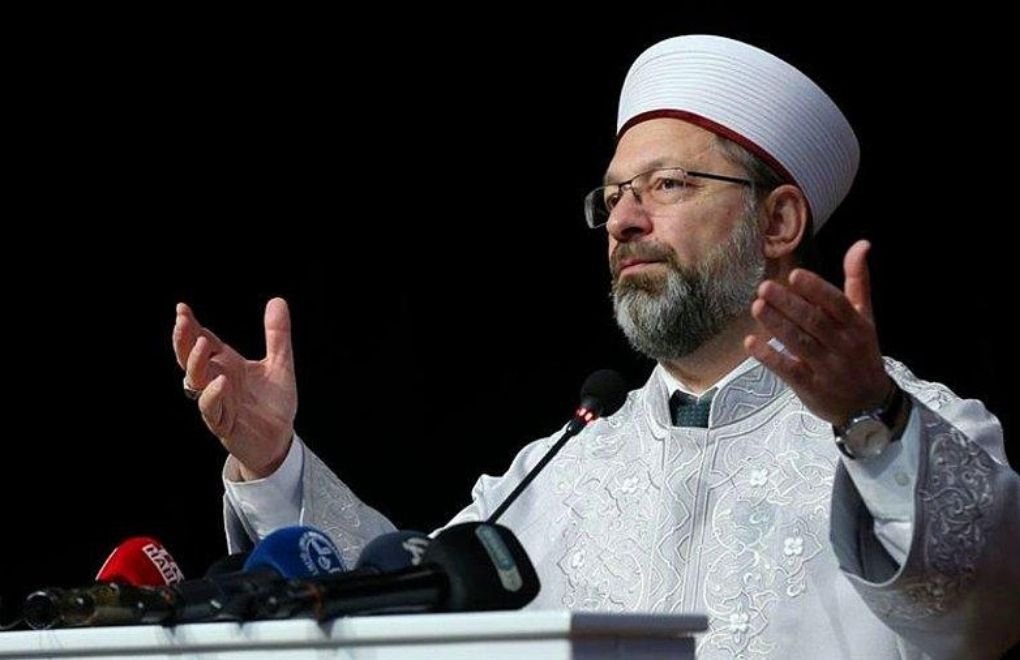
Turkey’s highest-ranking imam and head of Diyanet, Ali Erbaş, called for “a global jihad by all means because of the situation in Gaza”. Erbaş, who is the highest (religious) authority under President Recep Tayyip Erdoğan, was backed up in his stance by the pro-government newspaper Yeni Şafak, which, in a column, explicitly supported the violence. “I want to kill you in every conceivable way: with a knife, with a dagger, with a pistol, with a rifle, with a bomb...”.
By Paul Cliteur
Germany, a country with the largest Turkish population in Europe, responded immediately. The German government put the mosque umbrella organisation Ditib under heavy pressure. The Ministry of the Interior warned that cooperation with the organisation would cease if it did not clearly distance itself from Islamism and calls for violence.
Isn’t this call to jihad an internal Turkish matter? Why should Germany respond to this call? The answer to that question lies in the text that Erbas delivered to the 150 Islamic scholars.
He said: “We strongly emphasise that the Palestinian people have all legitimate forms of resistance against the Zionist occupation, including armed resistance. In addition, we consider it necessary to mobilise the Ummah for all forms of jihad in the way of Allah.”
In other words, Erbas is addressing not only the Gazans but the entire Islamic community, the Ummah. This makes the Israel/Gaza conflict a matter for the whole of the Islamic community. And the violence to which this jihad calls is not only violence against Israel, but also against any country that maintains ties with Israel or supports Israel.
As head of Diyanet, Erbas determines the course of more than 900 mosques in Germany that fall under Ditib (Turkish-Islamic Union for Religious Affairs). Thus, the calls from Turkey influence the lives of Turkish Germans and, in turn, the lives of Germans in general.
The Dutch response to jihad
Not every European country has responded so alertly to this call for violence. The Dutch government, for example, has reacted laxly. Diyanet is also strongly represented in the Netherlands, with 148 affiliated mosques. It operates in the Netherlands through the Islamic Foundation Netherlands (ISN) and holds ANBI status, which grants it tax benefits. But the Dutch government has not responded to Erbas’ call for jihad.
The Dutch parliament passed a motion from Geert Wilders’ Party for Freedom stating that the cabinet should distance itself from the Turkish authority Diyanet. This was because it had called for a “global jihad by all means”.
Calls for jihad are calls for terrorism
Why is an alert response such as that given by the German government and the Dutch House of Representatives significant? It is important because a call for global jihad, translated into secular terms, is a call for terrorism.
After all, the core of terrorism is that one tries to instil fear in a state or the population of a state by threatening violence (Art. 83a of the Dutch Penal Code). Violence is threatened because one wants to achieve something that cannot be achieved without violence.
That is precisely what Erbas is doing here. He is threatening a “holy war” not only against Israel but also against any country that supports Israel. The religious language of a call to jihad should not make us forget what is at stake here: a call to terrorism, albeit religiously motivated terrorism, but terrorism nonetheless.
As Islamism, the political shaping of Islam, grows stronger, calls of this kind will become increasingly common. They therefore pose a significant challenge to nation-states with a pluralistic population. In every country where Muslims live, calls for jihad from abroad will exert their influence.
The national sovereignty of a nation-state is, in fact, undermined by calls of this kind. Muslims may find themselves in a conflict of conscience. Who should I listen to? The national governments in the Netherlands, Germany, or any other European country where they may live, or the call to join the international Ummah?
Every European country has a duty to discourage Islamist tendencies within the Islamic community. And in particular to listen to jihadist, i.e., terrorist, calls for violence. It seems helpful to give these jihadist-terrorist calls a name of their own: theoterrorism. When ‘theoterrorism’ is Islamist-inspired, one can speak of ‘Islamist theoterrorism’.
Islamist theoterrorism is a great danger to this world.