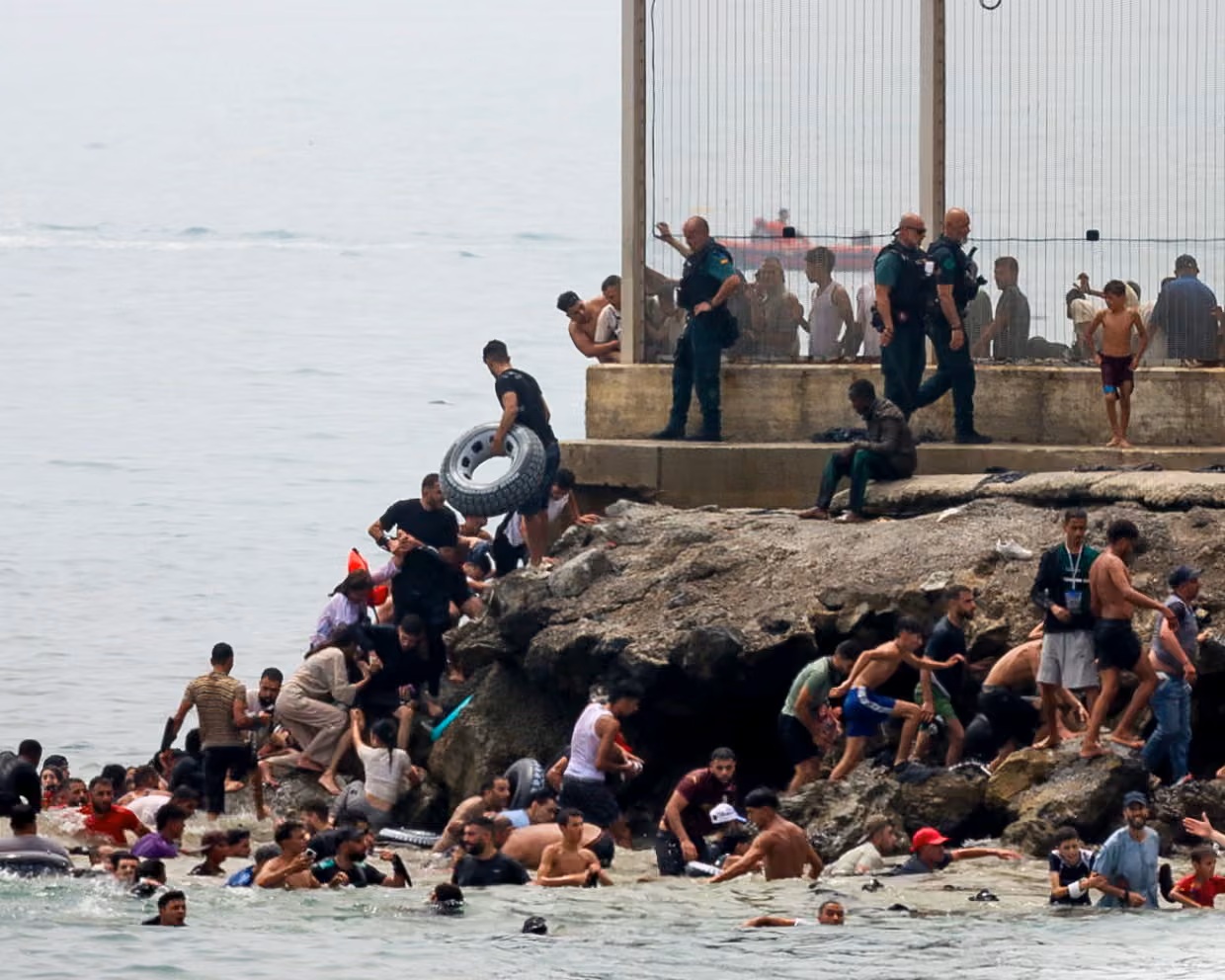
The reactions of Dutch Prime Minister Rob Jetten and the European heads of government to the crisis in Ceuta show how much bureaucratic language has replaced statesmanship.
By Oscar Hammerstein
How badly the Netherlands is currently governed, and how little geopolitical clout the European Union still has in times of crisis, becomes clear from two documents that appeared almost simultaneously after the mass storming of the Spanish enclave of Ceuta by tens of thousands of migrants from Morocco.
Illustrated by a tweet by Prime Minister Rob Jetten, mind you, only two days after the events, and the joint letter from the European heads of government. Which also arrived way too late.
Both texts have the same flaw. They describe a crisis but refuse actually to call it a crisis. They exude sympathy, consultation, and good intentions, but lack urgency, a sense of responsibility, and strategic leadership. They illustrate the difference between governing and statesmanship.
Jetten wrote on August 1: ‘The images from Ceuta are very striking. It's good to see that Spain and Morocco are making an effort to get the situation under control. The Netherlands regrets the deaths caused by human smugglers. Together with 21 other EU leaders, I urge the Irish presidency to call the EU migration ministers together to discuss the situation.’
At first glance, there’s nothing unreasonable there. That’s exactly the problem. The tweet is a textbook example of bureaucratic language that doesn’t deny the seriousness of an event but does hide it from view. The massive breach of a European border is referred to as ‘the situation.’ As if it were a storm, a traffic jam, or a regrettable incident for which no one in particular is responsible.
But the essential question is whether migration has also been used here as a political pressure tool. When a neighbouring country deliberately lets its border control slacken to put pressure on an EU member state, it’s no longer just a humanitarian crisis. Then migration becomes a geopolitical weapon, and the integrity of the European external border is at risk. Anyone who doesn’t investigate or even acknowledge this turns a question of power into a relief problem. Compassion is not border policy.
The order of Jetten’s message is also telling. He expresses his condolences for the dead. That is right and natural. But a government leader also has a primary responsibility: the protection of the territory, the rule of law, and the population. Compassion and decisiveness don’t exclude each other. The former can never replace the latter.
The tweet also almost exclusively points to human traffickers. There's no mention of any responsibility of the Moroccan authorities. This way, the relevant state actors disappear from the picture, leaving a familiar humanitarian drama with malicious smugglers, pitiable victims, and concerned European officials. The geopolitical issue is carefully avoided.
Then follows the inevitable European reflex: the ministers must meet to ‘discuss the situation’. Not: Spain gets immediate operational support. Not: Frontex is reinforced. Not: states that use migration as a pressure tool are held accountable. Instead: meetings.
That’s corporate jargon where a manager describes events, monitors the process, and organises a meeting. The statesman decides what’s at stake, assigns responsibilities, and announces measures.
A strong government leader could have said: 'The border of Spain is the border of Europe. Anyone who uses migration as a political pressure tool should know that Europe will protect its external border, combat human smuggling, and hold responsible states accountable.'
Such a statement does not solve the crisis. But at least it makes clear that Europe understands what it is facing.
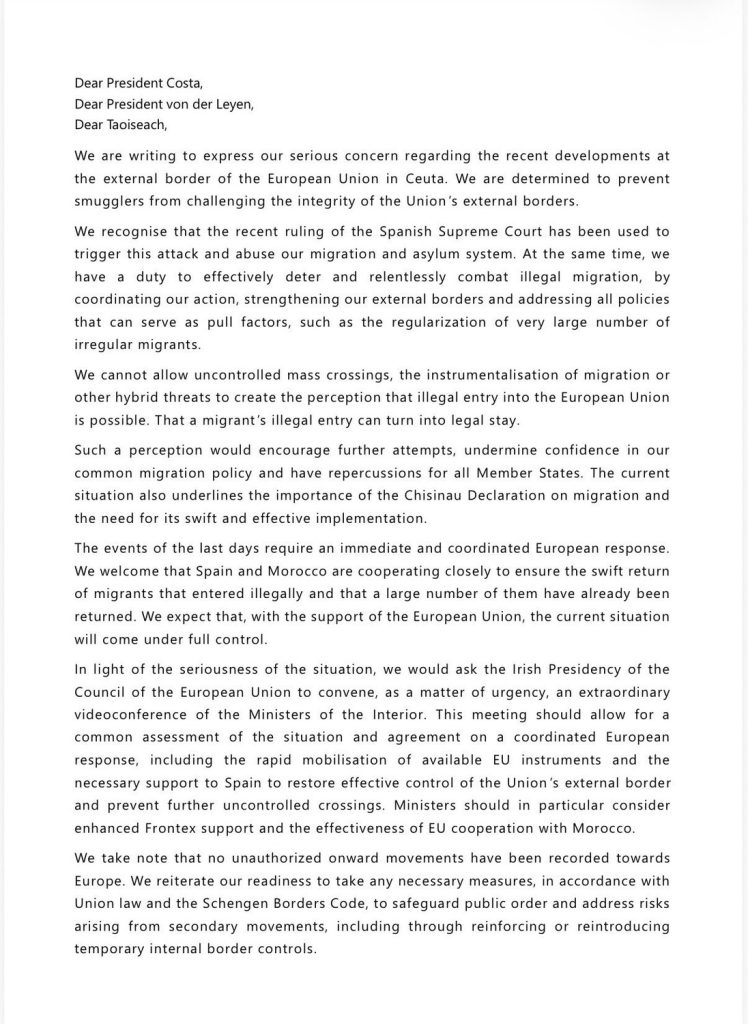
The European letter (see below)
The same administrative weakness shows in the joint letter from the European government leaders. Its goal is defensible: to prevent uncontrolled border crossings and protect the external borders. But the message is drowned in diplomatic caution.
The leaders declare themselves 'determined.' But determination is not something you proclaim about yourself. It's something others should infer from a government's actions.
They write that Europe cannot allow uncontrolled mass border crossings. The awkward counter-question is: so why were tens of thousands of people able to cross that border?
They welcome the cooperation between Spain and Morocco and expect the situation to come under control. But 'welcome' is not a policy tool, and expectation is not enforcement. A border is not guarded by optimism. Nations survive not thanks to welcomes. They survive thanks to results.
"We expect the situation to be fully under control." Hope is not a strategy, and expectation is not enforcement.
Perhaps even more striking is the call for the Irish EU presidency to bring the responsible ministers together. As if the Roman Senate, when Hannibal was at the gates, first set up a committee to study the nature of the crisis. When the enemy is at the gates, you do not hold meetings; you defend the city.
Frontex support also needs to be 'considered.' Consideration is a luxury of peacetime. An acute crisis demands decisions. When the gates are under pressure, you don’t first call a committee. You reinforce the gates.
Europe still talks, but says little. Brussels has perfected the language of concern, but forgotten the language of authority. It has an impressive dictionary of solidarity, cooperation, and consultation, but a civilisation isn’t defended with statements. It’s defended by the will to maintain its borders.
The Romans knew that a border isn’t a line on a map, but a promise that the state will protect its citizens. When that promise was no longer credible, the empire fell. A border that only exists in treaties isn’t a real border.
The first duty of a government is to know who enters its territory and under what conditions.
That’s not an extreme view, but the core of political sovereignty. Without control over its territory, a state eventually also loses the ability to organise asylum, immigration policy, and humanitarian protection credibly.
Thomas Hobbes understood four centuries ago that the legitimacy of a state ultimately rests on its ability to provide protection. Churchill also knew that words only gain meaning when backed by the will to act. That’s why the reactions to Ceuta are so revealing.
Not because everything in them is untrue or unreasonable, but because everything that really hurts stays out of view.
Who was responsible? Why did border control fail? Has migration been used as a political weapon? What immediate measures is Europe taking? And what are the consequences if a state lets tens of thousands of people head toward a European external border again?
None of these questions gets a clear answer. There’s sympathy. There’s consultation. There are expectations. There are good intentions. But good intentions have never guarded a border.
A political community is judged not by the elegance of its statements, but by its ability to protect its citizens, its territory, and its legal order. When a crisis at Europe’s external border is mainly met with concern and meetings, it’s not just border policy that’s in crisis. Leadership itself has crossed the border too.