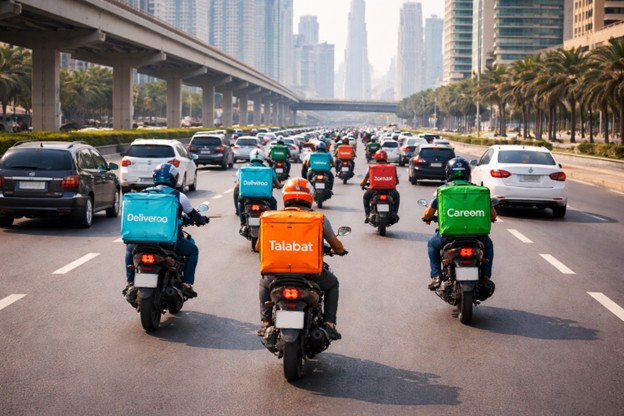
Driving back home on a regular Saturday afternoon, not rushing anywhere in particular, just letting the week loosen its grip with every stoplight and slow turn, when the road ahead began to feel unfamiliar, not due to congestion or an accident, but as a group of delivery motorcycles appeared together, as a motor pack, moving quickly and closely enough to shift the atmosphere inside the car before I had time to understand why fully.
It wasn’t one rider easing between lanes, something most of us have learned to anticipate by now, but several of them riding in succession, weaving between cars with barely any margin for error, appearing suddenly from blind spots, overtaking from directions that left no room for predictability, moving as if slowing down wasn’t part of the equation.
What stayed with me long after they disappeared wasn’t panic, but a sense of unease that lingered precisely because it felt familiar, because scenes like this no longer register as rare, because they’ve quietly worked their way into what we’ve come to accept as normal.
When the Road Starts to Feel Rushed
There was a time when dangerous riding stood out, when it disrupted the natural rhythm of traffic enough to be noticeable, yet what I witnessed felt almost expected, as though speed had gradually become the dominant force shaping how the road is used and understood.
Delivery riders today aren’t only navigating traffic patterns and signals; they’re navigating timers, notifications, ratings, countdowns, and expectations that don’t pause for congestion, weather, or caution, expectations that reward arriving faster far more visibly than arriving safely.
When time turns into currency, hesitation stops feeling responsible and starts feeling costly.
The Weight Carried Behind the Helmet
This isn’t a story about blaming riders, and it’s important to say that clearly.
Most delivery drivers are young men working long hours under sustained pressure that never shows up on a customer’s screen, where a delayed order can mean fewer incentives, fewer shifts, or a mark against their record, turning every red light into a calculation and every careful decision into a potential setback.
Over time, danger doesn’t arrive suddenly; it settles in gradually, until weaving through traffic feels more manageable than falling behind.
Streets That No Longer Feel Shared
As a driver, the change shows up in subtle, instinctive ways, in the way your hands tighten slightly on the steering wheel, in the extra moment spent checking mirrors before changing lanes, in the reflex to slow down when a motorcycle passes closer than expected.
Pedestrians sense it too, pausing longer before crossing, scanning the road more carefully, unsure where movement might come from next, as though the street itself has become harder to read.
The roads themselves haven’t changed, but the way we move through them has.
Convenience That Moves Faster Than Thought
We tap a screen, and something arrives, often without considering the journey it took to get there or the pressure carried along the way, the urgency built into every kilometre travelled.
The real concern isn’t only what might happen in a worst-case scenario, but how easily this level of risk has blended into everyday life, how convenience has trained us to stop questioning the conditions that make speed possible.
Faster has become the expectation, even when it gradually erodes safety.
Where Responsibility Really Begins
This isn’t something that can be solved by asking riders to be more careful while leaving everything else unchanged, or by shifting responsibility onto individuals operating within systems that leave little room for choice.
Responsibility has to sit higher up, with delivery platforms reassessing unrealistic timelines, performance pressure, and the assumption that speed should always come first, investing instead in training, realistic delivery windows, and structures that don’t force people to choose between safety and survival.
Road rules only work when everyone is given a genuine chance to follow them.
I didn’t witness an accident on my way home that afternoon, and for that I’m grateful, but I did witness something that felt like a warning unfolding in real time, one that lingered long after I parked the car and turned off the engine.
It stayed with me not for its drama, but for its ordinariness, for the fact that nothing went wrong, for how easily risk slips into routine when repeated often enough to feel familiar.
Cities continue to grow, technology continues to accelerate, and habits continue to shift, often faster than the systems meant to protect us. Yet, streets remain shared spaces shaped by collective behaviour rather than individual intention.
The question isn’t whether delivery motorcycles belong on the road, since they already do, but whether we are willing to slow down enough, as platforms, as regulators, and as consumers, to consider how much pressure we place on the people riding them and on the roads we all rely on.
When safety becomes something we assume rather than actively protect, it quietly stops being guaranteed, and the consequences, sooner or later, find their way back to all of us, whether we’re behind the wheel, crossing the street, or waiting for something to arrive at our door.