The European Commission’s 2026 meta-study on energy connectivity across the Eastern Partnership, the South Caucasus, Turkey, and Central Asia provides a timely assessment of Brussels' view of the evolving energy architecture on its eastern flank. While framed as a high-level analytical exercise rather than a policy blueprint, the document implicitly highlights Azerbaijan as one of the few regional actors capable of contributing simultaneously to Europe’s short-term energy security and its longer-term decarbonization objectives.
By Vasif Huseynov
Developments in Azerbaijan’s energy sector throughout 2025 and early 2026 closely align with this assessment, reinforcing the country’s role not only as a stabilising gas supplier but also as an emerging hub for electricity transit and system balancing across multiple corridors.
From the EU’s perspective, diversification remains the cornerstone of energy security. Despite the bloc’s long-term commitment to climate neutrality, the meta-study acknowledges that natural gas will continue to play a stabilising role during the transition, particularly in Southeast and Central Europe.
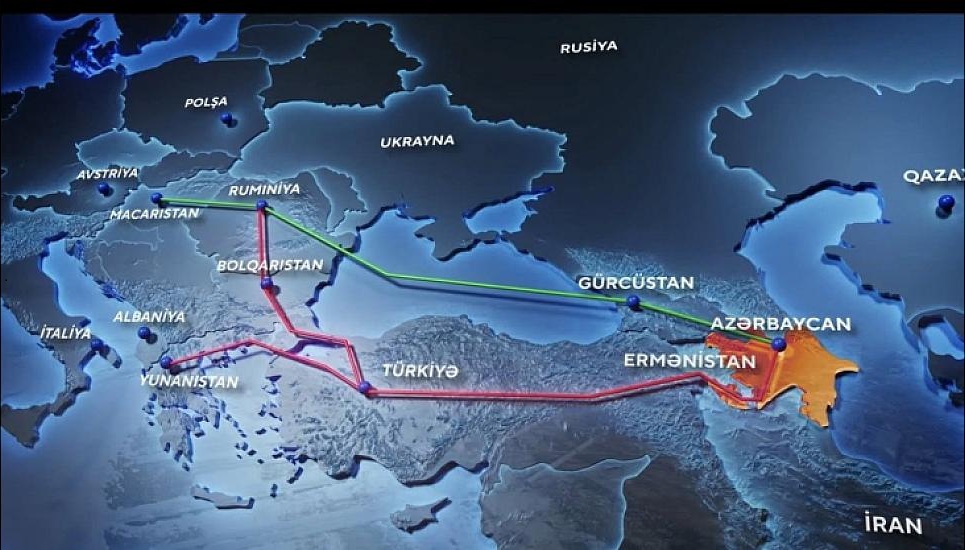
In this context, Azerbaijan’s role through the Southern Gas Corridor (SGC) remains strategically significant. In 2025, Azerbaijan exported approximately 25 billion cubic meters of natural gas, generating approximately $8.8 billion in revenue. Azerbaijani gas reached 16 countries, including 12 in Europe, following the start of supplies to Austria and Germany via the Trans Adriatic Pipeline in January 2026.
Exports to the European Union averaged around 13 bcm per year, reinforcing Azerbaijan’s reputation as a reliable supplier at a time when Europe continues to prioritise diversification away from Russian energy. Baku has repeatedly signalled readiness to increase deliveries, while emphasising the need for long-term demand guarantees to justify upstream investments and infrastructure expansion.
Baku signalled its readiness to increase gas supplies to Europe beyond its current level (approximately 13 bcm) but stressed the need for long-term demand guarantees. Without investment certainty, further expansion of upstream production and pipeline capacity would not be economically viable.
At the “Azerbaijan Executive Breakfast” during the World Economic Forum in Davos, President Ilham Aliyev stated that Europe has shown little investment interest in Azerbaijan’s fossil fuel or renewable energy sectors.
Nonetheless, the meta-study underscores that Europe’s future energy security increasingly depends on electricity connectivity and the integration of renewable energy markets.
In this context, Azerbaijan’s evolving role becomes particularly salient. As presented in the author's latest article for Liberum, Azerbaijan is committed to upgrading its green energy industry and investing significantly in this transition.
While Azerbaijan is not yet a direct electricity exporter to the EU, it is increasingly embedded in the regional ecosystem that Brussels views as strategically consequential. The Black Sea Submarine Cable project, which links the South Caucasus to Southeastern Europe, stands at the centre of this vision.
Developed jointly by Azerbaijan, Georgia, Romania, and Hungary, the 1,155-kilometre cable will transmit up to 1,300 megawatts of renewable electricity across the Black Sea. The project received EU Project of Mutual Interest status in December 2025, strengthening access to financing and regulatory support, with completion targeted for 2032.
However, the EU meta-study also emphasises that large-scale export routes depend on strengthened internal grids and alternative transmission paths to reduce system bottlenecks and geopolitical exposure. In this regard, Azerbaijan’s parallel investment in south-western electricity infrastructure — particularly the emerging Zangezur energy corridor — complements the Black Sea route.
By restoring direct electricity connectivity between mainland Azerbaijan and its Nakhchivan exclave and extending this line toward Türkiye, Baku is laying the groundwork for a continuous South Caucasus–Türkiye–Europe electricity axis that strengthens redundancy and system resilience.
Construction has already begun on the Zangezur high-voltage transmission line, designed to integrate Nakhchivan into Azerbaijan’s unified electricity system and eliminate its long-standing status as an energy island. A subsequent phase foresees a 400 kV transmission line from Nakhchivan to Turkey, aligning Azerbaijan’s grid more closely with European technical standards. From the EU’s perspective, such internal grid consolidation is not a secondary issue but a prerequisite for predictable, large-scale cross-border electricity flows.
These connectivity ambitions are reinforced by Azerbaijan’s rapid progress in renewable energy deployment. A defining milestone came in January 2026 with the official inauguration of the Khizi–Absheron Wind Power Plant, the largest wind facility in the South Caucasus.
The launch of Khizi–Absheron builds on earlier flagship projects such as the 230-megawatt Garadagh Solar Power Plant, developed with the UAE’s Masdar, which has already produced over one billion kilowatt-hours of electricity and saved more than 110 million cubic meters of gas since commissioning.
The Garadagh Solar PV Plant is the largest solar facility in the Caspian region and across the CIS. Developed with $262 million in foreign investment, it represents the country’s first industrial-scale solar power project implemented through international financing.
The European Commission’s meta-study repeatedly stresses that such ambitions must be underpinned by reinforced national grids, storage solutions, and regulatory alignment. Azerbaijan’s experience reflects this logic. Expanded clean power generation has enabled the country to reallocate natural gas for export while stabilising the domestic electricity supply.
Beyond domestic generation, Azerbaijan’s geographic position gives it increasing relevance in east–west electricity corridors that extend beyond the Black Sea. The Commission’s analysis notes country-driven proposals for a Trans-Caspian electricity link connecting Central Asia to the South Caucasus and onward to Europe.
Azerbaijan’s agreements with Kazakhstan and Uzbekistan to develop a Central Asia–Azerbaijan green energy corridor, supported by feasibility studies from the Asian Development Bank and the Asian Infrastructure Investment Bank, reinforce this vision.
Azerbaijan’s participation in multilateral memoranda on the trade in renewable electricity with Georgia, Türkiye, and Bulgaria reflects gradual progress toward deeper market integration. However, further regulatory convergence will be required to translate physical connectivity into sustained commercial flows.
Taken together, the European Commission’s 2026 meta-study and Azerbaijan’s energy trajectory through early 2026 tell a converging story. Azerbaijan is no longer viewed solely as a hydrocarbon supplier, nor is it portrayed as a fully fledged green energy exporter. Instead, it occupies a strategically valuable middle ground—combining gas supply reliability, renewable energy expansion, and bidirectional electricity connectivity.