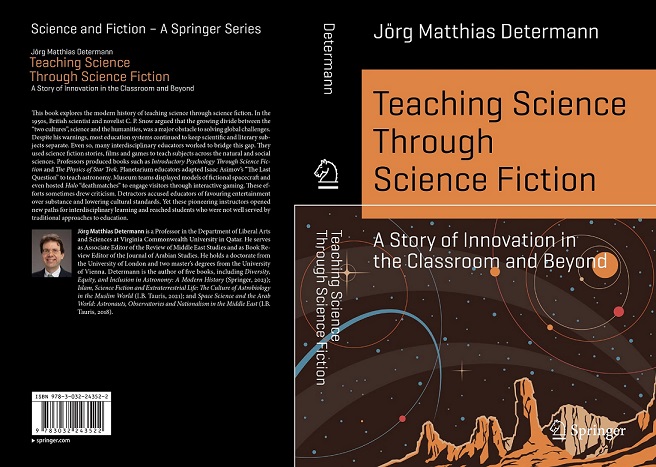
Dr Jörg Matthias Determann’s latest book: Teaching Science Through Science Fiction: A Story of Innovation in the Classroom and Beyond (Springer, 2026) is spot-on. I've always used SF to teach science in my academic career to do the same, almost to no avail. This has been a long time coming, and I’m so happy to see Dr Determann going beyond anything I was able to do in my limited experience as a university professor. The book is replete with modes of engaging pupils of all ages, ranging from good old-fashioned stories to video arcade games and planetarium laser shows.
By Emad Aysha
The book is average size for someone of Dr Determann’s calibre; 212 pages long, divided into 8 chapters. His previous books, Diversity, Equity, and Inclusion in Astronomy (2023) and Islam, Science Fiction and Extraterrestrial Life (2020), weigh in at 195 and 289 pages respectively. Don’t be fooled by the numbers, however.
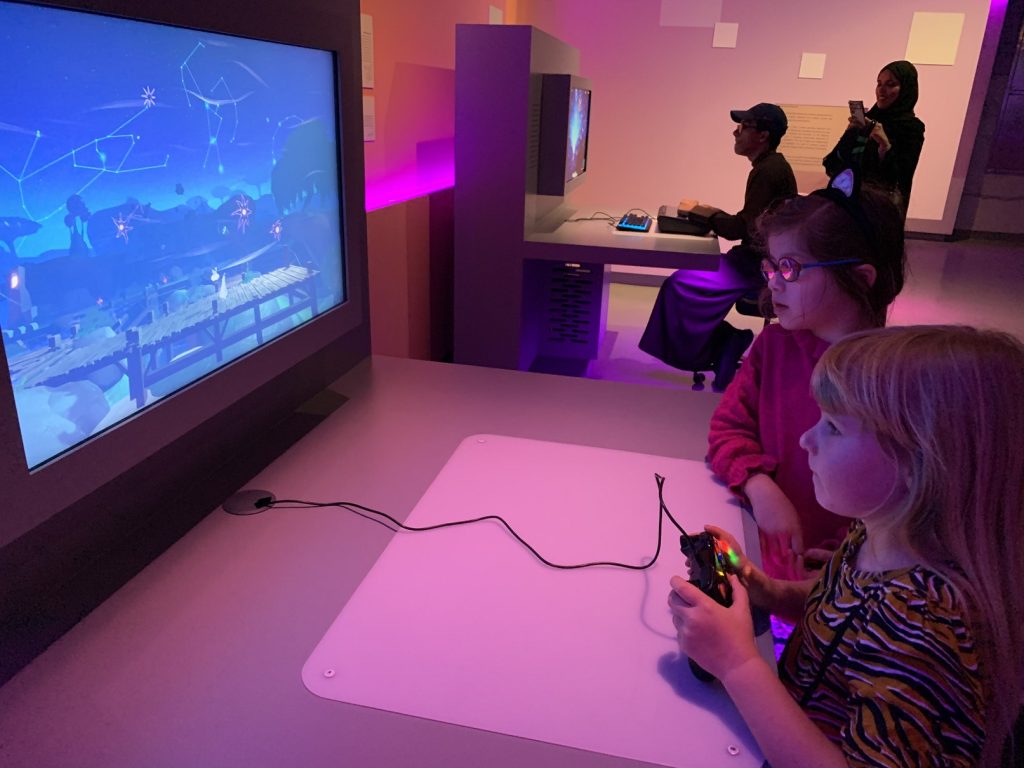
GENERATION SHIFT: Maria Determann, cited in the book (p. 205), plays Nightscape at National Museum of Qatar during the Mal Lawal 4 exhibition. Her experiences were the backbone for this pathbreaking book.
Each chapter in this new book feels like a book in its own right, but you zoom through the individual chapters like you’re reading an essay.
It took me only two days to read the whole text. Dr Determann’s style as a historian has always been relaxed, taking an empirical approach that doesn’t get itself bogged down in theoretical terminology. But he breaks new ground here as each chapter is divided into bite-sized chunks.
This makes amassing insights and data more focused and logical in your head as you read. The subheadings, moreover, are light-hearted and engaging: “A is for Asimov”, “Misfits”, “To Boldly Go Where No Curator has Gone Before”, etc.
The pictures in the book make it more accessible too. It’s academic enough for people like me but not too academic to put anybody else off either. The scope of the book is impressive too.
It begins at the beginning, with the pulps in the Golden Era of sci-fi (1920s-1940s) with Hugo Gernsback (1884-1967) arguing, way back in 1929, that his SF magazines could be an instrument of scientific instruction and literacy for young readers.
It all was brushed aside – no surprise there – till popularising science during the Cold War became a thing, thanks to Isaac Asimov (1920-1992) and Carl Sagan (1934-1996). The hostility in literature departments didn’t abate, of course, but that’s not the ultimate lesson of this foundational study.
There were other quarters hostile to using SF as a conduit for science education. Namely, the scientists themselves!
Not everyone, of course, since Asimov was a distinguished biochemist himself. But many science departments steadfastly refused to add SF stories to their curricula. They considered these stories to be zap-kapow type entertainment containing nothing but pseudoscience at best.
This wall of animosity was so bad, in fact, that it changed the whole demeanour of early sci-fi, forcing the pulp magazines to keep ‘sex’ out of their texts steadfastly. They were afraid they’d be lumped in with the erotica crowd. I presume the kind of exotic adventure stories pioneered by Robert E. Howard (1906-1936).
I’d always wondered why SF stories from that era were so ‘dry’. That’s also why I was all the more shocked as a kid reading Asimov’s later works like Robots of Dawn (1983) and Nemesis (1989), which were quite explicit by his standards.
Weirder still, some of the advocates of popularising and teaching science through SF themselves were hostile to SF, chief among them Isaac Asimov!
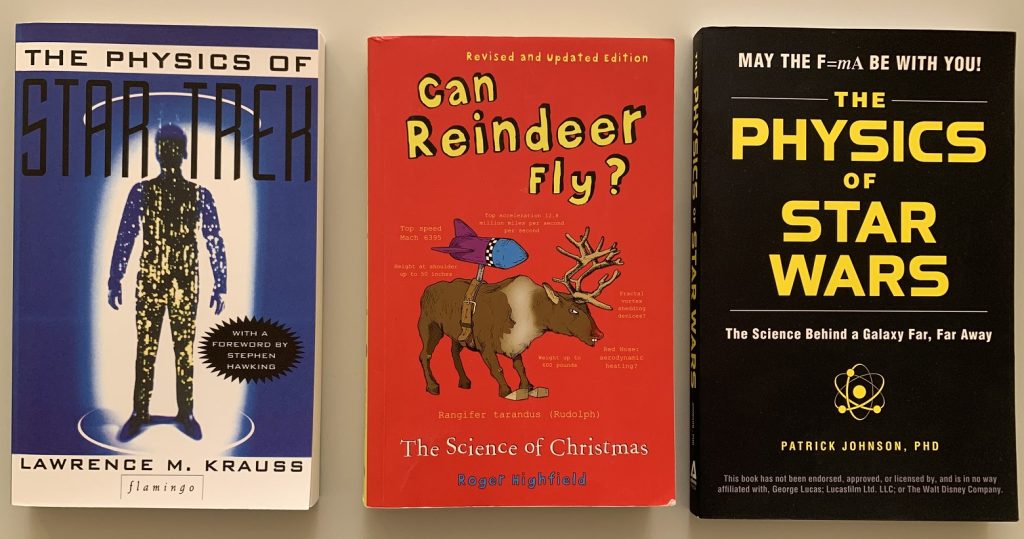
FANTASY TOOLKIT: Some examples of books (cited on p. 168) that met the approval of the big names in science fiction promoting science. More or less!
They liked serious, substantive written sci-fi and loathed the scientific inaccuracies contained in classics like the Star Trek (1966-1969) series and Close Encounters of the Third Kind (1977). Asimov, it turns out, was pretty darn grumpy and egotistical.
Asimov’s commitment to popularising science through SF also hurt the cause because he insisted on a bland and literal style of fiction writing. This didn’t win him any points with the literary establishment.
Asimov, among others, also refused to work with the UFO crowd to popularise science or SF. It seems they were afraid of not being taken seriously as authors and scientists if their names were associated with UFO sightings, witnesses or researchers.
Then there’s the sex scandals to contend with. Not that he was the only one. Jeffrey Epstein pops up here, amazingly enough (p. 206)—more surprises followed in the text.
Arthur C. Clarke, it turns out, was grumpy and egotistical himself. And a bit of a cultural snob, deriding the twin evils of Fanaticism and Superstition that he saw as keeping Asian poor (p. 26).
I have my own qualms about our Oriental cultures, but it’s not nice saying these on somebody else’s soil.
Then there’s poor Martin Harry Greenberg (1941-2011). A political scientist and SF editor who hit a brick wall himself when he tried to use science fiction stories to teach in the social sciences.
I couldn’t believe this. He’d edited the famous Isaac Asimov's Wonderful Worlds of Science Fiction series, some of the best and most informative anthologies out there on everything from Neanderthals to Comets.
SF is more than adept at social science, not least touchy topics like dystopia and Utopia. Look at stories like “Strikebreaker” (1957) and “2430 A.D.” (1970) by Asimov. Or how he explains the dynamics of the scientific community in “Belief” (1953), “Ideas Die Hard” (1957) and Robots of Dawn.
Never mind Philip K. Dick, a psychedelic and dystopian author extraordinaire. How could something like that happen to Greenberg of all people?
Boy, and I thought I had it bad till I finally got to teach my own custom-made course: “Science, Literature and Development”. (I’d been teaching ‘Scientific Thinking’ before then.)
As a rejoinder to Clarke, our own Liberum article on Egyptian sci-fi children theatre Kawkab Sika is cited in the book. I don't think he, or Asimov, ever dreamed up that particular way to propagate scientific knowledge.
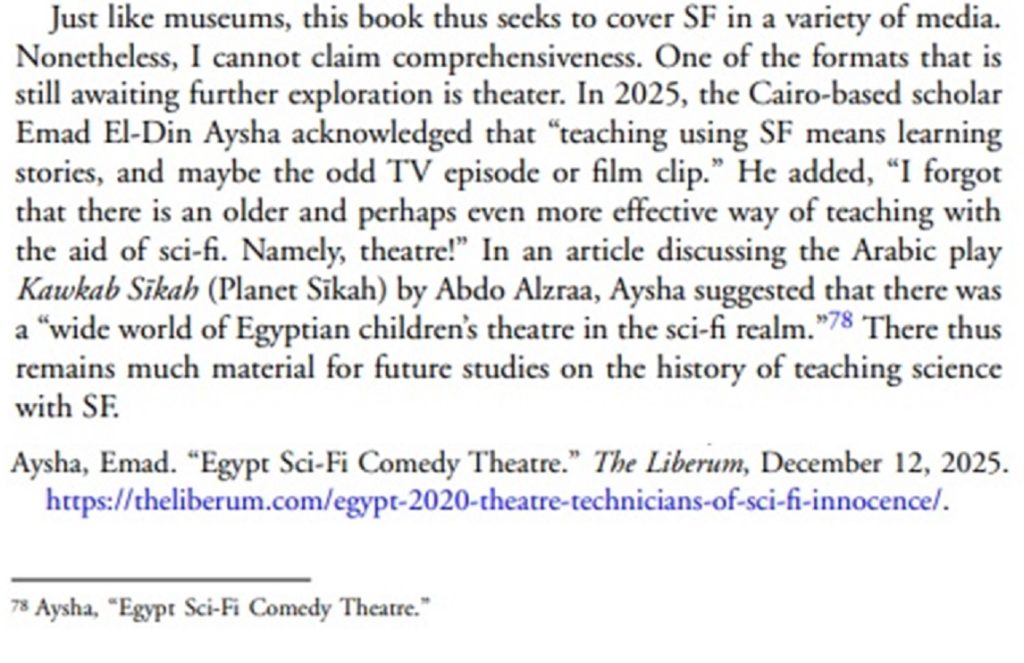
IN THE NEWS: My small contribution to this book. [Screenshot from the book, p. 30]
Another surprise came with this statistic from Eurobarometer: “scientific knowledge among the European population had remained practically unchanged between 1992 and 2001” (p. 86). Except for dinosaurs, of course, thanks to Jurassic Park!
More to the point, I was reminded of an Egyptian educational researcher from the 1990s who found that only about 4% of all cultural produce in the country dealt with science. But to his amazement, he found the same figure for the 1960s.
That is, at the height of Nasserism with all its modernising and industrialising pretences. (Mustafa Suwayf, We and the Future [نحن والمستقبل], 1994, pp. 222-223, 219-222.)
Well, at the least the Europeans did something about it, helmed by scientists like Austrian physicist Heinz Oberhummer. It was also great to see the dearly departed James Gunn in there and his own uphill battle to get SF taught at university.
Thanks to their cumulative efforts, museums began stocking up on old arcade games to help students do calculations in shoot ‘em up and alien invasion scenarios.
Computer games for teaching maths are normal now at schools, almost at the kindergarten level. Planetariums inviting the likes of Leonard Nimoy and William Shatner to introduce documentaries about the stars and light shows have worked wonders on both sides of the Atlantic.
I attended a laser show at the London Planetarium as a kid, and reading this book helped bring back so many fond memories: a heartwarming experience and a must-read for everybody else. I really think it’s Dr Determann’s best work to date.
In short, please buy it and read it for yourselves. And while you’re at it, maybe you’d like to take a peek at my own magnum opus on teaching science through stories and other art forms:
“When and When Not to Use Science Fiction to Teach Science: A Perspective From Egypt”, in Saad Boulahnane, Mohammed Hirchi, Hanane Allioui and Oumaima Mousaid, ed.s, Generation Z and the Transformation of Education, Work, and Digital Society, (IGI Global Scientific Publishing, 2026), pp. 261-279.

FEEDBACK LOOP: Arab academics, authors and activists are beginning to bring their experiences to bear on the global intellectual landscape. 'The Liberum' is only the first step!
There are some surprises there too!