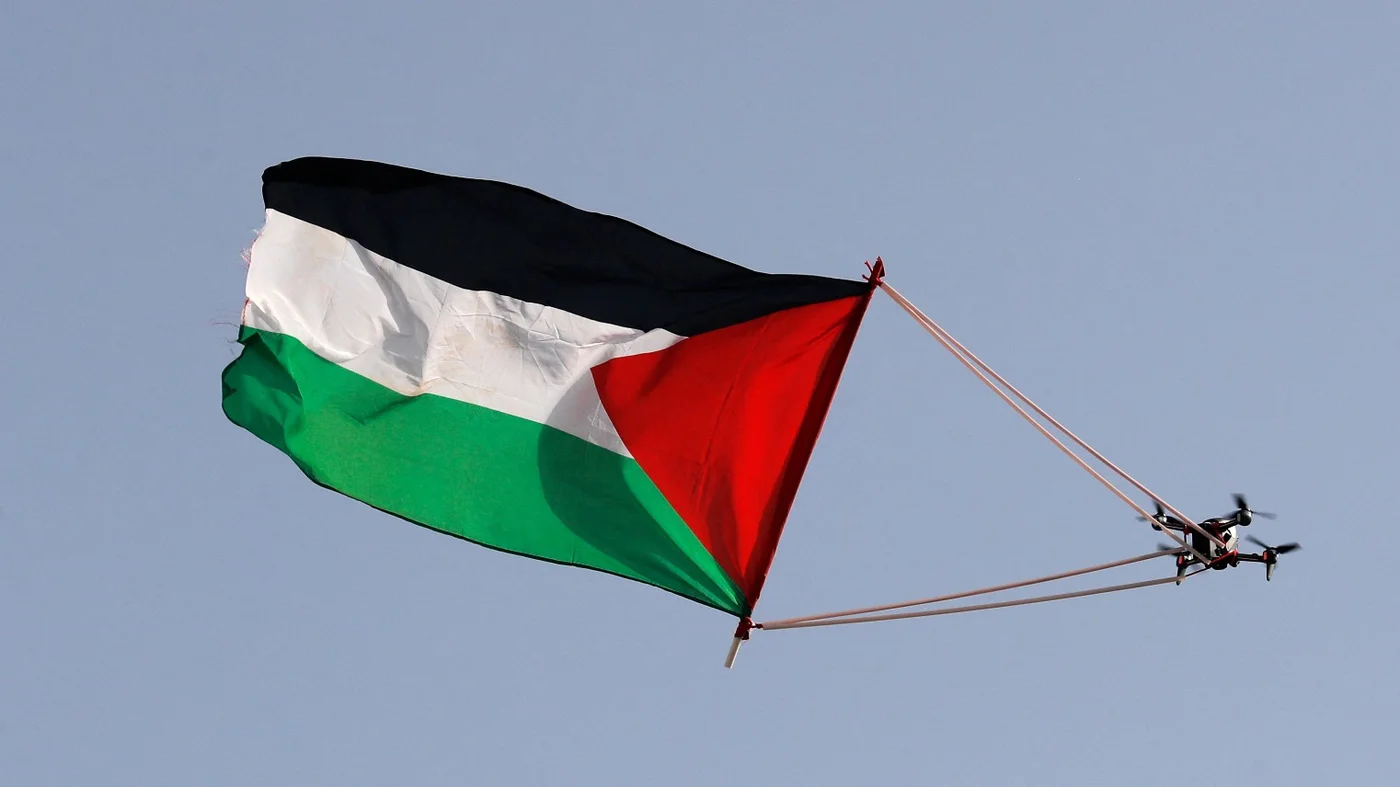
Who remembers the elaboration about ‘On the Edge of Jerusalem’ (على حافة القدس, 2024)? Everything about this novel is a surprise, so we had to talk to the author herself. Here, the Russians declare war on the Palestinians, in an effort to distract the Americans and Israelis from the Ukraine war. And then the North Koreans follow suit!
By Emad Aysha
The protagonist, Cardiff, is half Palestinian with a death sentence in her genes. Her best friend Ahila (اهله) is a Jewish Palestinian of Iranian extraction. The antagonist is a half-Israeli who was shunned by his own people and is jealously in love with Cardiff.
The greatest surprise, for me, is that the author isn’t Palestinian but wrote a novel that ‘feels’ so Palestinian. And she wrote it before the Gaza war while still anticipating the massacres of children and hospitals.
Finally, the novel has now been translated into Romanian for a burgeoning European audience.
Please introduce yourself.
I am Yara Saeed, Egyptian, 23 years old, and I just graduated this year from Alexandria University in psychology. I started working just two months ago, but I’ve been writing since I was 8!
I wrote short stories about Disney princesses, then finally transitioned from writing about cartoon characters to real-life people during my final primary school years. Of course, I never showed these stories to anybody, not even my family. Then, one fateful day in my first year of middle school, I was scribbling away on my way home when I dropped my notebook. My friend insisted on reading it. She liked it so much she recommended I publish it on social media.
That was still an original idea at the time, towards the end of 2015. Online platforms weren’t nearly as powerful as they are now. My friend also helped me with my first story, published on my Facebook account and serialised into short episodes, like a TV series. Despite that, it spread amazingly, and overnight the whole school knew me, even my teachers, who all genuinely liked it.
My next story, also with a little creative help from my friend, came out in the same format, and with my third story I finally had a fanbase by 2017. That’s when I decided to write my first novel and end my Facebook exercises.
I completed my new project by mid-2020; I wasn’t even 18 yet, and then the Corona outbreak happened. Fortunately, I found a good publishing house and signed a contract with my prospective publisher. Gold-woven Fabric (نسيج التبر) came out in January 2021, a psychological drama exploring the true nature of evil in the human mind.
It’s set in the past, spanning four real-life historical episodes, with some imaginings of my own.
From that point on, writing became more than a hobby for me, and I entered the world of publishing. I’m already looking for a publisher for my third novel. Wish me luck!
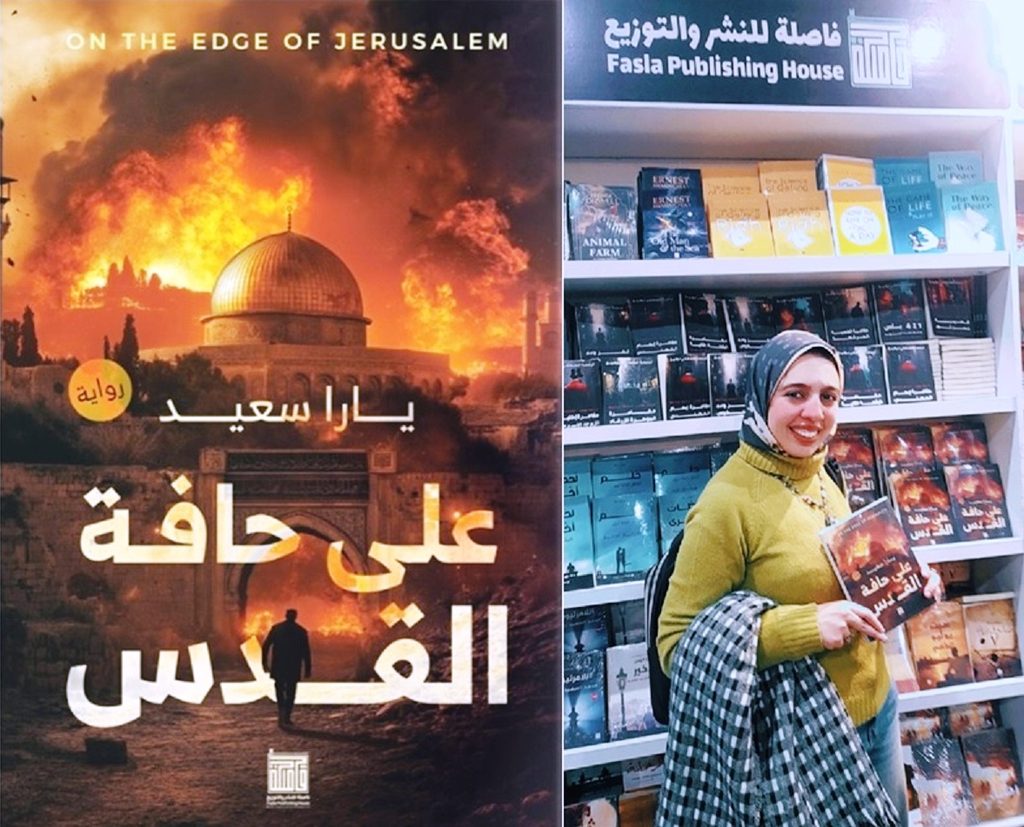
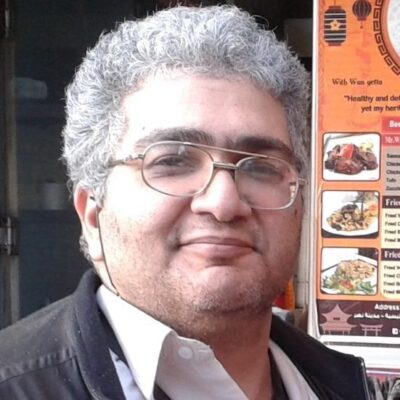
NOVEL CONTROVERSY: Yara Saeed [right], while as Egyptian as they come, outdid the Palestinians at their own game - imagining a scientifically plausible Palestine. [Photos provided by interviewee]
What genres do you write in? Who are your favourite authors?
I lean more toward social drama in my writing, but I also love mysteries and crime. I’m also interested in politics, history, and psychology, although I don’t write much romance.
As for reading, I’m an omnivore, but my favourite author by far is Ahmed Khaled Tawfik, along with Ihsan Abdel Qudus, Naguib Mahfouz, Tawfik Al-Hakim, and Radwa Ashour. As for world literature, I prefer Russian literature: Dostoevsky and Tolstoy.
What inspired your novel ‘على حافة القدس’?
I graduated from high school after completing the humanities stream, and in history class, we studied the Palestinian cause from its inception to the early 2000s. I couldn’t stop crying during my studies, out of sorrow and shame for the condition they’ve reached because no one extended a helping hand in the face of such clear and belligerent injustice.
At the exact time, by pure coincidence, I was following the American medical drama ‘House M.D.’ more for fun than anything else. So it's no surprise that, as soon as I graduated in 2021, I dedicated myself to writing a novel set in Palestine, with the heroine as a medical doctor.
More thoughts accumulated about the advance of technology and about a new kind of murder, combined with my deep desire to witness the day Palestine would become free. It was a slow creative process, taking roughly two years to make.
Why is the story not told by Cardiff herself?
I recounted the story through someone other than the heroine because the story is narrated via writing. Moreover, the narrator, the Egyptian journalist Noah Jasir al-Adham, is a gifted writer. This made him well suited to tell the tale and pull all the disparate events together, and to portray all the characters, in contrast to Cardiff. The fulcrum of her story is what she experiences only, in the here and now.
Additionally, having someone other than the hero brings you closer to the reader. You listen to a story told to you by someone normal like yourself, someone who isn’t experiencing all these adventures like the protagonist; a different point of view, an outsider's interpretation of events.
I was intrigued by Cardiff’s friend ‘اهله’. Is this pure fiction, or are there people like that in occupied Palestine?
Oh no, she was not a purely fictional character! Palestine contained Jews of all nationalities at the time, thanks to the British ‘migration’ policy. In the case of Iranian Jews, however, this wasn’t a collective migration driven by British policy, but individual family transfers dating back to the 17th century. It peaked in the 1940s, but the number transferred did not exceed 2000. Zionist activities in Iran were prominent at the time, but migrants went mainly for economic or religious reasons, not politics.
Why is Palestinian science fiction important, in your opinion?
Palestinian literature naturally leans toward realism and drama. It is so full of emotion and social stories that it will last at least another century! Therefore, anything that counters the ‘stereotype’ of Palestinian literature is welcome.
Once free, Palestine is capable of catching up with the rest of the world technologically. It is already advancing, despite the long years of occupation. This is because its people are educated and have an unbelievable determination.
Look at what Japan was able to accomplish after two atomic bombs. And here comes the centrality of science fiction. To convince the world that even if the land is occupied, it is not just a collection of ruins and impactful social stories. It is so much more.
As for me, I wrote the book because I love Palestine and want to articulate this love when I was a young woman, not yet twenty. And I will always love Palestine. If I write about it again, it will be from a new stage of my life and maturity, with a new perspective.
Everything I write, whatever the topic, and no matter how distant it is from me personally and how imaginary it is, is ultimately a documentation of my life in one fashion or another.
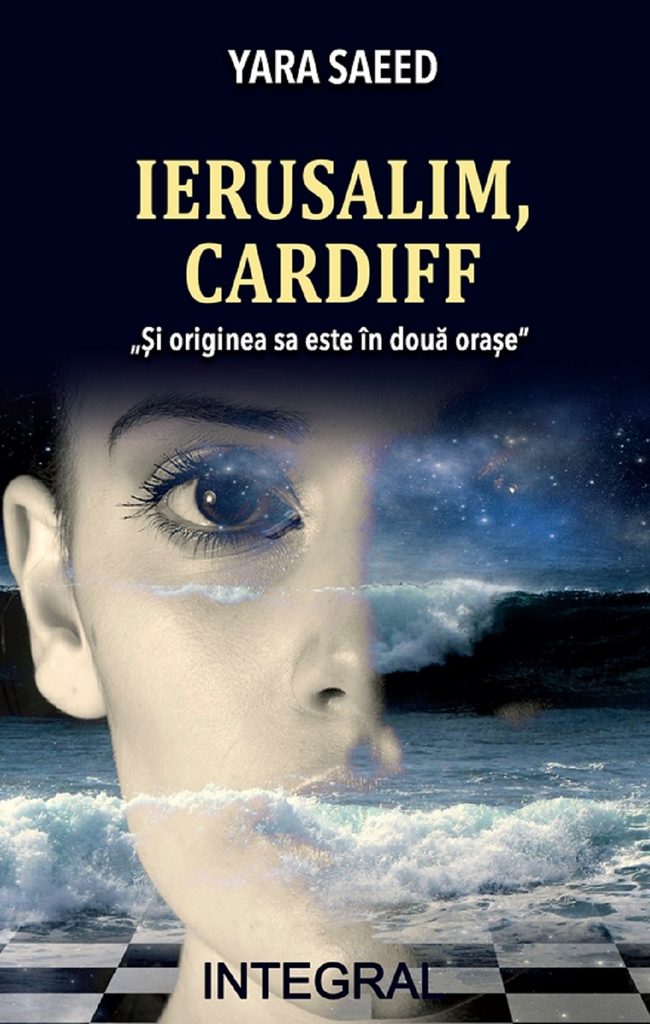
CHECK MATE: The Romanian version of Yara's novel carrying a thoroughly Egyptian message to the whole world - nations begin in households, and in women's hearts.
And how did your novel end up in Romania?
I received a call from the publishing house telling me that a Romanian publisher had liked my work and wanted to have it translated and published in his country.
Later, when I found out the date of my trip to the Cairo International Book Fair in 2026, I learned that the publisher had actually been there a few days before my trip. He spoke about the novel and how much he admired it. He was also surprised by my age, and he spoke about the Egyptian people’s love for Palestine and the shared sense of humanity between the two peoples.
Finally, what are your future plans?
They are threefold. I’m sticking with my educational job, but mainly as a short-term scheme to earn a living and gain work experience. My second plan is to study cinema, specifically directing and cinematography. I’ve always loved cinema, and I hope it will shape my writing, making it more geared toward visual literacy.
As for writing, I’m hoping to find a publisher that can help me apply for the Booker Prize. This is an arduous process, living here in Alexandria.
An additional albatross is that I can’t force myself to write. I’m not a professional author, and I’ve tried, but I failed. I write because I have to, when I need to. This is going to sound terrible, but writing, for me, is about being remembered, so people know there was someone from Egypt named Yara Saeed. One day, one of us will depart this earth, leaving part of their soul behind in writing for some of us.
I hope this isn’t too much, but thank you so, so much for listening to what I have to say and helping my work reach a much wider audience. And for that I am eternally grateful to The Liberum!!