Azerbaijan marked a new milestone in its energy transition earlier this month with the official launch of the Khizi–Absheron Wind Power Plant, the largest wind energy facility in the South Caucasus. Beyond its symbolic value, the project reflects a concrete shift in Azerbaijan’s energy trajectory, signalling a growing commitment to renewable energy as both an economic necessity and a strategic choice.
By Vasif Huseynov
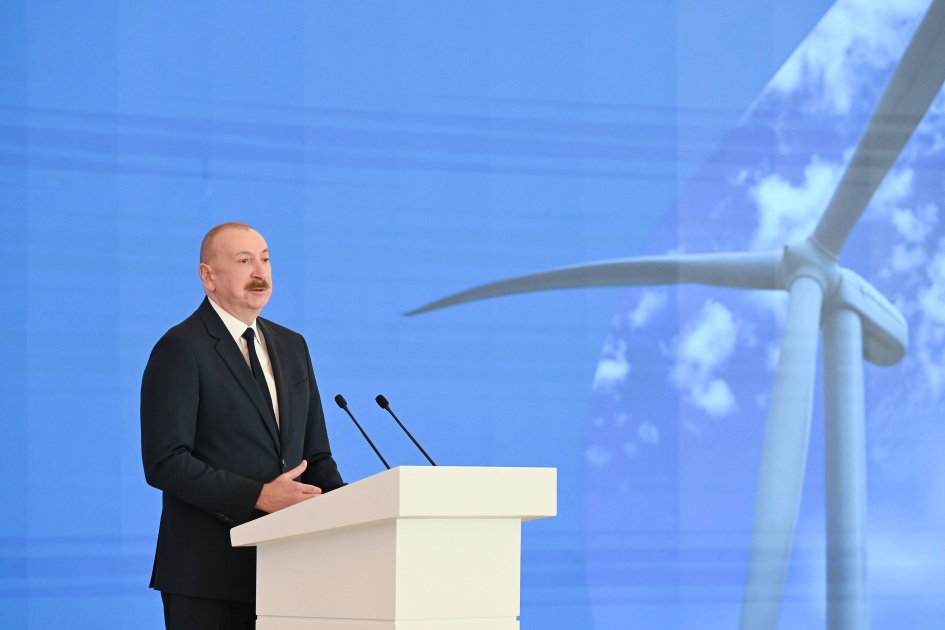
The 240-megawatt project was inaugurated on January 8 in Baku with the participation of President Ilham Aliyev and senior representatives of Saudi Arabia’s ACWA Power and China’s PowerChina.
Developed under an independent power producer model, the Khizi–Absheron plant consists of 37 turbines installed across the Absheron and Khizi districts and represents approximately $340 million in foreign investment. It is designed to generate approximately 1 billion kilowatt-hours of electricity annually, supplying power to more than 300,000 households. Official estimates suggest that the project will save around 220 million cubic meters of natural gas per year and reduce carbon dioxide emissions by over 400,000 tons.
Speaking at the inauguration ceremony, President Aliyev underscored that renewable energy has become a central pillar of state policy and a key instrument for modernising Azerbaijan’s energy system.
The launch of the Khizi–Absheron facility comes amid a broader reassessment of Azerbaijan’s long-standing reliance on oil and gas revenues. While hydrocarbons remain critical to fiscal stability and foreign policy leverage, Baku has increasingly framed renewable energy as a strategic response to structural constraints within the oil sector and to shifting global energy dynamics. Rather than a rupture with the past, the transition reflects a calibrated effort to reduce long-term dependence on fossil fuels while preserving energy security and export credibility.
For more than a century, Azerbaijan’s development trajectory has been shaped by “black gold.” From the oil boom of the late nineteenth century to the post-Soviet recovery anchored by the Azeri–Chirag–Gunashli (ACG) fields and the Baku–Tbilisi–Ceyhan pipeline, hydrocarbons underwrote state revenues, infrastructure expansion, and geopolitical standing. Oil income financed macroeconomic stabilisation in the 2000s, large-scale public investment, and post-conflict reconstruction after the 2020 war.
At the same time, this model embedded structural limits, tying growth prospects to production ceilings and market volatility. By the mid-2020s, these constraints became increasingly visible. According to the Ministry of Energy, Azerbaijan produced 27.7 million tons of oil and condensate in 2025, a 4.8 per cent decline from the previous year.
Natural gas has provided greater resilience and strategic flexibility. Azerbaijan remains a key supplier to European markets through the Southern Gas Corridor, exporting roughly 25 billion cubic meters annually and making $8.821 billion in revenues.
In January 2026, SOCAR began supplying natural gas to Austria and Germany via the Trans Adriatic Pipeline, expanding Azerbaijan’s gas exports to 16 countries – bringing the total number of European countries importing Azerbaijani gas to 12.
In this context, renewable energy has emerged as a strategic complement to hydrocarbons rather than a substitute. Expanding clean power generation enables Azerbaijan to free up natural gas for export, stabilise the domestic electricity supply, and adapt to tightening global climate and investment conditions.
By the end of 2025, installed renewable capacity reached approximately 1,829 megawatts, accounting for nearly one-fifth of total electricity capacity. Flagship projects such as the 230-megawatt Garadagh Solar Power Plant, developed with the UAE’s Masdar, have already demonstrated tangible results, producing over one billion kilowatt-hours of electricity and saving more than 110 million cubic meters of gas annually.
The Khizi–Absheron wind project builds on this momentum and illustrates Azerbaijan’s ability to attract large-scale foreign investment under predictable regulatory conditions. ACWA Power executives have repeatedly highlighted Azerbaijan’s investor-friendly environment and long-term strategic clarity.
In a January 2026 interview, ACWA Power Executive Director Mohammad Abunayyan described Azerbaijan as an emerging green energy hub linking the Caspian region with European markets. He noted that Baku’s approach prioritises economic viability and system balance over politically driven targets, enabling the integration of wind, solar, storage, and green hydrogen into a coherent national framework.
Looking ahead, Azerbaijan’s ambitions extend beyond domestic generation. By 2030, the government aims for renewables to account for at least 30 per cent of installed power capacity, with plans to commission six gigawatts of wind and solar power and expand further by the early 2030s.
The technical potential is substantial. Onshore renewable capacity is estimated at 135 gigawatts. In comparison, offshore wind resources in the Azerbaijani sector of the Caspian Sea are assessed at 157 gigawatts, placing Azerbaijan among the world’s most promising locations for large-scale wind development.
Crucially, Baku is also positioning itself as a regional exporter and transit hub for green electricity. The Black Sea Submarine Cable project stands at the centre of this strategy. Developed jointly with Georgia, Romania, and Hungary, the 1,155-kilometre cable will transmit up to 1,300 megawatts of renewable electricity directly to Southeastern Europe. The project received EU Project of Mutual Interest status in December 2025, strengthening access to financing and regulatory support, with completion targeted for 2032.
In parallel, Azerbaijan is advancing the Central Asia–Azerbaijan green energy corridor with Kazakhstan and Uzbekistan. Supported by the Asian Development Bank and the Asian Infrastructure Investment Bank, the initiative aims to channel surplus renewable electricity across the Caspian Sea toward European markets.
Agreements signed in April 2025 launched feasibility studies and grid integration efforts, reinforcing Azerbaijan’s ambition to act not only as an energy producer but as a system-shaping transit state.
Taken together, these initiatives reflect a strategic recalibration rather than a sectoral pivot. Azerbaijan is leveraging its hydrocarbon legacy, infrastructure, and geographic position to embed itself in future-oriented energy systems.
As President Aliyev noted at the Khizi–Absheron inauguration, national power generation capacity has nearly tripled over two decades to around 10 gigawatts, with the next phase defined by diversification and sustainability.
The transition from black gold to green power is therefore not a retreat from Azerbaijan’s energy identity but its evolution. Oil and gas laid the foundations of sovereignty and regional influence. Renewables now offer a pathway to preserve that influence under new global conditions.
If successfully implemented, Azerbaijan’s post-oil strategy will allow the country to remain an indispensable energy actor across Eurasia – not only as a supplier of hydrocarbons, but as a hub for clean power, connectivity, and long-term regional integration.