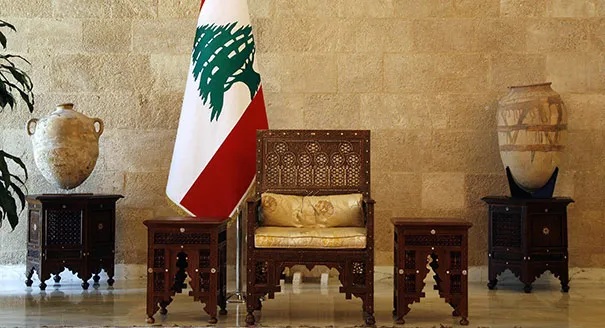
The Lebanese constitution was created in 1926 for a divided land, conceived as a solution to a fundamental challenge: how to build a unified state out of a deeply plural society. Its architects envisioned a system in which diversity would not lead to fragmentation but would instead be managed through representation, proportionality, and institutional balance. In theory, it was a model of coexistence: an attempt to transform sectarian difference into political stability.
By Nadia Ahmad
For a time, it worked, or at least appeared to. But nearly a century later, that promise feels increasingly out of reach. The Constitution has not collapsed; it has calcified. It continues to exist, but it no longer adapts.
In a region defined by rapid transformation and recurring shocks, Lebanon remains governed by a framework designed for a different era. The result is not stability, but stagnation.
The origins of a fragile balance
Drafted under the French Mandate, the Constitution combined elements of European constitutionalism with local political realities. It introduced separation of powers, civil liberties, and parliamentary governance. At the same time, it embedded sectarian identity within the state's structure.
This was not an accident—it was a compromise. By allocating political power along confessional lines, the system aimed to prevent domination by any single group. Yet in doing so, it also redefined politics. Representation became inseparable from identity, and governance gradually shifted from policy-making to power-sharing.
What began as a mechanism of protection evolved into a framework of limitation.
Power sharing and its limits
The confessional distribution of authority—Maronite President, Sunni Prime Minister, Shia Speaker—became the cornerstone of Lebanon’s political system. For decades, it provided a degree of predictability. Each community saw itself reflected in the state, and this visibility helped sustain a fragile equilibrium.
But equilibrium is not the same as functionality. As Lebanon’s internal dynamics evolved and regional pressures intensified, the system’s rigidity became increasingly apparent. Decision-making came to depend on consensus among actors whose interests often diverged fundamentally.
This is where the system begins to falter. Not because it fails outright, but because it slows everything down. Urgent reforms are negotiated into irrelevance. Strategic decisions are postponed indefinitely. Governance continues—but without direction.
Taif and the illusion of resolution
The Lebanese Civil War exposed the limits of the constitutional framework with devastating clarity. The Taif Agreement, which brought the war to an end, sought to correct imbalances by redistributing power and reinforcing parity between communities. It was presented as a solution, but in reality, it was an adjustment.
What allowed Taif to function was not only its internal provisions but also its external sponsorship. Syria, under a centralised and secular regime, acted as a decisive arbiter of Lebanon’s political order, while Saudi Arabia provided political backing and legitimacy. Together, they created an imposed equilibrium—one that stabilised Lebanon not through institutional strength, but through regional oversight.
That equilibrium has since disappeared.
The transformation of Syria, from a coherent state actor into a fragmented and conflict-ridden arena where jihadist dynamics have periodically emerged, has removed a critical stabilising force. Lebanon, once indirectly regulated by its larger neighbour, now finds itself exposed to the full weight of its internal contradictions.
The Constitution was never designed to function in this environment.
Leadership without leverage
Lebanon’s political leaders operate within a system that limits their capacity to act. Authority is dispersed, decisions require consensus, and consensus is increasingly difficult to achieve.
This does not produce balance—it produces hesitation. Major initiatives, whether economic reforms or strategic alignments, are often diluted before they are even implemented. Leadership becomes reactive, shaped by compromise rather than guided by vision.
The Constitution still performs one of its original functions: it prevents domination. But in doing so, it also prevents decisiveness. It protects the system from collapse, while quietly undermining its ability to function.
The evidence of this structural paralysis is not difficult to find. The 2006 war exposed delays in coordination and recovery. The financial collapse of 2019 was preceded by years of postponed reforms. Even today, critical issues such as energy development and maritime resources remain entangled in internal disagreements.
These are not isolated failures. They are symptoms of a deeper problem. The system does not break—it stalls. And in a region that does not wait, stalling carries its own risks.
Communities, not just institutions
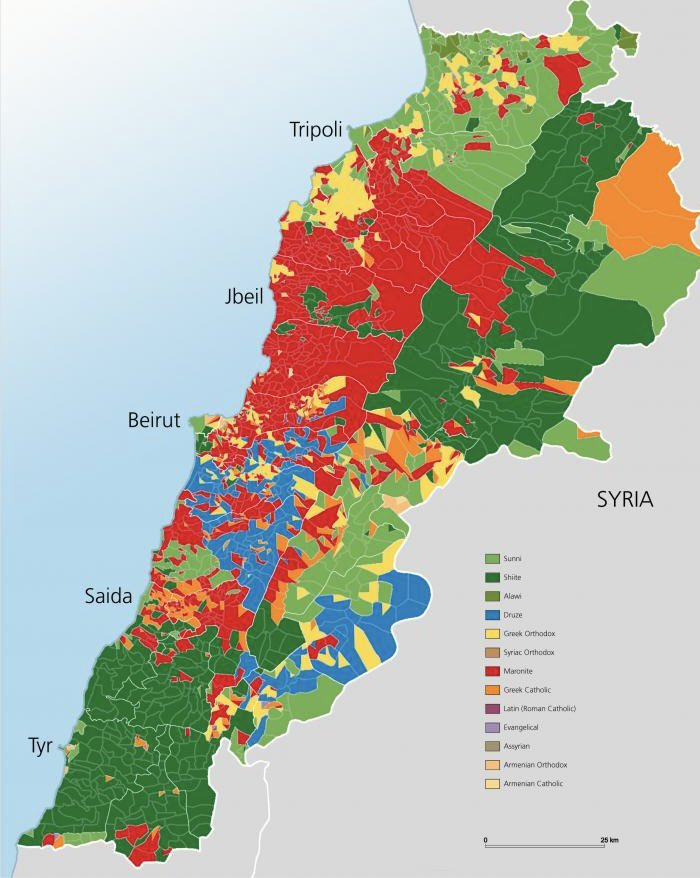
Any discussion of reform must take into account Lebanon’s social reality. Its communities do not simply participate in the system—they define it.
The Druze tradition tends toward balance and adaptability. Christian communities often emphasise continuity and representation. Sunni actors generally favour stronger central authority and clearer external positioning. Shia factions, particularly those aligned with resistance frameworks, operate within a broader regional logic.
These are not temporary positions. They are rooted in history, geography, and perception of threat. This is why reform is so difficult: it is not only about changing institutions, but about reconciling different visions of what Lebanon is—and what it should be.
Beyond Westphalia
Lebanon’s crisis can no longer be understood solely through constitutional analysis. It is now deeply geopolitical. The traditional Westphalian model—based on centralised sovereignty and clearly defined authority—no longer fully applies in the Levant.
Borders remain, but control is uneven. State authority exists, but it is often contested. Non-state actors operate across boundaries, and external alliances shape internal realities.
In such an environment, insisting on a purely centralised model of governance may no longer be realistic. What is required is not the abandonment of sovereignty, but its adaptation. A more viable approach may lie in a form of layered sovereignty:
A central state responsible for defence, currency, and international representation;
Decentralised governance structures managing local affairs and development;
Regulated external engagement that acknowledges security realities without dissolving national unity.
This is not fragmentation. It is an attempt to align political structure with geopolitical reality.
Reform as necessity, not choice
The question is no longer whether reform is needed, but whether it is still possible.
Constitutional adjustments could reduce the scope of sectarian veto power, allowing institutions to function more effectively while preserving representation. A formal doctrine of active non-alignment could provide Lebanon with a clearer strategic posture in a polarised region.
Decentralisation—whether described as federalism or administrative reform—could relieve pressure on central institutions and restore a degree of governance efficiency. None of these measures is simple. But the alternative is to continue the current trajectory.
A limited role for the outside world
External actors have long played a role in Lebanon, often in ways that complicate rather than resolve its challenges. Yet in the current context, a limited and carefully defined international role may be necessary.
This role should remain technical: facilitating dialogue, offering expertise, and encouraging timelines. The objective is not to impose solutions, but to make reform possible.
Reform cannot remain theoretical. It requires a process.
A credible starting point would be establishing a nationally representative dialogue body, supported by constitutional experts. Its task would be to draft targeted amendments focused on decentralisation and strategic neutrality.
Implementation would need to be gradual. Institutional reform, fiscal restructuring, and administrative adjustments cannot be imposed overnight. What matters is continuity and credibility.
Reform carries risks, but so does inaction.
Decentralisation may be perceived as fragmentation, yet without it, central paralysis is likely to persist. The presence of armed non-state actors remains a challenge, but without a functioning system, integration becomes even less likely.
Regional interference will not disappear. The question is whether Lebanon develops the institutional capacity to absorb it. Lebanon does not lack identity. What it lacks is a structure capable of sustaining it under pressure.
The Constitution, as it stands, reflects a different time—one in which regional balances, particularly the Syrian role alongside Saudi sponsorship of Taif, helped compensate for internal weaknesses. That environment no longer exists.
Today, Lebanon faces a choice. It can preserve a system that no longer functions or adapt it to a new reality. Adaptation will not be easy. It will require rethinking sovereignty, redistributing authority, and confronting deeply rooted assumptions. But without it, the cycle of paralysis will continue.
Lebanon has long been described as fragile. That may still be true. But fragility does not have to mean failure—if the structure is allowed to evolve.