Before Qur’anic verses were recited, the Arab body knew the mathematics of scarcity. It walked across horizons where water was rumour, and shade a negotiation. The sun disciplined the flesh before religion did. Yet beyond the arid Arabian dunes, there were lands with running rivers and fruitful soil – The Fertile Crescent.
By Nadia Ahmad
To the North and East of Arabia, the arteries of the Fertile Crescent flowed, the lands where orchards replaced thorn bushes, where grain grew taller than memory, where greenery interrupted endless monochrome sand. The desert soul knew of these places, imagined them, and dreamed in contrast.
Ramadan emerged within this geographical context of deep geological contrast. While the month of Ramadan did not invent hunger, it ritualised it; it did not create thirst, it sanctified it.
Time bends in Ramadan, as a society collectively enters controlled deprivation, not as an accident but through discipline. Even in cities, the memory of the desert is carried in Muslim bodies, where Islam was born.
The desert body
In the desert, hunger is not a metaphor; hunger is a climate. Before fasting was ingrained into theology, it was a geographic necessity. Across the Arabian Peninsula, survival of the fittest was limited to bodies trained to endure heat, thirst, and delayed sustenance. Water was distant, shade was conditional, and harvest uncertain. The desert does not permit impulsive consumption; it demands restraints.
In fasting from dawn to dusk, the “desert body” rehearses its origin. While in breaking fast at sunset, it tastes abundant as a promise – a fleeting echo of the Euphrates and Nile River it once gazed toward. Ramadan does not introduce deprivation to the desert body; it formalises it.
From dawn to sunset, thirst is no longer accidental and circumstantial – it is scheduled. Hunger is no longer a misfortune dictated by climate – it is ordained. During Ramadan, the body becomes a clock; time bends, days stretch, and evenings contract into communal release as a society collectively synchronises around restraint.
This is more than devotion; it is a form of temporal engineering. What was once imposed by the climate is now imposed by culture, and consecrated by Allah.
In this light, Ramadan can be read not only as a religious obligation but as the ritual preservation of ecological memory. The annual rehearsal of scarcity, which is Ramadan, is an ecological memory ritualised. Anthropologists have long observed that religious practices often encode environmental realities. In agrarian societies, harvest festivals mirror abundance. In river civilisations, purification rituals centre on water. In arid societies, ritualised abstinence mirrors the barren climate.
Fasting as cultural muscle
When practised collectively, fasting produces psychological effects: heightening self-control, group cohesion, group awareness of time, and highlighting the distinction between sacred and ordinary time. The disciplined body becomes a social unit; the synchronised community becomes a coordinated organism.
Throughout history, disciplined populations have proven easier to mobilise – whether for defence, migration, reform, or expansion. This is a phenomenon not unique to Islam. Medieval Christian Lent cultivated similar rhythms of abstinence and penitence across Europe.
Ritual creates muscle memory, which can later serve multiple ends. Religion and religious practice do not determine how discipline will be used; political leadership does.
Dreaming of Water
The desert imagination was never centred around endurance alone; it was also about longing. The Qur’anic imagery of gardens beneath which rivers flow resonates powerfully in a landscape where rivers are rare. The contrast between aridity and fertility shaped spiritual symbolism.
The Arabian Peninsula sits adjacent to the Fertile Crescent – a land of rivers, orchards, and settled agriculture. The desert mind inevitably imagined greenery when such stark contrast was observed and experienced.
Longing does not automatically translate into conquest. But ecological contrast shapes aspiration. Where scarcity dominates daily life, abundance requires moral radiance.
Closed time and political appropriation
At sunset, the entire population rises as though summoned by a silent command, an army of bodies and minds moving in unison, disciplined, synchronised, and inexorable. To an outside eye, the coordination is a striking spectacle. An uncanny living rhythm of obedience that hints at the power of ritual to organise not just bodies but to shape and condition collective will.
Ritual fasting operates within sacred time – a recurring, cyclical interruption of ordinary life. When religious time becomes “closed” – oriented toward final truths and revelations, ultimate victory, or definitive historical missions – it can be absorbed into political narratives.
Rituals themselves are not inherently imperial, but ritualised discipline can be politically harnessed. This distinction is crucial.
For many non-Muslim Europeans, shaped by cultures that prize individual autonomy over collective rhythm, such synchronisation can feel disquieting; the sight of millions responding to a single sacred signal, “Al Azan,” may evoke not only fascination but suspicion. Serving as a reminder that ritualised discipline, when internalised at such a scale, creates forms of solidarity and mobilisation unfamiliar to liberal societies.
The double-edged sword of scarcity
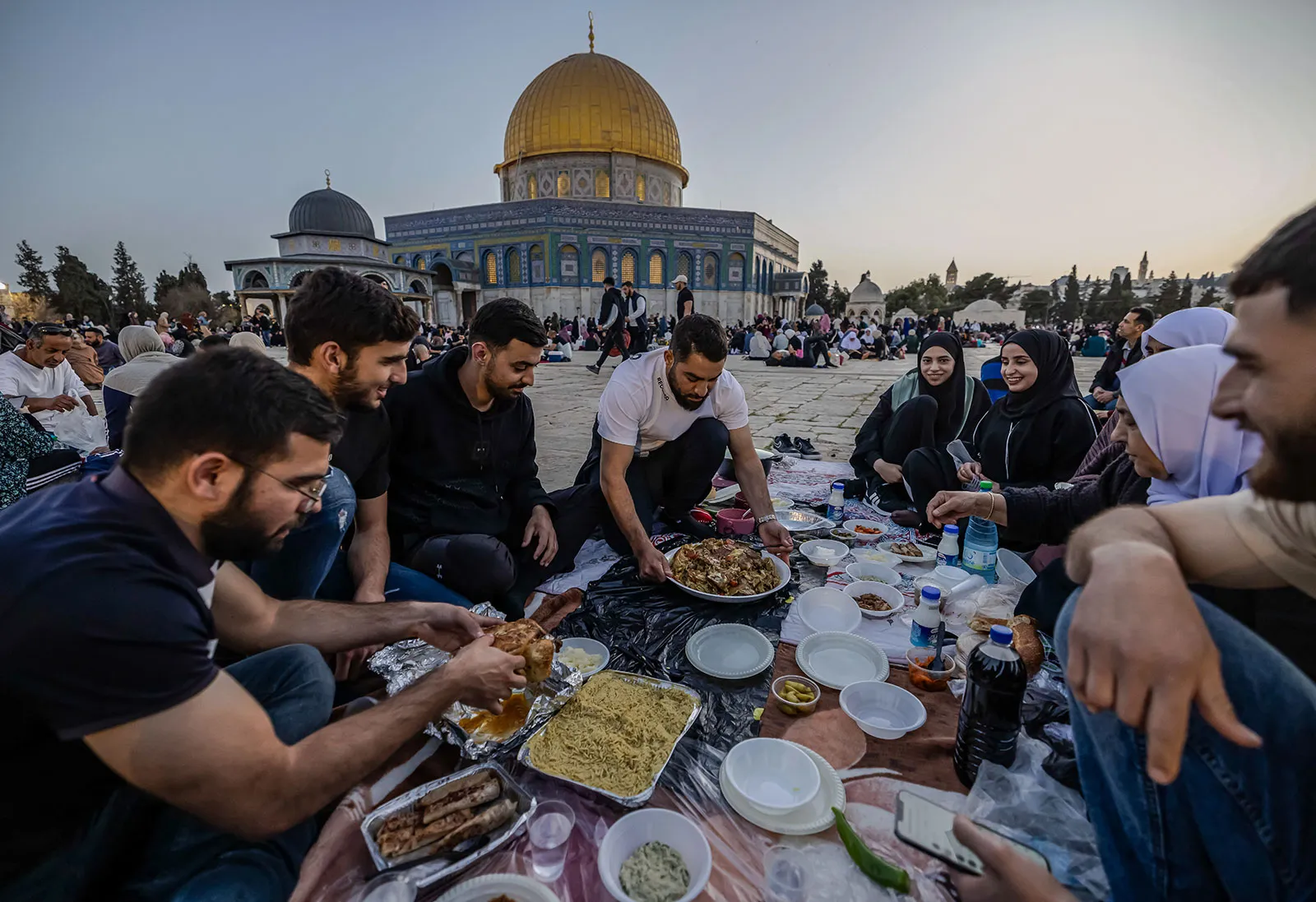
Ramadan preserves a desert ecology within modern cities. Even in the context of urban abundance, the body rehearses thirst. This rehearsal produces empathy for the poor, charity, and communal solidarity. It also produces resilience under hardship – a trait valuable in times of conflict or expansion.
Scarcity ritualised becomes identity. Identity mobilised becomes history. Ritualised hunger is never politically neutral; when an entire society disciplines itself according to a synchronised sacred calendar, it is not only rehearsing memory; it is rehearsing obedience to a temporal authority. Sacred time reorganises economic rhythms, sleep cycles, social gatherings, and public space. It teaches populations to internalise command through devotion rather than coercion.
History shows that such synchronisation – whether in the medieval Christian Kingdom of Kent, revolutionary France, or early Islamic nations- policies can create a population accustomed to coordination around shared signals.
The question is not whether fasting is authentic, but whether sacred time is used as infrastructure for social or political direction (for example, many have observed that jihadists often use Ramadan for their deadly attacks).
Observed from afar, these patterns of discipline are striking and reveal how human bodies (Muslim bodies in this context) can be shaped to align with collective temporal agendas.
Between spiritual death and spiritual use
Analysing Ramadan anthropologically does not diminish its spiritual meaning for believers. It is to recognise that religious forms emerge within ecological contexts and later interact with political realities.
The desert body did not disappear with modernisation; it was ritualised, preserved, and transmitted. The question for contemporary societies is not whether fasting disciplines populations; it does. The question is how that discipline is framed:
As compassion? As introspection? As communal cohesion? Or as a historical mission? Religious time can remain open – a recurring ethical recalibration, or it can be closed, bent toward a singular narrative of destiny. The direction is not decided by climate; it is decided by interpretation.
Memory without instrumentalisation
Ramadan may be understood as the cultural preservation of ecological memory – the desert teaches the body patience. That memory can cultivate humility, solidarity, and resilience. Whether it becomes a tool of empire or an exercise in compassion depends not on the fast itself, but on the stories society attaches to it. Hunger is an ancient experience; what we do with hunger is historical.
A civilisation that remembers hunger must decide whether it fasts to conquer history or humanise it.