Some societies understand themselves through victory, and others through defeat. The latter tend to be more stable. Victories age quickly; they become ceremonial, decorative, something to commemorate. Defeats, by contrast, endure. They remain morally active. A defeat can function for centuries as a foundational truth.
By Rafael Baroch
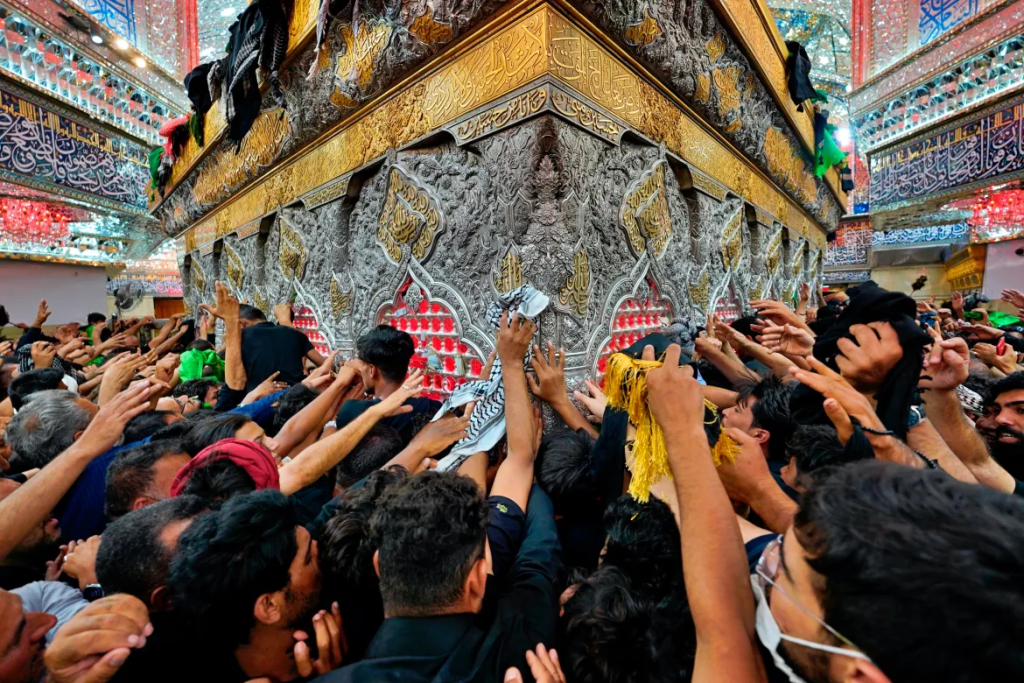
Shiism (Shiah Islam) may be the most striking example of a civilisation organised around such a defeat. The Battle of Karbala in 680 CE, where Husayn ibn Ali—grandson of the Prophet—was killed by the forces of Yazid I, is not merely a historical event. It has become a permanent moral compass.
For Shiites, Karbala is not a closed chapter. It is a lens. History is read as a repetition of the same conflict: a small group of the righteous against a powerful but corrupt ruler. Husayn versus Yazid. The martyr versus the tyrant. Each era redraws the conflict with new names, but the moral structure remains unchanged.
As the Iranian-American scholar Hamid Dabashi has shown, Karbala functions in Shiite thought not merely as memory, but as a permanent interpretive framework—an archetypal schema through which every political struggle can be understood as a confrontation between a righteous minority and tyrannical power.
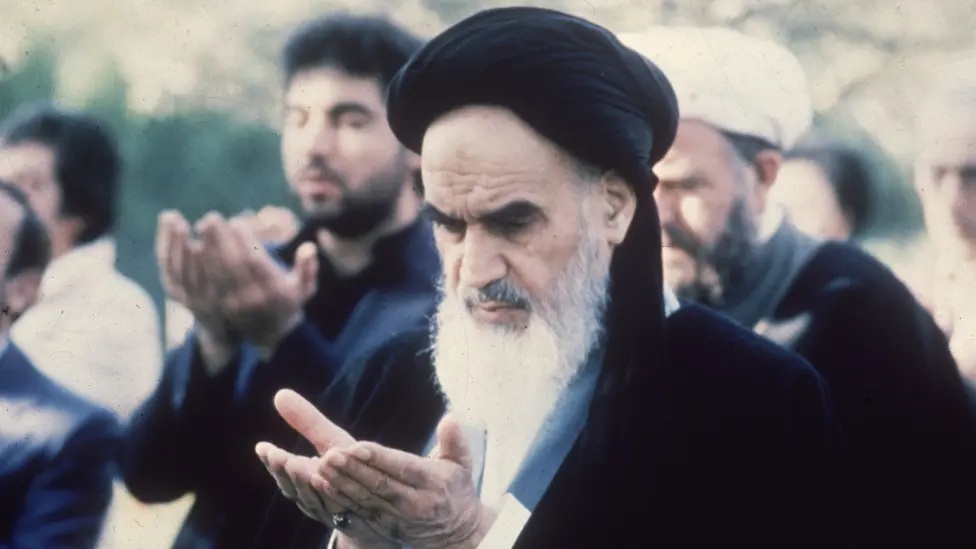
Listening to the rhetoric of the Islamic Republic of Iran, one sees how this schema becomes political. Under the rule of the late ayatollah Ruhollah Khomeini, Karbala ceased to be only a religious symbol and became the foundation of a revolutionary political Islam. Husayn’s story became a model for resistance against tyranny and a source of legitimacy for political struggle.
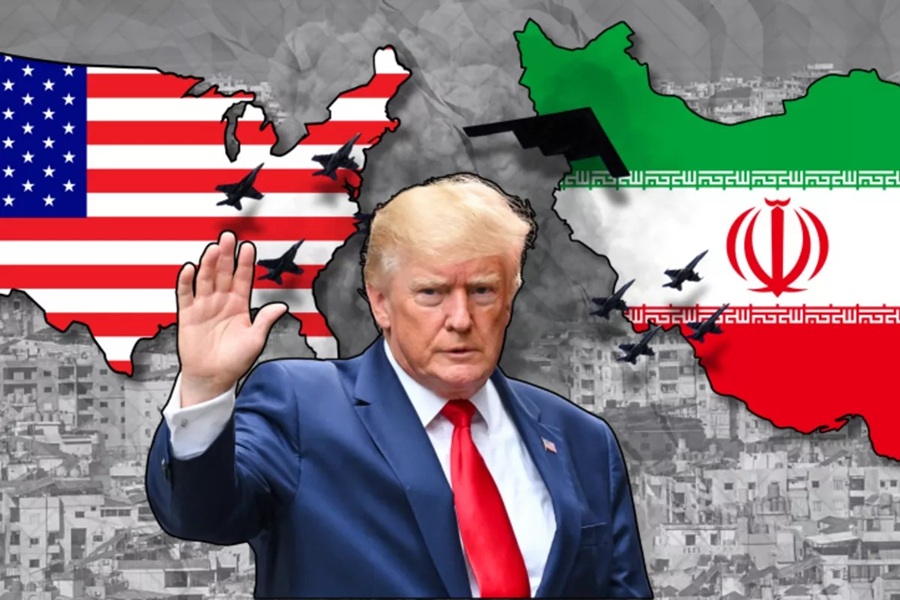
The categories remained the same; only the names changed. The oppressed are now Iran and the “peoples of the world.” The oppressors are the United States, the “Great Satan”, and Israel, the “Little Satan.”
Within such a worldview, everything finds its place. Economic hardship, social unrest, water shortages, inflation—all are absorbed into the same narrative. When conditions deteriorate, this does not suggest internal failure. It confirms that the enemy is active.
The narrative becomes self-sealing: it cannot be refuted, because refutation itself is already anticipated and neutralised.
When one turns to contemporary Western politics, a similar structure begins to emerge. The modern progressive worldview has its own founding moments. Not Karbala, but colonialism, slavery, and imperialism. Not Husayn, but the anonymous mass of the oppressed.
Here, too, the world is divided. On one side, the oppressed: minorities, former colonies, refugees, marginalised groups. On the other hand, the oppressors are colonialism, capitalism, patriarchy, and white hegemony.
Political problems are no longer primarily analysed in terms of interests, institutions, or historical contingency. They are interpreted through a moral schema. Climate crisis? Capitalism. Economic inequality? Colonial structures. Geopolitical conflict? Western imperial legacies.
The terms differ, but they point to the same underlying role: the oppressor. In many progressive analyses, that role ultimately acquires a single name: the West. Not as a geographical designation—that would be too crude—but as a moral category. The West becomes the embodiment of wealth, power, and historical dominance, and therefore the natural bearer of guilt.
Just as the United States and Israel assume the role of Yazid in Iranian revolutionary rhetoric, so “the West” appears here as the historical antagonist. Not merely one powerful actor among others, but the source from which much of the world’s injustice is said to have emerged—and from which, it is assumed, it continues to flow.
It is an appealingly coherent story. And like all coherent stories, the problem begins precisely there.
It makes the world legible. Where inequality exists, there must be an oppressor. And where an oppressor is required, the candidate is already waiting: wealthy, historically dominant, politically visible.
The diagnoses may vary—climate, migration, economic inequality, geopolitical conflict—but the suspect remains remarkably consistent.
And like any effective moral narrative, this one comes with fixed roles. Victims who speak with moral authority. Oppressors who speak under the weight of guilt. And a history that is no longer examined, but presented as evidence.
This does not mean that colonialism or imperialism are irrelevant. On the contrary. But their function changes when they shift from historical explanation to a totalizing framework. History ceases to be a complex field of causes and becomes a moral drama.
What both systems share is their political appeal. They offer clarity. They provide identity. They tell people where they stand—and who stands on the wrong side.
They also provide something politics rarely offers so efficiently: moral certainty. To be a victim is to possess a form of legitimacy. One’s words carry greater weight. One’s motives are less easily questioned. One’s failures are more readily explained as the result of structural oppression.
This does not mean victimhood is fabricated. It means it becomes a political category—a source of authority that is structurally resistant to challenge.
The problem arises when a society comes to understand itself permanently in those terms.
In revolutionary Shiite ideology, Karbala never ends. Each generation must choose between Husayn and Yazid. The struggle cannot conclude, because the world remains divided between oppressor and oppressed—and that division is constitutive of identity itself.
Something similar emerges when political identity is built entirely around historical structures of guilt. The struggle becomes potentially endless. Racism cannot disappear because the system must continue to produce it. Colonialism cannot truly end, because it persists as a structuring principle of the present.
Politics becomes a perpetual reenactment of the original conflict.
The irony is that systems presenting themselves as emancipatory often produce a remarkably static worldview. They offer a clear moral framework, but little room for historical change. Progress itself becomes suspect, because it threatens to soften the very antagonism on which the narrative depends.
This is not an argument for historical nihilism—as if injustice never occurred or left no trace. Karbala was a killing. Colonialism was a crime. Slavery was a systematic injustice. The question is not whether these facts matter, but how they function politically.
The distinction between historical explanation and totalizing moral framework is crucial. In the first case, the past provides insight: it helps explain how inequality emerged and how it might be addressed. In the second, the past becomes constitutive of identity: it defines who one is and who one stands against.
That makes politics no less intense—but far less flexible.
Once assigned the role of oppressor or victim, one tends to remain in that role. And a society that organises itself around those roles finds it increasingly difficult to change—even when circumstances demand it.
Here, perhaps, lies the real parallel.
Not because Shiism and progressivism are the same, that would be historically careless and intellectually cheap, but because both reveal how powerful a political narrative can become when it anchors itself in a sacred origin of injustice.
From that moment on, history becomes a tribunal. The past is no longer a source of understanding, but a reservoir of accusations.
In the Shiite universe, that tribunal is called Karbala.
In the progressive universe, it bears different names, but the logic is the same. Karbala still lives: in the rhetoric of Tehran, in the streets of Baghdad, in the theology of martyrdom.
And in the West, history is increasingly treated as if it happened yesterday: not to understand it, but to judge it again, and again, and again.