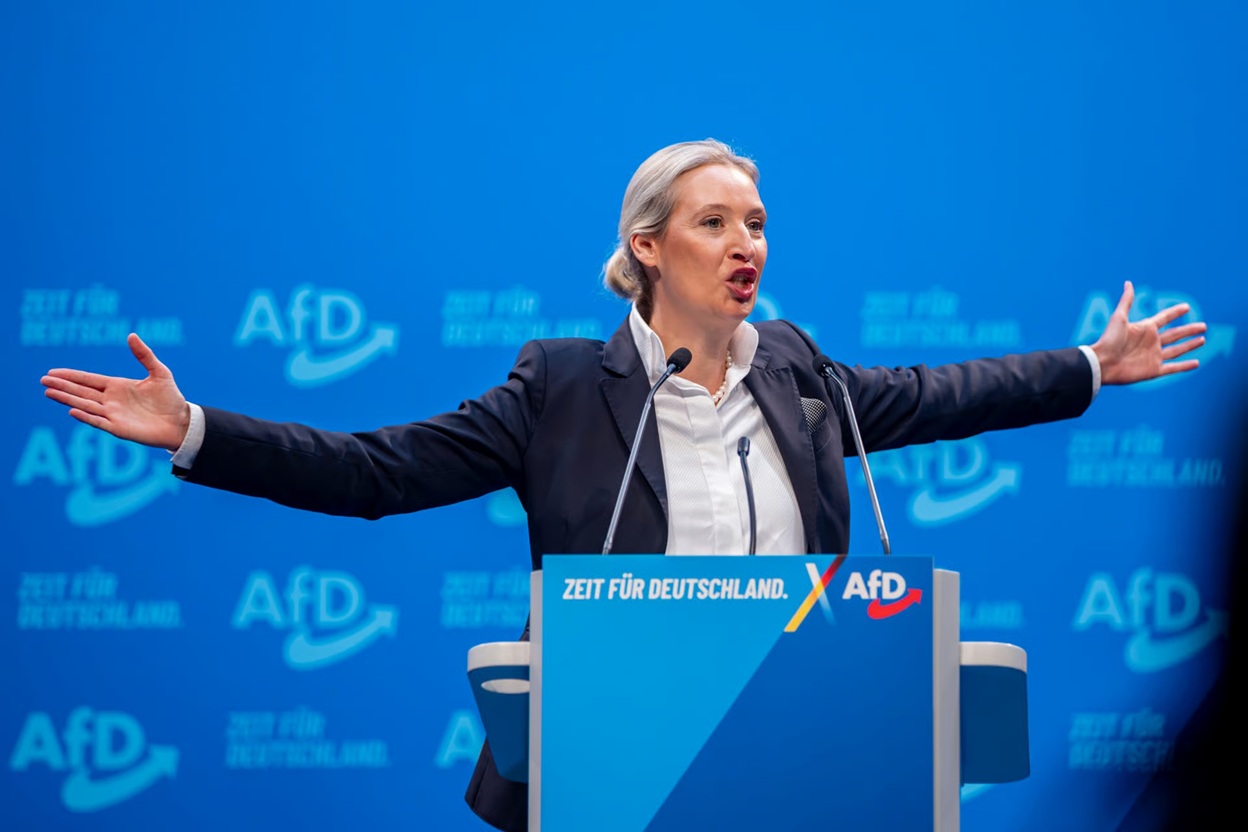
Europe was governed for decades by parties that believed history had already chosen them. Then the voters discovered that history had not. Across Europe, the old political order has been losing something more important than elections: the authority to define what Europe is allowed to be.
By Rami Audi
Traditional parties that once seemed almost permanent have watched their electorates drift toward movements they once dismissed as populist, nationalist, reactionary, or dangerous. The labels have changed. The phenomenon has not. Something deeper is happening.
The European voter is not simply rebelling against a particular tax policy, migration figure, coalition agreement, or Brussels regulation. He is asking a more uncomfortable question: What exactly is being preserved here?
A political system can survive losing an election. It becomes vulnerable when the people it governs begin to suspect that those governing them no longer believe in the civilisation they inherited. That suspicion has been growing.
Europe spent much of the last generation learning to distrust the language of belonging. National pride became suspect. Borders acquired a moral stigma. Historical memory was increasingly approached through the vocabulary of guilt. Cultural continuity was sometimes treated as a disguised form of exclusion.
At the same time, the language of universalism became stronger. Every human being was said to possess equal dignity; a proposition that belongs among the great achievements of Western moral thought. But somewhere along the way, we lost a distinction. Universal human dignity does not mean that civilisations are interchangeable.
A German, a Frenchman, a Pole, a Greek, a Spaniard, an Italian, or a Dutchman does not cease to have a particular historical inheritance merely because humanity is universal. The universal and the particular were never enemies.
Indeed, much of what the modern West calls universal was first cultivated in particular places, through particular histories, institutions, arguments, religions, revolutions, wars, and generations of human beings. This is the paradox at the centre of the contemporary European crisis.
The West became so determined to prevent its particular inheritance from becoming an excuse for domination that it sometimes began to speak as though having a particular inheritance were itself a moral problem. It is not.
A civilisation is not a race. It is not a bloodline. It is not a genetic possession. It is a historical inheritance.
The West is Rome and Athens. It is Jerusalem and the Christian transformation of Europe. It is the medieval university, the Reformation, the scientific revolution, the Enlightenment, constitutional government, individual rights, national traditions, literature, art, philosophy and the extraordinary idea that political power itself must answer to a law higher than the ruler. It is also a contradiction.
The West has committed terrible crimes. It has conquered, exploited, persecuted and destroyed. It has repeatedly violated the principles it later proclaimed. But this does not invalidate the civilisation.
A civilisation does not become mature by pretending its history contains no darkness. It becomes mature by possessing enough confidence to confront its darkness without concluding that the entire inheritance must therefore be rejected. This is where Europe has begun to confuse self-criticism with self-cancellation. There is a difference.
Self-criticism says: We have failed our principles. Self-cancellation says: Our principles are themselves evidence that we were wrong to exist as we did. The first is moral seriousness. The second is civilizational exhaustion.
And perhaps this explains more about the rise of Europe's new right than many commentators are willing to admit. The new right did not emerge in an intellectual vacuum.
It emerged after millions of Europeans began to feel that certain questions could no longer be asked honestly within the old political vocabulary.
How much immigration can a society absorb while maintaining cultural continuity? What is the purpose of a national border? Does a state owe special obligations to its own citizens? Can integration succeed without assimilation into at least some common civic culture? Can a society preserve liberal values while simultaneously abandoning the historical culture through which those values developed?
These are not inherently extremist questions. They are questions of political philosophy.
Yet when legitimate questions are treated as illegitimate merely because uncomfortable people ask them, politics does not become more moderate. It becomes more radical.
The old establishment often made another mistake. It assumed that voters dissatisfied with rapid social change could be persuaded simply by being told their concerns were morally inferior.
But people do not abandon their sense of belonging because a television commentator calls them backwards. Quite often, they become more determined.
The result is the strange political landscape now visible across Europe: parties once considered marginal increasingly influence governments, coalitions, and national debates, while traditional parties discover that the political centre they thought they owned has moved beneath their feet.
The old order's instinct is often to describe this as a democratic emergency. Perhaps sometimes it is. But there is another possibility. Perhaps it is partly a democratic correction. Democracy is not merely the right to choose among parties that already agree on the boundaries of permissible thought. It is also the mechanism through which citizens can tell an establishment that its assumptions are no longer theirs.
That does not mean every demand of the new right is wise. It does not mean nationalism is always benign, immigration is always harmful, or progressive politics is always mistaken. The point is more fundamental:
A political movement should be judged by the arguments it makes, not merely by the social status of the people who make them.
The old establishment's greatest weakness may therefore be psychological rather than electoral. It became convinced that history was moving in one direction. More integration. More mobility.
More immigration. More cultural fluidity. Less nationalism. Less religion. Less attachment to inherited identities.
And anyone who resisted this movement was assumed to be resisting the future itself. But history has never been so obedient. Human beings remain stubbornly attached to place, memory, language, family, tradition and collective identity.
Modernity did not abolish these things. It merely made intellectual elites less comfortable talking about them. And now they have returned to politics.
This is why the European border has become such a powerful symbol. A border is not merely a line on a map. It answers a philosophical question: Who is responsible for whom?
A political community cannot have unlimited obligations without eventually discovering that the concept of political community itself has become meaningless.
Hospitality is a virtue. But a state is not a hotel. Compassion is a virtue. But government must also maintain order. Human rights are universal. Political responsibility, however, remains organised largely through particular communities.
Europe's challenge is not to choose between humanity and identity. It is to understand how they can coexist.
This is also where the European right can make either its greatest contribution or its greatest mistake.
If it merely replaces progressive dogmas with conservative dogmas, it will eventually reproduce the same intellectual emptiness it opposes. A civilisation cannot be renewed by nostalgia alone.
The right must therefore answer a question of its own: What is the West for? Not merely what is it against. Not against immigration. Not against Brussels. Not against the Left. Not against globalisation. Those are political positions, not civilizational purposes.
A serious European conservatism must be capable of saying what it intends to conserve — and why. It must defend national sovereignty without turning nationalism into mythology. It must defend borders without confusing foreigners with enemies.
It must defend Christianity and Europe's religious inheritance without pretending that Europe can return to a vanished age. It must defend liberal democracy without becoming ashamed of the civilisation that created and developed its institutions.
Above all, it must recover the distinction between pluralism and nihilism. Pluralism says that different people may live differently. Nihilism says that ultimately nothing is worth defending strongly enough to distinguish.
The first is compatible with civilisation. The second eventually consumes it. This is why the European political revolt deserves to be taken seriously even by those who dislike the parties leading it. Voters moving away from traditional parties are not necessarily demanding an authoritarian Europe.
Many are demanding something much simpler: recognition. Recognition that their homes have histories. Recognition that borders have purposes. Recognition that culture matters. Recognition that citizenship means something. Recognition that political communities cannot survive indefinitely on administration alone. And recognition that being proud of one's civilisation does not automatically mean believing that someone else's civilisation is inferior.
The West once possessed an extraordinary confidence in the possibility of combining particular belonging with universal principles. That confidence produced some of its greatest achievements.
Today, however, Europe sometimes seems trapped between two fears: the fear of becoming intolerant and the fear of appearing insufficiently tolerant. The result is paralysis.
But tolerance was never supposed to mean that a society must become indifferent to its own survival. Liberalism was never founded on the proposition that every tradition is equally true. It was founded, in part, on the recognition that human beings disagree about truth and therefore require institutions capable of protecting freedom amid disagreement. That requires convictions.
A civilisation without convictions cannot remain liberal for very long.
It will eventually become either authoritarian or nihilistic — because when citizens no longer share enough beliefs to sustain institutions, institutions themselves become empty containers.
Europe's political upheaval may therefore be less mysterious than it appears. The old parties promised management. The new movements promise belonging. Whether they can deliver something worthy of that promise remains to be seen.
But the question they have forced back into European politics is one many intellectuals have avoided for too long: What is Europe? And beneath it lies an even more uncomfortable question: Does Europe believe what it is deserves a future?
If the answer is yes, Europe does not need to become less democratic, less tolerant, or less open. It needs to become less afraid of itself.
It can acknowledge its failures without despising its inheritance. It can welcome outsiders without pretending that borders have no meaning. It can believe in universal human dignity without declaring its own historical identity illegitimate. It can change without surrendering continuity.
Because a civilisation does not survive by freezing itself in the past, it survives by giving its inheritance to another generation. And perhaps that is the real crisis facing the West. Not that it has forgotten how to rule. Not even that it has forgotten how to prosper.
It has begun to forget that it is supposed to have heirs.