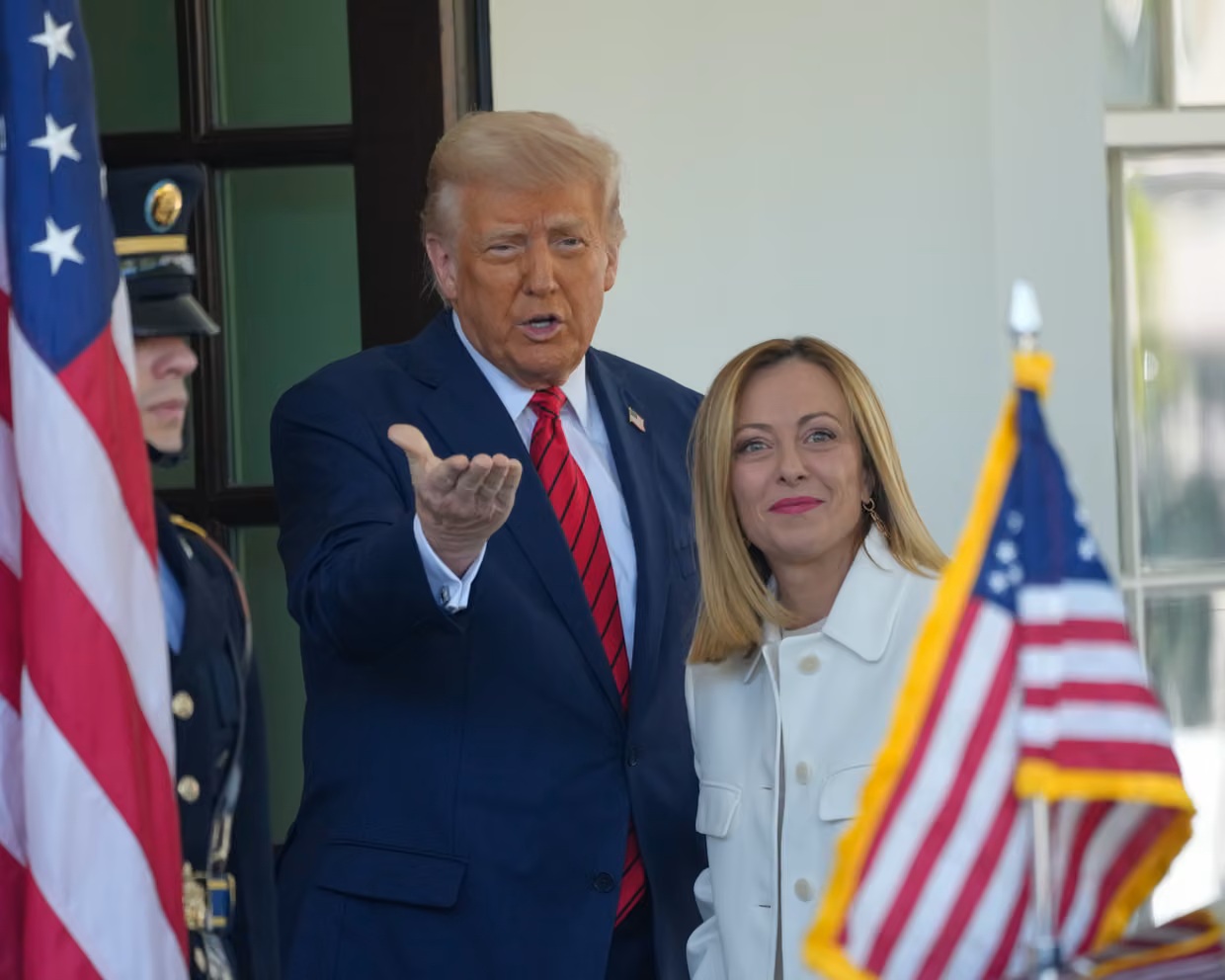
The photograph should have been unremarkable. Two smiling leaders stood side by side during the G7 summit, posing for the cameras as politicians have done thousands of times before. Yet within days, that image had become the centre of an unusually bitter transatlantic quarrel. Donald Trump claimed that Italy's Prime Minister Giorgia Meloni had insisted on taking the picture. Meloni answered with a sentence that travelled across Europe almost as quickly as Trump's remark.
By Nadia Ahmad
"Neither I nor Italy ever beg" was more than a denial. It was a statement of national pride. Diplomacy often collapses over borders, trade agreements or military alliances. Rarely does it stumble over a photograph.
Yet that brief exchange revealed something much deeper than a disagreement between two conservative leaders. It exposed a simple political reality that many had chosen to ignore: even the closest ideological allies eventually collide when each is determined to put his or her own country first. Only months earlier, the story had looked very different.
When Donald Trump returned to the White House, Giorgia Meloni appeared to be his natural partner in Europe. She was the only European leader to attend his inauguration, a symbolic gesture that many interpreted as proof that Rome enjoyed a privileged relationship with Washington. Across conservative circles, commentators spoke of a new transatlantic axis linking Trump's America with Meloni's Italy.
The similarities were obvious. Both built their political careers by challenging established elites. Both promised stronger borders, greater national sovereignty and a reduced dependence on distant bureaucracies.
Both appealed to voters who felt that globalisation had weakened their countries and that national identity deserved to be defended rather than apologised for. For many supporters on both sides of the Atlantic, the partnership almost seemed inevitable.
It was an attractive political story. After years in which European conservatives often found themselves at odds with Washington, here were two leaders who appeared to speak the same political language. They criticised uncontrolled migration, questioned old assumptions about globalisation, and presented themselves as defenders of ordinary citizens against political establishments that had lost touch with reality.
Photographs reinforced the narrative. Warm meetings, friendly smiles and mutual praise created the impression that Europe had finally found an American president who genuinely understood its new conservative movement.
But politics has always been less sentimental than photography.
Friendship between leaders may produce memorable images, yet governments are rarely guided by personal chemistry alone. Every prime minister eventually discovers that campaign slogans become more complicated when they encounter the realities of power. Every president learns that allies remain sovereign states, not political supporters. The first real test came not through speeches but through war.
As tensions in the Middle East escalated and Washington sought broader military cooperation, Italy faced a difficult choice. Supporting an ally is one thing. Becoming directly involved in another regional conflict is something entirely different. Rome chose caution, invoking constitutional limits and declining requests that would have drawn Italy more deeply into the crisis.
From Washington's perspective, such hesitation could easily appear disappointing. From Rome's perspective, it was simply the responsibility of an Italian government elected to defend Italian interests before anyone else's.
That was the moment when two powerful slogans quietly collided. America First and Italy First. For months, they had sounded almost identical. In practice, they were never destined to produce identical decisions. That contradiction is often overlooked by those who mistake ideological sympathy for strategic unity.
History is full of leaders who admired one another yet found themselves divided the moment national interests pulled them in different directions. Political chemistry can open doors, but it cannot erase geography, constitutional limits or domestic public opinion. Every leader ultimately answers to voters at home, not to friends abroad.
Trump has built his political identity around a simple promise: America will never apologise for putting itself first. It is the principle that has shaped his approach to trade, alliances, immigration and foreign policy. His supporters admire him precisely because he refuses to subordinate American interests to international expectations.
Meloni rose to power on a remarkably similar promise. For years, she argued that Italy should recover its confidence, defend its borders and speak with its own voice rather than merely echo the consensus emerging from Brussels. Like Trump, she turned patriotism into a governing philosophy rather than an election slogan.
The irony is impossible to miss. The very ideas that initially brought the two leaders together are now producing friction between them. If both genuinely believe their countries come first, moments of disagreement are not signs of betrayal. They are almost inevitable. That helps explain why the dispute over a simple photograph resonated so strongly.
Trump's remark that Meloni had "begged" for a picture may have been intended as humour, political theatre, or personal bravado. Trump has always enjoyed dominating the political stage through exaggeration, often treating public appearances as extensions of his campaign rallies.
But what works before an American audience does not necessarily translate across the Atlantic.
Meloni understood immediately that the issue was no longer about her. It had become about Italy. By answering, "Neither I nor Italy ever beg," she shifted the conversation from personal pride to national dignity. She was not merely correcting Trump's version of events; she was reminding both Italians and Europeans that alliances should never require humiliation.
That response explains why many Italians, including people who do not support Meloni politically, viewed her words positively. At that moment, she was seen not simply as the leader of a conservative government but as the representative of the Italian state. The relationship then entered a more delicate phase.
Neither Washington nor Rome has any interest in turning disagreement into open hostility. The United States remains Italy's most important strategic ally outside Europe, while Italy remains one of America's key partners in the Mediterranean. Security cooperation, intelligence sharing and NATO commitments are far too significant to be sacrificed over personal disputes.
Yet politics is not governed only by institutions. Symbols, perceptions and public narratives also shape it. When Trump later posted another pointed message about Meloni ahead of the NATO summit, critics in Italy interpreted it as another unnecessary public slight. Supporters of the Italian prime minister argued that Washington's tone was becoming increasingly dismissive toward one of its closest European partners.
Whether that interpretation is entirely fair is almost beside the point. In politics, perception often matters as much as reality. Once trust begins to erode, every joke sounds sharper, every disagreement appears larger, and every public gesture acquires a meaning that might never have existed before.
Perhaps that is the strangest aspect of the Trump-Meloni relationship. It is neither a friendship nor a rivalry. It is something in between—a partnership built on shared convictions but constantly tested by competing responsibilities.
That may ultimately be the defining paradox of the new conservative movement on both sides of the Atlantic.
For decades, political commentators assumed that leaders sharing the same ideological language would naturally move in the same strategic direction. Trump and Meloni have demonstrated that this assumption has limits. National conservatism may create common values, but it also strengthens national priorities. And national priorities do not always point in the same direction. That is not necessarily a sign of failure.
In many ways, it is exactly what both leaders promised their voters. Americans elected Donald Trump to defend American interests, not Italy's. Italians elected Giorgia Meloni to defend Italy's interests, not Washington's. When those interests overlap, cooperation comes naturally. When they diverge, tension becomes unavoidable.
Perhaps that is why the recent disagreements feel so unusual. They are taking place not between ideological opponents, but between two politicians who often agree on the larger questions shaping the Western world: border security, migration, national sovereignty and the need to reconnect politics with ordinary citizens.
Yet governing is always more demanding than campaigning. Campaign slogans are broad enough to unite people. Government decisions require choosing between competing interests, weighing risks and accepting that every choice has consequences. A leader praised at home for defending national interests may be criticised abroad for doing the same thing.
The Trump-Meloni relationship is therefore becoming something larger than a personal story. It offers a glimpse into the future of relations between the United States and the new generation of conservative governments in Europe. Warm words and ideological affinity will continue to matter, but they will no longer be enough. The real measure of these relationships will be how they withstand moments when allies disagree without allowing disagreement to become estrangement.
That is a challenge every alliance eventually faces.
History remembers many political friendships that faded because leaders confused personal rapport with strategic permanence. The strongest partnerships are not those without disagreements, but those capable of surviving them.
The photograph that sparked the latest controversy will eventually be forgotten. Another summit will produce another handshake, another smile, another carefully choreographed image for the cameras.
What will matter far more is whether both leaders can look beyond the headlines and recognise a simple political truth: two governments built on the promise of putting their own countries first will sometimes walk side by side, and sometimes choose different paths.
There is no contradiction in that. It is the natural consequence of taking national sovereignty seriously. Perhaps the real surprise was never that Donald Trump and Giorgia Meloni began to disagree. The real surprise was that so many people believed America First and Italy First could travel together indefinitely without eventually reaching a crossroads.