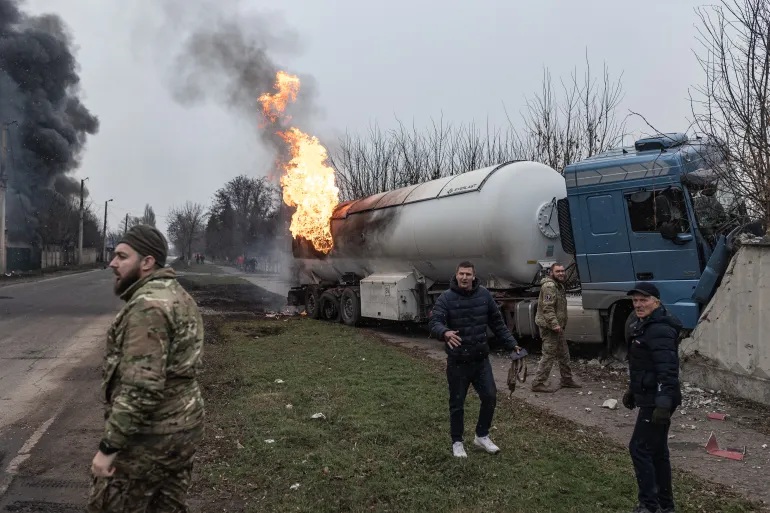
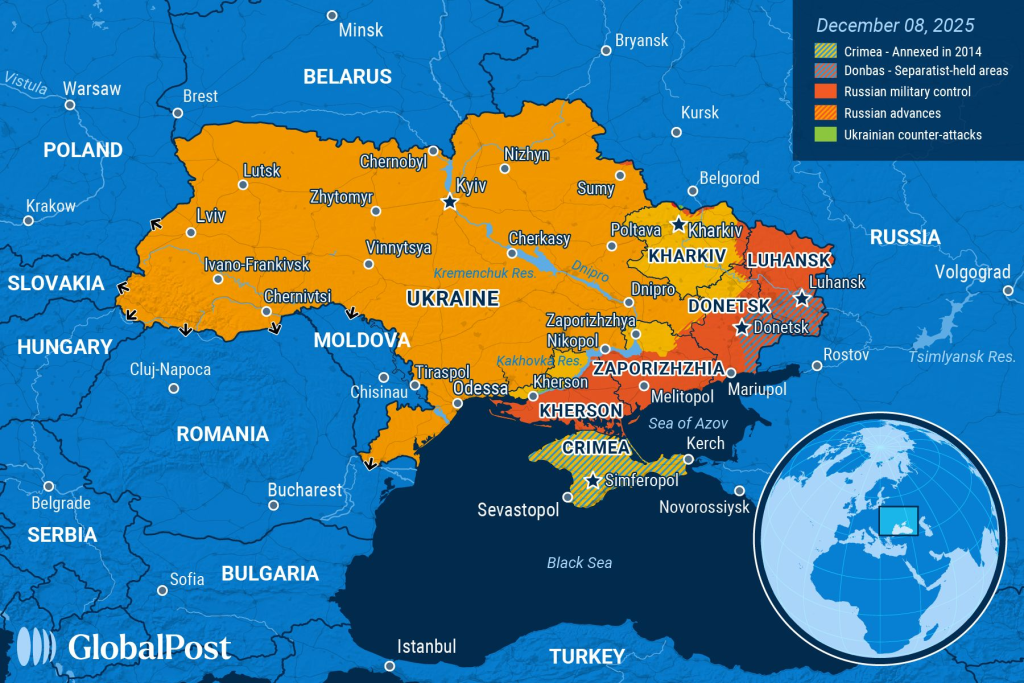
As the author of this article, I have not missed a single day or a single piece of news about the war since February 2022. Throughout this period, I have spoken to individuals from both Russia and Ukraine, listening closely to their perspectives on the conflict. Even my dissertation, awarded a distinction at UCL (available on ResearchGate), was dedicated to the right of peoples to self-determination in Ukraine. Now, with the war nearing its 1,400th day, it becomes evident that the subject of Ukraine is unlike any other.
By Siyavush Baghirov
Russia’s narrative is familiar to us all. According to Moscow, since 2019, the Zelensky government has been severely restricting the rights of Russian-speaking citizens, banning the Church, inviting NATO in, and spreading neo-Nazism (on the last point, Russia is not entirely wrong).
In this account, Ukraine may be a sovereign state, but it must abide by the neutrality clause enshrined in its Constitution. At the same time, Russia claims to be safeguarding the shared values of all post-Soviet peoples and demands that Ukraine, too, refrain from rejecting these values.
Russian President Vladimir Putin skillfully deploys historical arguments as well, asserting that Ukraine is a “pseudo-state.”
Narrative by Ukraine, the EU, the UK, and the Biden Administration
Here, Russia is portrayed as a brutal aggressor whose arguments are manipulative from start to finish. Moscow is seen as a threat to the free and democratic world. Russia, they say, seeks to keep post-Soviet nations under its control.
Putin, facing rising domestic discontent, puts the West, his traditional external enemy, at the centre of attention and wages war in Ukraine, therefore.
Narrative of the Trump Administration
According to the narrative of current U.S. President Donald Trump, the 2021 U.S. elections were not “stolen,” and had Trump remained president, the war would never have begun.
Who is right or wrong in the war is not the primary concern here; what matters now is stopping the conflict and ensuring that the United States emerges with maximum benefit.
Most likely, you have encountered these three narratives many times in local media, told in different words and wrapped in more colourful images. Yet limiting ourselves to these three “stories” prevents us from seeing the larger picture behind the scenes.
From that perspective, the war in Ukraine is a grand, multi-layered chessboard. The leading players are not merely Russia and Ukraine, nor is it, as the Western media often claims, a binary showdown between the Democratic and Autocratic worlds.
Every side in this conflict has its own agenda. Broadly speaking, these sides include: 1) Russia; 2) Ukraine + the EU; 3) The UK; 4) The US; 5) China; 6) States prioritising national self-interest above supra-interests (Hungary, Slovakia, etc.)
Each has its own objectives. Labelling the conflict as “Democratic World vs. Autocratic World” creates the illusion of unity on both sides. In reality, nothing could be further from the truth.
Let’s start with the so-called autocratic camp. Its two leading actors - Russia and China- are bound together primarily by their shared perception of an American threat. The primary catalyst for this alignment, as Kissinger noted shortly before his death, is the Biden Administration; never before had Russia and China been this close.
Yet their partnership is one of friendly adversaries. To secure China’s political and military support, Russia has been leasing lands in its Far East to Beijing, territories China has historically claimed. This, in turn, increases Chinese dominance in those regions. In short, necessity has pushed Moscow and Beijing together.
The possibility of Russia attacking Europe or China invading Taiwan is not dismissed, and with every passing week, these scenarios seem increasingly plausible.
Democrats
The democratic camp, however, is far more fragmented. Here I must state boldly: the Russia–Ukraine conflict is, in essence, a Moscow–London war. Zelensky is London’s protégé—during my time in London, he would travel there almost every week.
For the UK, a war with Moscow is both necessary and undesirable. Undesirable because London is not equipped to fight a militarised Russia alone; essential because the UK seeks to weaken Moscow in Ukraine and, above all, to trigger a clash between Moscow and Brussels to reassert dominance over Europe.
This alone shows that while London and Brussels may appear to be on the same side, they too are friendly adversaries - just like Russia and China.
Remarkably, the goal of dismantling the European Union unites Russia, the UK, and even the US, whose anti-EU sentiment has recently found informal expression in Elon Musk’s public statements.
While not imminent, the possibility of the EU collapsing from within or through a Russian military intervention is now stronger than before. Ironically, EU members closest to Russia, especially the Baltic states, are among those that could be neutralised most rapidly.
Without the EU, how would these states survive, and what political course would they follow? These questions genuinely concern observers.
The weakest actor in today’s conflict, and this may surprise you, is not Ukraine but the European Union. Let us acknowledge openly: Ukraine, one way or another, has already lost. It is no longer an independent agent that anyone treats as a genuine player; its very existence is now under threat.
The EU continues trying to present Ukraine as a key stakeholder in the conflict, but these efforts are failing; Macron’s recent embarrassment in Beijing is just one example.
The potential unravelling of the EU raises profound legal and political questions: the fall of the Union would mark the collapse of Churchill’s grand vision, the supranational state model, and the ideal of a free, barrier-less market. It also invites early reflection on the future status of the European Court of Human Rights.
For these reasons, the Russia–Ukraine conflict is not, fundamentally, a dispute between Russia and Ukraine. It is a war in which friendly adversaries unite to confront adversaries who are not friendly at all.
Additionally, one can interpret this conflict through a religious lens. In many respects, this war resembles the centuries-long march of the Catholic Church against the Orthodox East. But this march now appears to be faltering. I will leave the religious dimension here—this is a subject for another article.
Siyavush Baghirov(LLM) is an Azerbaijani scholar of Jerusalemite Jewish heritage. Baghorov is a graduate of the University College London and is a lecturer at Baku State University. He has diverse interests and offers diverse commentary on topics ranging from law to global affairs. This is his first contribution to The Liberum.