We are a young country, but we have a very ancient history. There have been people in Uzbekistan since the start of civilisation.
Uzbekistan was a crossroads of empires and different religions. In those ancient days Zoroastrianism was the dominant religion, but to here Alexander brought the Hellenistic pantheon of gods. Buddhism spread from India to China and Japan by passing through our lands and later Islam arrived. All these beliefs have left their mark and lived in harmony shoulder to shoulder up to the present day.
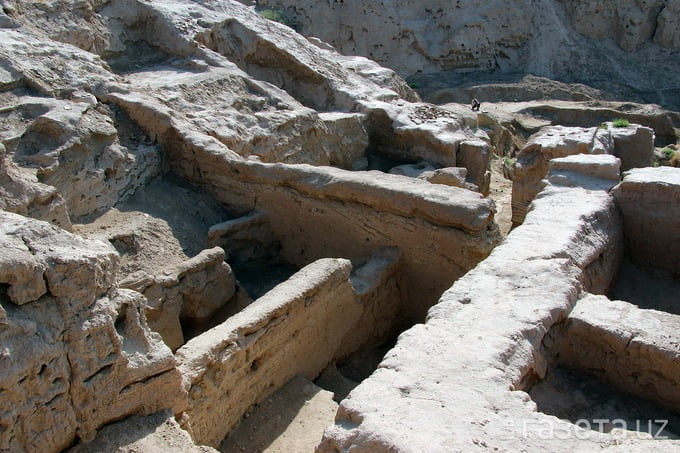
The site of the ruins of Alexandria on the Oxus (the Oxus, one of the great rivers of the world, is known today as the Amu Darya) was closed in Soviet times. But nowadays the gateway to the attraction is wide open and the first flush of tourists has been allowed to travel to this exotic location.
From the dust slopes of the hill the ruins of the city stand on, verdant green fields sweep away into the Amu Darya valley and Afghanistan is visible across the river. The site is still not fully excavated and there is little in the way of supporting infrastructure other than a brand new road running to the site from the nearby city of Termez. The archaeologists I was travelling with clambered through the ruins, excited to see this piece of legendary history up close.
One of the major changes that Uzbekistan has made is a radical freeing up of its visa regime. Getting visas for most of the Former Soviet Union (FSU) remains a major bureaucratic hurdle that can take weeks of organising, reams of paperwork, hours of queuing at embassies and hundreds of euros in fees. To enter Uzbekistan today, you can simply fly there and obtain a 30-day tourist visa stamp on the border if you are citizen of one of the 85 countries that have been granted visa-free access.
Uzbekistan is now the second most freely accessible country in the world after Georgia.
It is also very safe. The proximity of Afghanistan might unsettle some, but the security on the border is tight and none of the instability in that country has spilled over into its neighbour. Afghans cross into Uzbekistan visa-free and there is a large trading centre just over the Afghanistan-Uzbekistan Friendship Bridge, where merchants come to buy and sell goods peacefully.
Uzbekistan is one of the five safest countries in the world according to the UN rankings.
But it is the rich history that is the main pull for tourists. The Silk Road ran through Uzbekistan connecting Venetian traders like Marco Polo with the orient. Traders have been passing through the ancient cities of Khiva, Bukhara and Samarkand for more than two millennia.
As part of the “fertile crescent”, the lands that make up Uzbekistan today were home to several empires from the earliest days of civilisation, before Europeans had moved out of their caves.
This is the home of the Kushan empire where many people from all religions cohabited in peace for many centuries. Buddhism used to be the main religion of the land and today it is the Muslim religion. But this diversity of cultures that stretches back into ancient history is the basis of the religious tolerance that Uzbekistan enjoys today.
Alexander the Great is thought to have lived at the site of Alexandria on the Oxus, also known as Alexandria the Furthest, for two years before turning south and into India on the last leg of his epic journey.
Promoting tourism will put Uzbekistan on the path to what is an obvious money earner, providing badly needed jobs for the fast-growing population. But the government’s sponsorship of research into the country’s cultural heritage is also playing a serious role in the tourism revival. One side of the president’s drive to promote the cultural heritage is aimed at the youth, to define Uzbekistan’s identity, not just as a post-Soviet nation, but as a country with very deep roots. At the same time in this world of religious intolerance and terror, the government is keen to instil the tolerance of a multi-denomination culture that was a hallmark of previous empires and is the tradition of moderate Islam, which is the predominant religion in the country today.
The cultural heritage project is the president’s initiative as he is keen to present Islam as a peaceful religion to the whole world. The most important thing is education and the government is investing heavily in it. The budget has dedicated 7% of GDP to education—one of the highest rates in the world. Education is offered free of charge from the age of two through to 16. The aspiration is to become an educational hub for the whole of Central Asia.
In addition, the government has special education programmes for the children of Afghan refugees that cross the border into Uzbekistan to escape the violence in their own country. They are taken in and taught in their own language. “It’s our contribution towards bringing peace in Afghanistan.
The government has invested heavily into the cultural heritage programme. More than 150 scientists from over 50 countries were invited to a series of conferences held in August and hosted in Tashkent, Termez and Samarkand, along with journalists, museum curators and academics.
We have only been working on developing tourism for the last two years but we can already see the results.
In 2016, Uzbekistan recorded 1.3mn visitors but by last year the figure had shot up to 5.4mn. Some 6.4mn are expected in 2019.
The number of foreign visitors is up five-fold in the last three years and our ambition is to get to 10 million per year. The government is investing into tourism infrastructure and it will become a major source of jobs and income for the people.
By Sher Karimov