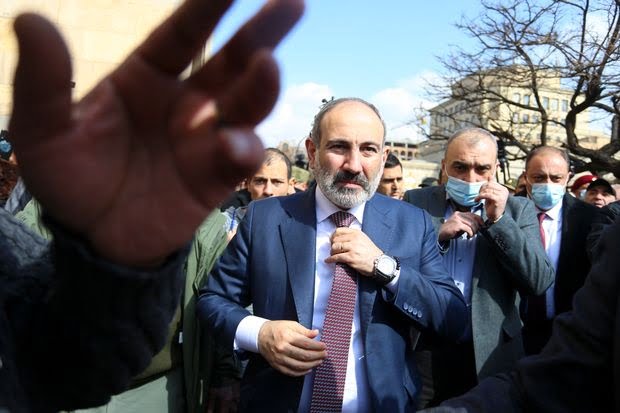
Armenia is facing a serious political turmoil. The country’s Prime Minister Nikol Pashinyan has accused top military officers of attempting a coup after the army reportedly demanded his resignation. How will the situation in the Caucasus unfold?
By Nikola Mikovic
Pashinyan has been in trouble after he fired a high-ranking general for questioning the Prime Minister’s knowledge of Russian Iskander weaponry used during the Nagorno-Karabakh war last fall. On February 25, the General Staff released its demands in a letter signed by 40 senior military officers.
The letter says that Pashinyan’s decision to remove Lieutenant General Tiran Khachatryan as first deputy chief of the General Staff was made for “short-sighted and unfounded reasons.”
“The ineffective management of the current authorities and the serious mistakes in foreign policy have put the country on the brink of collapse,” the army’s General Staff and other senior military officials said.
Rally in Yerevan
Pashinyan promptly staged a rally in Yerevan in an attempt to consolidate his position. Indeed, he managed to mobilize his supporters, although their number was much lower than in 2018 when he came to power after the 2018 “color revolution”.
"The army is not a political institution and attempts to involve it in political processes are unacceptable," he told his supporters.
Given that the military did not join anti-Pashinyan protesters who have been staging demonstrations since the Prime Minister signed the de facto capitulation in November 2020, nor did the army arrest Pashinyan, their open letter was likely a warning to the country’s leader.
Pashinyan, on the other hand, has already shown that protests and calls for his resignation do not bother him too much. The opposition has not been able to overthrow Pashinyan to this day, although a new political moment – the rebellious General Staff – is expected to weaken his position.

It is worth noting that right after the defeat in Nagorno-Karabakh, the army supported Pashinyan saying that it was “impossible to continue the hostilities”. In response, the Armenian Prime Minister handed out awards to the military, which was perceived by the opposition as bribery.
It is very unlikely that the main reason for General Staff’s “coup attempt” is the fact that the country lost the war three months ago. The dismissal of General Khachatryan, as well as Pashinyan’s comments on Russian-made Iskander missiles – allegedly they did not explode or exploded by only 10 percent during the conflict with Azerbaijan – play more important roles in the current Armenian turmoil. Moreover, it is hardly a coincidence that Russian MiG-29 was seen flying over Yerevan on February 25, during protests staged by Pashinyan and his opponents.
The Kremlin
Although the Kremlin and the Russian Foreign Ministry said that what is happening in Armenia is its internal affair, Russian President Vladimir Putin already discussed the political crisis in Armenia with Pashinyan.
The United States, on the other hand, reportedly warned Armenia armed forces not to intervene in government and encouraged all parties to exercise calm and restraint and to de-escalate tensions peacefully, without violence. In other words, it is not very probable that two major powers will allow the Armenian army to overthrow its Prime Minister.
Sooner or later, however, Pashinyan will have to step down, be it after snap elections or as a result of mass protests and strong pressures from the army and foreign powers. In any case, whoever replaces the 45 year old politician will have to keep following the same agenda. There will be no escalation with Azerbaijan over Nagorno-Karabakh, and all points of the peace deal will have to be implemented, including the construction of the Nakhchivan Corridor that will limit Yerevan’s sovereignty over significant section of southern Armenia.
Even though the Caucasus nation has not recovered from the post-war political crisis, it has just enter another one. As a defeated country, with or without Pashinyan in power, Armenia will have to keep making unilateral concessions to its formal ally Russia, as well as to its archenemy Azerbaijan. Gone are the days of political stability in Yerevan.
Nikola Mikovic is a Serbian journalist and a senior Geopolitical Analyst he publishes often for The Levant News.