In this version, Oscar Isaac plays the titular Victor Frankenstein, taking the character to new depths of depravity, while Jacob Elordi elevates the so-called monster to new heights of humanity. Both actors, you will note, are of Spanish extraction – like the director. And a good thing too!
By Emad Aysha
Only someone like Guillermo del Toro could take a story that’s been done to death, not least by the Hammer horror people, and give it a visual and thematic makeover.
The colour palette is typically full of drizzly blacks and greys, befitting the subject matter and period, but with generous dollops of colour, most notably red. We’re introduced to Victor Frankenstein as a boy, with his very French mother draped in a ‘loud’ shade of red.
The colour is repeated throughout, with obvious allusions to life and death. She dies in childbirth, delivering his kid brother, with plenty of blood. Also, the young Victor always worships at the altar of a guardian angel statue, which is also coloured red.
By contrast, the boy’s father, an obnoxious doctor, is blond and is associated with a cold colour like blue. That might explain the Danish expedition to the North Pole, dressed in grey, a further allusion to coldness that a Mediterranean dude like del Toro would make.
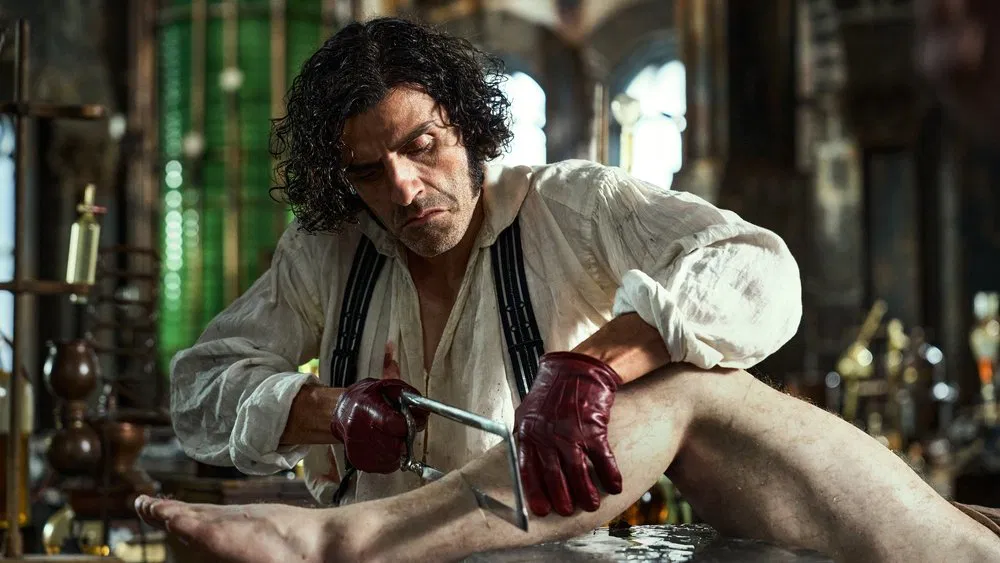
BUTCHER'S APPRENTICE: Oscar Isaac as Victor Frankenstein, piecing together a puzzle of parts even he can't pick apart afterwards.
When we see the bride-to-be, Elizabeth, she’s dressed in blue yet has flaming red hair. (The grownup Victor teases her about her choice in books, thinking she’s reading a ‘Mediterranean’ love and adventure story; she’s actually into the science of insects).
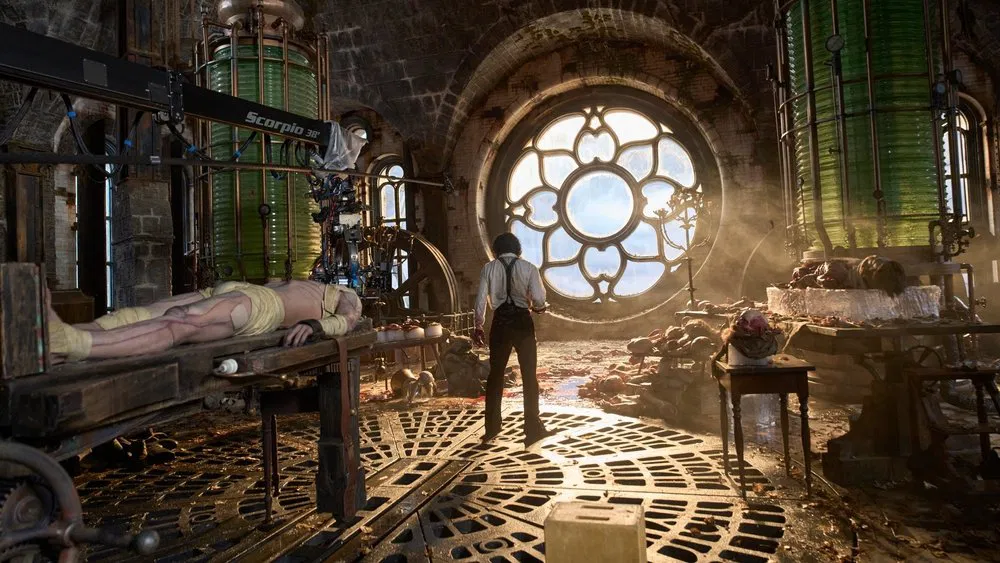
Other visual queues include the sheer ‘scale’ of things. Places are cavernous and oversized; the looming tower of a castle that Victor is given by the Austrian arms manufacturer (Christoph Waltz) is staggering.
Nonetheless, it all feels real and lived in, with a clutter of furnishings and tools, which is more than I can say for Dune: Part One (2021). (I just had to throw it in there, didn’t I?!) And Oscar Isaac is in both movies, to boot.
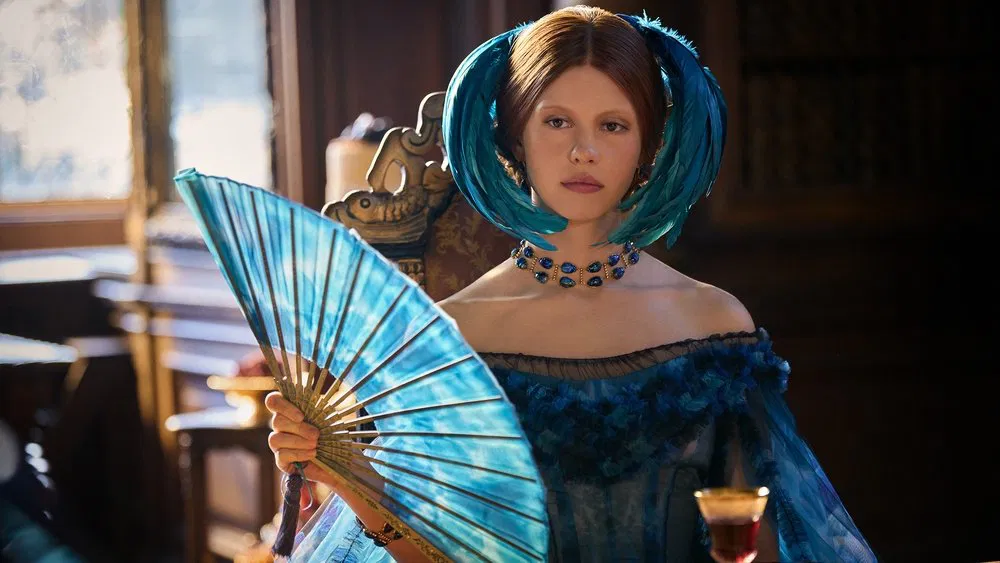
JADE PRINCESS: Mia Goth as Elizabeth, a statuesque beauty caught between her love for the beast and her beastly loves.
The movie is art-house at its best – see the Magic Magy reaction – with every camera angle carefully created to add tension or delight. Likewise, the beast is presented gradually, and almost in a Lovecraftian setting, like a lost relic in the snow.
Victor tragically inherits the moniker of Baron from his dead dad. He also inherits his pomposity and cruelty, treating his creation as he was treated when his father berated him for being a slow learner—the sins of the father, yet another Catholic motif.
Redemption and forgiveness follow suit. The old blind man the creature befriends is also someone doing penance, through his blindness, having killed a man. He’s the second person who took pity on the creature, bringing out his humanity.
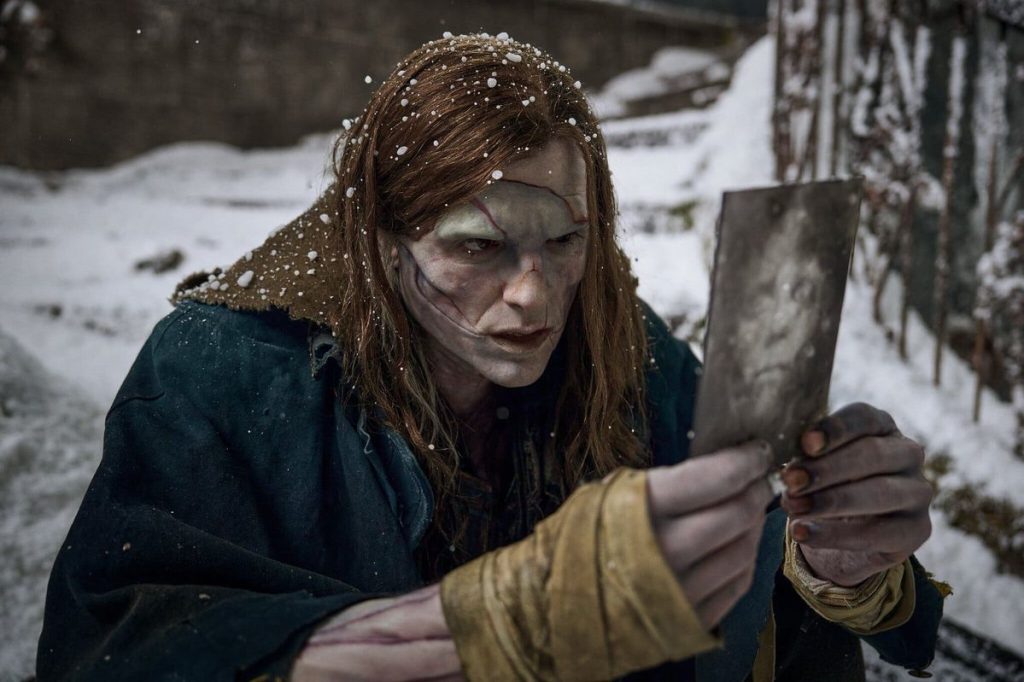
MONSTER'S BALL: The most moving performance by far is by Jacob Elordi as the eponymous Creature. Ah, but what would Mary Shelly think?
I have a sneaking suspicion that she’s meant to be Mary Shelly herself. She’s the conscience of the story. (Her uncle, Waltz, is clearly the comic relief but also the harbinger of a Faustian bargain).
She’s also the spark of inspiration for Victor. When she sees a cadaver he’s working on, she talks about symmetry and God’s handiwork. That’s how he figures out where to put the electrodes.
There are more Catholic themes here since she compares the heavily dissected body to a painting of a Christian martyr. (The body is also held in a cross-like fashion for electrocution.)
Despite her misgivings about a man giving life (usurping a woman’s role), she takes pity on the creature, believing in his essential goodness. Needless to say, this makes Victor jealous, making it easier to destroy his own progeny. (Victor also can’t stand to be touched, evidence of excessive ego.)
Elizabeth is also anti-war, noting how nice notions like honour, valour, and patriotism are misused by the powerful who send the young to die for them. Not coincidentally, then, the bodies Victor uses for his creation come from the battlefield.
Remember, his scientific sponsor is also a man-at-arms, and someone dying of syphilis – again being punished for his sins. (Not surprisingly, he wants his brain placed inside the creature.)
Talk about the military-industrial complex run amok. The scene where Victor is slicing and sawing away on bodies is revolting and ‘hilarious’ at the same time. People are treating people like spare parts. What an appropriate motif for the world of today!
Anger is the only thing that makes Victor listen to his creation. I presume this is from the novel, but you get the feeling del Toro was talking, again, about the world of today. Violence begets violence, like the villagers shooting at him.
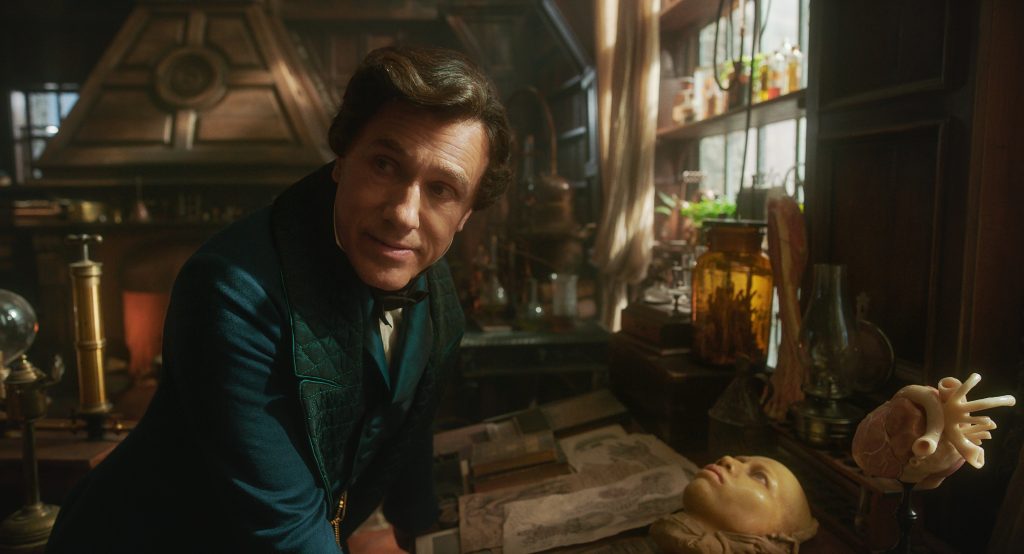
FAUSTIAN PROFITEER: Christoph Waltz as Harlander, a trader in spare machine as well as human parts. Oh, and the much needed comic relief too.
Likewise, the Third World has to use violence, or ‘terrorism’, to get noticed and lodge its legitimate complaints to the First World. The creature even wears clothes he found from a dead (and discarded) soldier.
The scene in which he learns words is based on persuasion and innocence, in contrast to the forceful approach Victor’s father takes. No reason that approach can’t be extended to the uneducated masses of the Global South.
Self-destructive geopolitical competition is also hinted at by the Danish mission to the North Pole, which sought to prevent the Russians from getting there first. (How ironic, given Trump’s Greenland remarks and ambitions!)
The movie is so cosmopolitan. Victor talks about Chi power, from Chinese medicine and mythology, and there’s also the lymphatic system that ‘Muslim’ medics call the hidden circulatory system.
Not to forget the warmth of the Mediterranean sun. The monster, when he’s first created, can’t handle the sunlight. It hurts his eyes, but Victor tells him not to fear since it’s the source of all life.
The colour red again. In the closing scene, after the creature forgives Victor (again a Catholic motif), he finally glories in the sunlight. He almost looks normal, with a less cold hue to his skin.
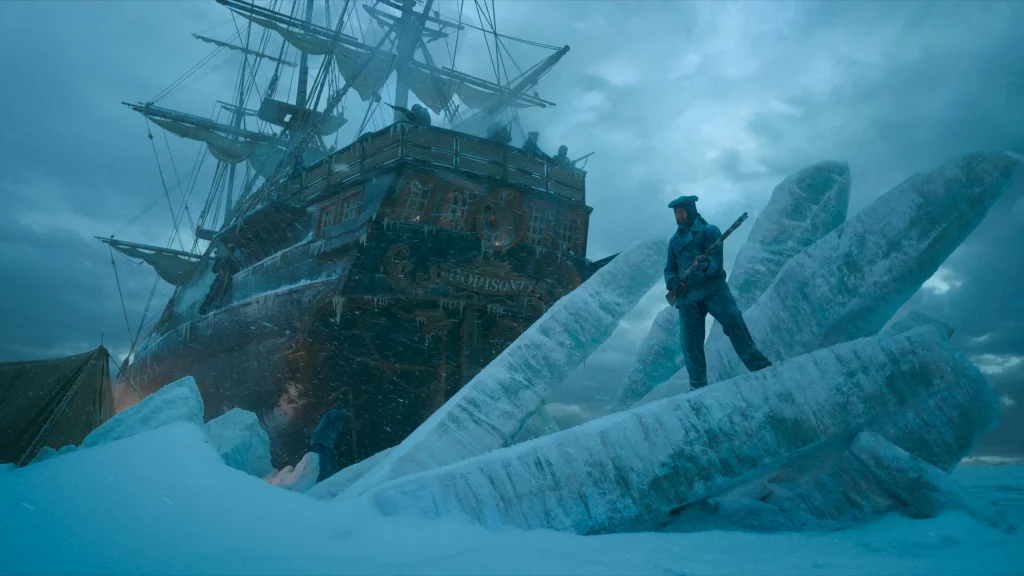
DANISH FOLLY: Before Greenland, there was the mad scramble for the North Pole (screenshot) between the West and Russia. How little has changed!
His skin was always cold, and he hated the ‘cold’ of the winter. He needs companionship, the warmth of others. You’ll also note that while he kills the wolves, he doesn’t kill the Huskies.
What a movie, and what a performance by Jacob Elordi as the gentle beast. And what a heartbreaking score to bring out the enormity of the tragedy, and the elation.
A must-see, but on something other than a puny Netflix TV screen!