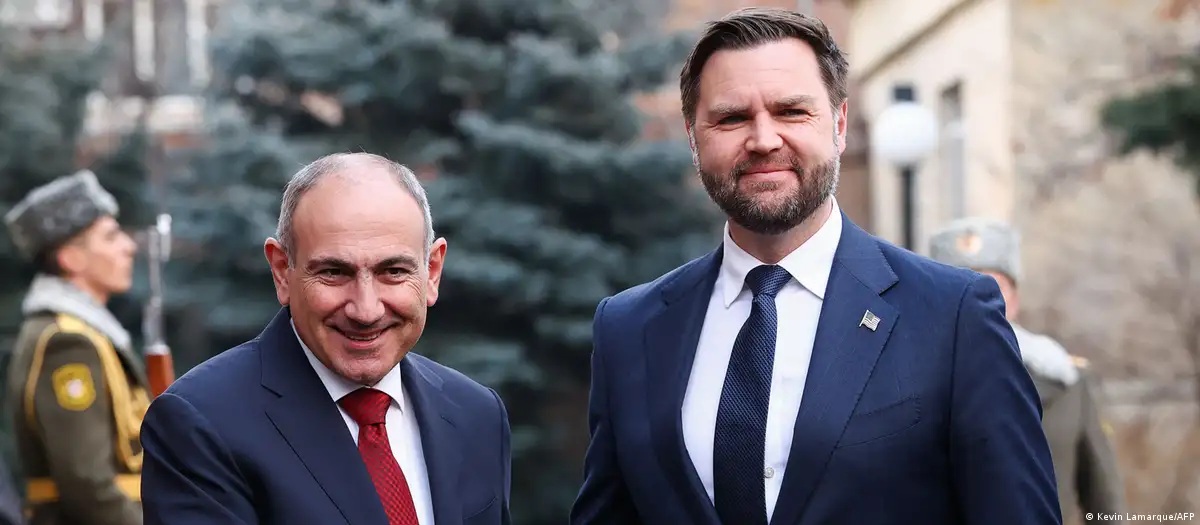
Armenia has become the stage for intense diplomatic activity and symbolic statements ahead of this week’s visit to Yerevan by the American delegation led by US Vice President J.D. Vance. While the authorities are outlining plans for integration into the Trump Route for International Peace and Prosperity (TRIPP initiative), voices from Moscow are increasingly emphasising the need for Yerevan to “make a choice” between the EU and Russia.
By Alihuseyn Gulu-Zada
This situation places Prime Minister Nikol Pashinyan and his team in a genuinely complex and multifaceted position, forcing them to balance between deepening ties with the West and preserving their decades-long strategic partnership with Russia.
A key infrastructure project to be discussed during the Armenian-American talks will undoubtedly be the TRIPP Corridor. Media outlets had previously reported that the US delegation led by Vance plans to visit the TRIPP construction site.
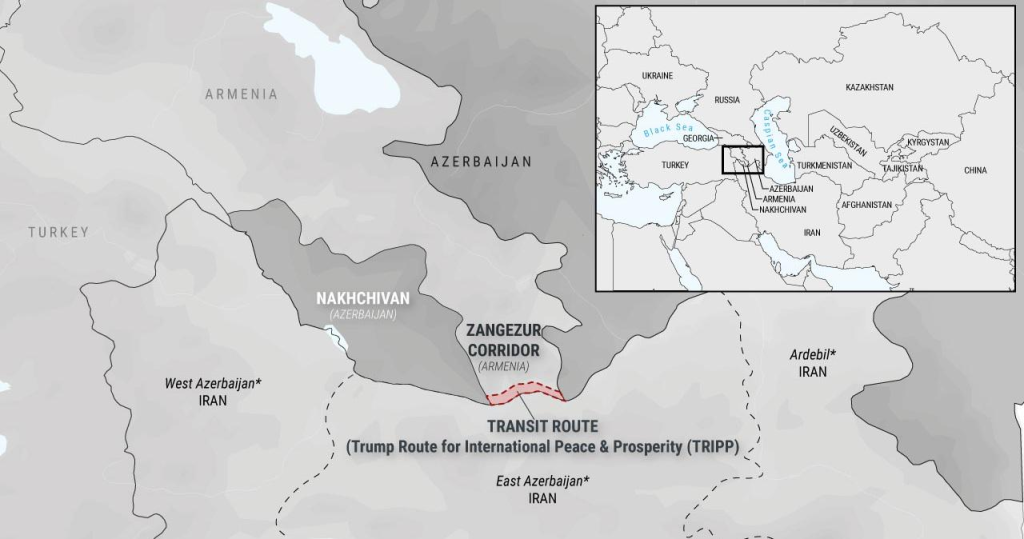
In mid-January, the United States and Armenia agreed to establish a joint venture to develop transport routes in Armenia and signed a framework agreement. Under this agreement, the new company will initially be 74% owned by the US side and 26% by Armenia, with the possibility of increasing Armenia’s share up to 49%.
However, Armenia’s opposition sees potential risks in this arrangement. On February 5, 2026, MP Hayk Mamijanyan from the “I Have Honour” faction stated that Azerbaijan could gain an indirect stake in the project through American investment funds. He pointed to the links between AECOM (which is already conducting site studies in Armenia) and the American investment giant BlackRock.
Mamijanyan reminded that Azerbaijan’s State Oil Fund (SOCAR) had previously signed a strategic cooperation agreement with BlackRock, with planned investments of up to 1.5 billion USD. In his view, this creates a “well-founded suspicion” that Baku might participate in financing the Armenian section of the route.
Against this backdrop, on February 6, 2026, Minister of Economy Gevork Papoyan expressed confidence that direct railway communication with Azerbaijan could become operational within a few years – precisely thanks to the launch of TRIPP. He emphasised that while the state creates the political framework, it is up to businesses to establish real connections, which will take time as the markets remain unfamiliar with one another.
Russia’s interests
Russia is naturally following the TRIPP project’s progress closely. The Armenian parliamentary speaker Alen Simonyan's visit to Moscow (February 4-7) and his meeting with Russian Foreign Minister Sergey Lavrov were key indicators of the current state of Russian-Armenian dialogue.
On February 5, 2026, Russian Deputy Prime Minister Alexey Overchuk stated directly that Armenia should bear in mind that the EU is transforming from an economic bloc into a military-political alliance hostile toward Russia. A day later, Russian Ambassador to Armenia Sergey Kopyrkin noted that Moscow was open to discussing possible participation in TRIPP, citing the two nations’ close cooperation in the railway sector.
During subsequent talks with the Armenian side, Lavrov emphasised that Armenia’s membership in the Eurasian Economic Union (EAEU) was incompatible with EU membership. He remarked that the European Union is forcing countries to make a false choice of being “either with Russia or with us.”
In contrast, Moscow, while respecting Yerevan’s decisions, proceeds from pragmatic realities. Simonyan responded that Armenia had no intention of taking steps against Russia and remained interested in preserving ties. Regarding EAEU membership, he added that Armenia saw no need to leave the organisation and believed a mutually beneficial solution could be found.
Lavrov also expressed surprise at Yerevan’s recent statements about a “mythical northern threat” to Armenia, linking them to the EU’s activity, which, as he put it, “has declared war on Russia.” Simonyan countered that Armenian society reacts painfully to Moscow’s harsh rhetoric, as the perception of Russia as an ally is still deeply rooted.
Medium-term outlook
The official closure of the conflict with Azerbaijan and the opening of trade relations are taking place amid an increasingly complex geopolitical environment – not only for Armenia but for the entire South Caucasus.
Current geopolitical trends clearly indicate that Armenia is undergoing a deep transformation of its foreign policy orientation. Pashinyan’s government is seeking to integrate into Western logistical projects such as TRIPP and to host US Vice President J.D. Vance, while simultaneously reassuring Moscow of its loyalty to existing alliances, including the EAEU.
However, based on statements from top Russian diplomats, particularly Foreign Minister Lavrov, the Kremlin is not entirely satisfied with this course. It seeks at least a shared role in regional economic initiatives – especially TRIPP.
Thus, the issue of “choosing a side” is likely to become increasingly relevant for Yerevan, as the potential geoeconomic confrontation between Russia and the West in the South Caucasus, crucial for US and EU access to Central Asian markets, is no longer merely a hypothesis.
Alihuseyn Gulu-Zada is an independent analyst and researcher specialising in geopolitical processes, risk dynamics and security, as well as the history of the South Caucasus and Iran. His research interests include the peace process between Armenia and Azerbaijan, domestic and foreign policy trends in Iran with implications for the Middle East, and Russia's and Turkey's external vectors in the South Caucasus. His first contribution to The Liberum can be found here.