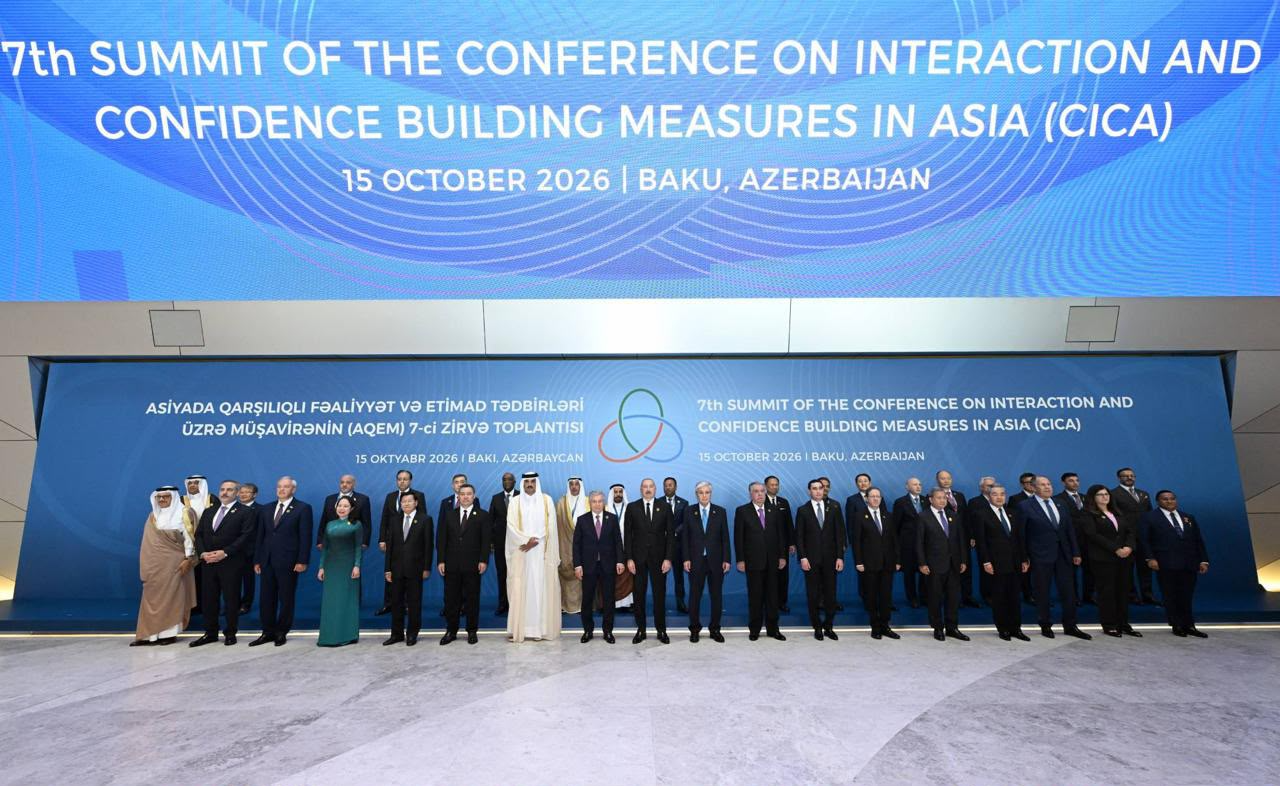
Azerbaijan's expanding role in regional cooperation was underscored by two major diplomatic gatherings, held within a week of each other. The eighth Consultative Meeting of the leaders of Central Asia and Azerbaijan was held in Avaza, Turkmenistan (October 8). Baku hosted the Seventh Summit of the Conference on Interaction and Confidence Building Measures in Asia (CICA) one week later, on October 15.
By Roza Bayramli
Although the two formats differ in membership and objectives, both reflect Azerbaijan's growing role in regional cooperation. Baku is strengthening its institutional ties with Central Asia while taking a more active role in cooperation across Asia. This process also has implications for the South Caucasus, particularly its increasing significance in connecting Asian and European markets.
The Avaza meeting was the first formal summit since Azerbaijan became a full-fledged participant in the Central Asian Consultative Meeting format in November 2025. The six leaders signed a Joint Statement and a Decision on the Consultative Meeting's Regulatory Documents. Azerbaijan's chairmanship of the format in 2027 will provide an opportunity to advance the initiatives discussed in Avaza.
The discussions reflected a growing emphasis on economic cooperation and collaborative projects. Azerbaijani President Ilham Aliyev stated during his address to the summit that "Azerbaijan's trade with Central Asian countries increased by more than 50 per cent" in 2025. Additionally, "over 400 companies with capital from Central Asian countries are actively operating" in Azerbaijan, and joint investment funds have been established with Kazakhstan, Uzbekistan, and Kyrgyzstan.
Aliyev underscored the need to shift from trade to joint investment, production, and access to international markets. Shavkat Mirziyoyev, Uzbekistan's president, also adopted this strategy in his proposals. "We have already reached a point where standard mutual trade is no longer sufficient; we need to create finished products together," stated Mirziyoyev.
Mirziyoyev suggested holding a Central Asia–Azerbaijan Business Forum in Khiva in 2027, with the formula "six economies – one product" as the guiding principle. In addition, he advocated accelerating the establishment of the Council for Infrastructure Development and creating a financial and technical support platform for joint investment projects. The first meeting of the Council was proposed for Uzbekistan.
These initiatives could give the C6 format a stronger practical economic dimension. Nevertheless, most proposals require additional coordination and funding. Azerbaijan's 2027 chairmanship will face the challenge of transforming these ideas into tangible projects.
While C6 emphasises closer collaboration among six nations, CICA provides a much broader platform. Its members include China, India, Türkiye, Israel and Russia, countries with different political and security interests.
In December 2024, Azerbaijan assumed the CICA chairmanship under the theme "Stronger CICA: Connectivity, Digitalisation and Sustainable Growth in Asia." During its chairmanship, Baku advocated institutional reforms and practical collaboration in finance, education, transportation, and other sectors.
The Seventh CICA Summit produced several institutional outcomes. The Baku Declaration was adopted, Laos became the 29th member state, Azerbaijan's chairmanship was extended until 2028, and Azerbaijani diplomat Sultan Hajiyev was appointed Secretary General from 2026 to 2030.
Progress toward institutional transformation persists, even though the CICA Charter, which is anticipated to serve as the legal framework for the Conference's transformation into a fully-fledged international organisation, was not adopted at the summit. Reaching consensus among countries with diverse interests remains complex; however, the dedication to strengthening CICA provides a solid foundation for future progress.
At the same time, CICA continues to prove its value as an inclusive platform for dialogue and cooperation among countries with different political positions and priorities. Its value lies less in directly resolving geopolitical disputes than in identifying shared interests and maintaining dialogue.
Transport, energy, and digital connectivity are among the clearest areas where C6 and CICA can complement one another. This potential is exemplified by the Middle Corridor, which spans Central Asia, the Caspian Sea, and the South Caucasus, linking China and Europe.
According to a September 2026 World Bank report, strategic investment and improved integration could increase trade volumes along the Trans-Caspian route by more than threefold and halve travel times by 2040. Nevertheless, these advantages depend on significant regulatory reforms and infrastructure improvements.
For the European Union, a more coordinated Trans-Caspian transport network would support efforts to diversify trade routes and strengthen economic ties with Central Asia. This also increases the importance of the South Caucasus, particularly Azerbaijan and Georgia, in connecting Asian and European markets.
At Avaza, Mirziyoyev stressed the importance of developing transport corridors as integrated economic networks rather than separate infrastructure projects. He added, “Production facilities, logistics and service facilities, and industrial zones should be developed along the new transport corridors.”
The C6 format could facilitate coordination of these priorities among the six participating countries. CICA, meanwhile, could broaden the discussion to a wider Asian audience and encourage engagement with other major economies.
Azerbaijan has already promoted this agenda through CICA by organising a conference on transport corridor digitalisation in December 2025 and hosting the Conference of Port Authorities in Baku in September 2026.
Digital and energy infrastructure provide another link between the two formats. Presidents Aliyev and Kassym-Jomart Tokayev officially inaugurated the Trans-Caspian Fiber-Optic Cable Line on October 15, which was developed under the Digital Silk Way initiative. The project aims to improve the digital connectivity between Asia and Europe.
Speaking at the CICA Summit, Tokayev also highlighted the Caspian Green Energy Corridor, which Azerbaijan, Kazakhstan, and Uzbekistan are developing to connect electricity networks and potentially supply European markets via the Black Sea.
While these initiatives are not conducted within the context of CICA, they illustrate how a limited number of nations can collaborate in practical ways to advance a broader regional connectivity agenda.
The Baku and Avaza summits were significant milestones in Azerbaijan's expanding role in Eurasian cooperation. Baku's growing influence in shaping regional cooperation is evidenced by the extension of its CICA chairmanship until 2028, the upcoming C6 chairmanship in 2027, and the institutional developments that were achieved at both summits.
CICA offers a more comprehensive platform for engaging major Asian economies, while C6 provides opportunities to enhance economic, transport, and energy cooperation with Central Asia. Together, these formats strengthen Azerbaijan's status as a diplomatic and connectivity hub linking Central Asia, the South Caucasus, and broader international trading markets.
For Europe, these developments could create new opportunities for trade diversification and cooperation along the Middle Corridor. Ultimately, the importance of the two summits will depend on translating political commitments into practical projects, thereby strengthening Azerbaijan's emerging position as a critical link in Eurasia's evolving economic and diplomatic architecture.
Roza Bayramli is a Senior Advisor at the Centre for Analysis of International Relations and Multiculturalism(AIR Centre) in Baku, Azerbaijan. Areas of expertise include Central Asian affairs, Eurasian geopolitics, regional connectivity, and multilateral cooperation. Currently pursuing a PhD in International Relations, with regular contributions to international analytical publications and expert forums.