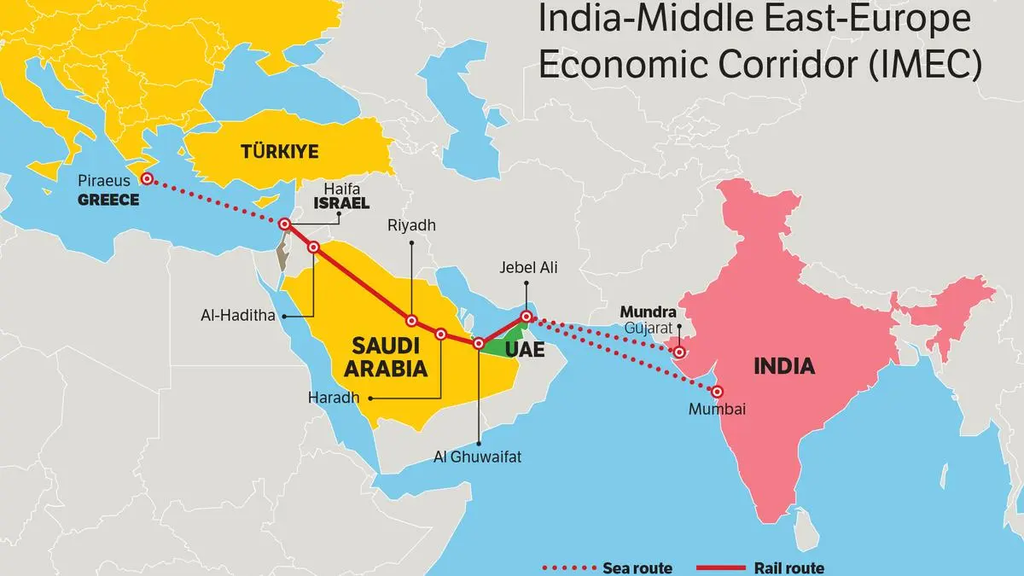
On maps and in summit communiqués, the India–Middle East–Europe Economic Corridor (IMEC) is presented as a seamless link connecting Mumbai to Piraeus via the Arabian Peninsula and the Levant. Launched as a Western-backed counterweight to China’s Belt and Road Initiative, the national interests and security priorities of its participants have pulled the corridor in opposing directions, a fracture driven by a profound shift in the Middle East’s balance of power.
By Ahmad Ghosn
A classical reading of Middle Eastern power dynamics explains the friction inside IMEC. A regional power is defined by political reach that extends beyond its own borders. Following the collapse of the Assad regime in Syria, Iran no longer meets this criterion in the Levant.
Even if Tehran were to acquire nuclear capability, the loss of its Syrian land bridge has severed its direct territorial access to the Mediterranean. Non-state actors cannot replace the sovereign legitimacy, airspace, and logistical depth Damascus once provided.
Before Bashar al-Assad’s fall, the region operated under a tripolar balance among Iran, Turkey, and Israel. Iran’s retreat created a strategic vacuum. Left unchecked, a purely bipolar contest between Turkey and Israel would be structurally unstable; classical balance-of-power logic dictates a third pole to absorb friction and prevent hegemony by either side.
Competing on regionality
This search for a third Arab pole is playing out directly through the intensifying competition between the United Arab Emirates and Saudi Arabia over oil policy, political vision, and regional leadership—pulling external powers like Israel, Turkey, India, and Pakistan into rival orbits.
On one side, the United States, Israel, and India increasingly view the UAE, capital-rich, agile, and explicitly aligned against political Islam, as that preferred Arab counterweight. In Washington, Abu Dhabi has positioned itself as a secular partner; the UAE Embassy’s counterterrorism materials note that it has stood “at the forefront regionally in identifying and countering the Muslim Brotherhood, viewing the group as a promoter of extremist ideologies and destabilising actions.”
Together, India, Israel, and the UAE have steadily deepened what analyst Mohammed Soliman has termed an “Indo-Abrahamic” partnership, building on the Abraham Accords to integrate security, technology, and trade across South Asia and the Middle East.
On the other side, Turkey, Pakistan, and broader currents of regional opinion look to Saudi Arabia, banking on its demographic weight, energy reserves, and Islamic legitimacy.
In August 2026, Riyadh formalised this alignment by signing the Mecca Joint Defence Agreement with Turkey and Pakistan. The pact consolidates a Sunni-oriented security framework while bringing Pakistan—a nuclear-armed rival that India explicitly seeks to bypass through IMEC—directly into Saudi Arabia’s formal defence architecture.
One corridor with many alliances
These rival alignments have split IMEC’s physical and diplomatic momentum into two distinct spheres.
The Eastern Leg: The Indo-Abrahamic Sphere On the eastern segment, the Indo-Emirati partnership has rapidly consolidated around shared economic interests and security concerns. For India, IMEC secures access to Gulf capital and energy while establishing a maritime route insulated from Pakistani leverage.
Official data from India’s Department for Promotion of Industry and Internal Trade indicate that cumulative FDI from the UAE into India reached $26.45 billion by mid-2026, making Abu Dhabi India’s seventh-largest source of foreign direct investment and accounting for more than 3.25 percent of total cumulative equity inflows.
Anchored by the 2022 Comprehensive Economic Partnership Agreement, the 2024 Inter-Governmental Framework Agreement, and an Indian diaspora that makes up roughly 36 per cent of the UAE’s population, both sides have operationalised their segment through digital trade platforms and local-currency settlement arrangements.
The Western Leg: The Euro-Israeli Sphere. On the western half of the corridor, the strategic focus shifts to the Eastern Mediterranean, where Israel uses IMEC both as a transit route to Europe and as a tool to contain Turkish influence.
To bypass Turkish territory, Israel has advanced three overlapping infrastructure projects with Greece and Cyprus, each meeting active resistance from Ankara:
IMEC’s day after
IMEC is already partially operational, not through completed rail lines or pipelines capable of rivalling the Strait of Hormuz, the Red Sea, or the Suez Canal, but through the security arrangements and diplomatic blocs it has helped solidify.
While the corridor gave the I2U2 grouping (India, Israel, the UAE, and the United States) a vehicle to advance a shared regional vision, its "day after" now depends on finding a workable formula for these rival powers to coexist and engage despite deepening competition.
Moving beyond narrow bilateral and trilateral tracks requires an inclusive framework that reconciles competing interests, specifically by bringing Saudi Arabia back into the fold.