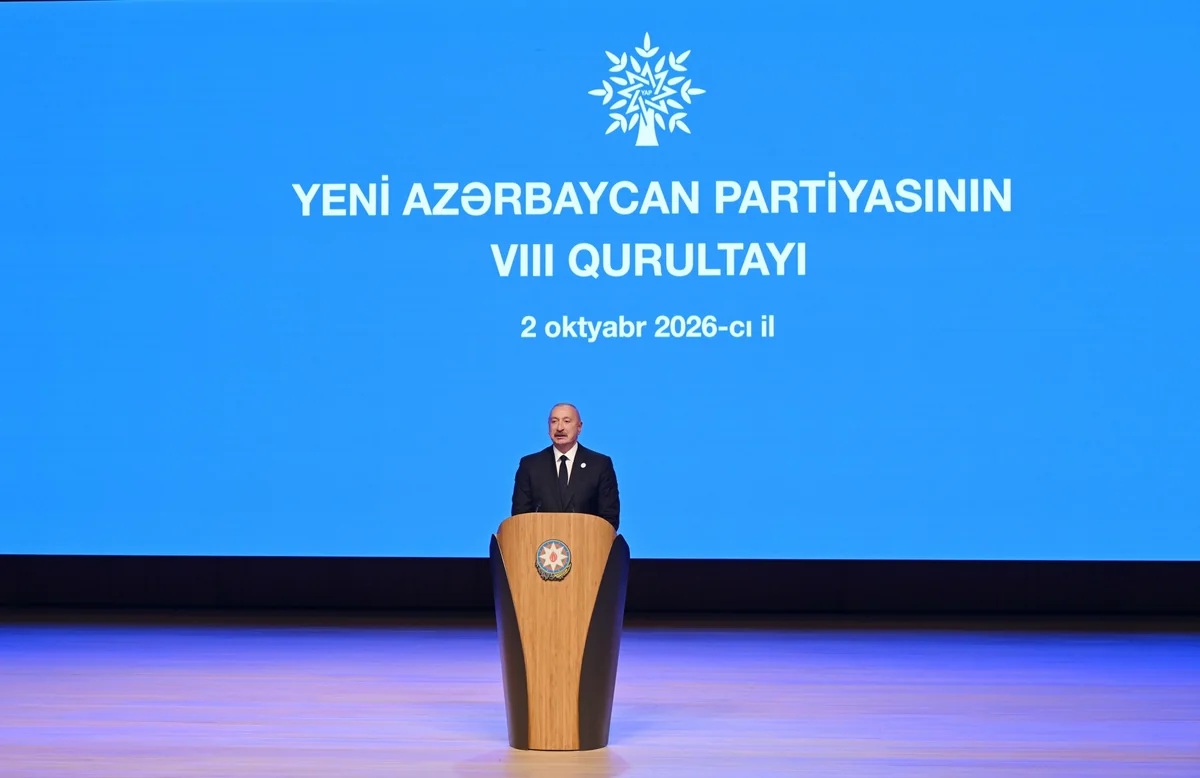
Azerbaijani President Ilham Aliyev addressed the 8th Congress of the New Azerbaijan Party (YAP) in Baku on Friday, the first party congress convened since Azerbaijan fully restored its territorial integrity and sovereignty. His speech reviewed three decades of statehood, but its lasting importance lies elsewhere. The President set out, in systematic terms, the principles that guide Azerbaijan’s conduct in international affairs.
By Vasif Huseynov
Taken together, these principles amount to a coherent foreign policy doctrine, which may fairly be called the Aliyev Doctrine. The doctrine is built on the premise that a state is genuinely independent only when it relies on its own resources for its security and development, engages every centre of power without subordinating itself to any, and neither accepts nor practises interference in internal affairs.
The President gave this proposition its sharpest formulation himself: “We do not need anyone’s help, nor do we need anyone’s patronage.”
The doctrine rests on five principles: self-reliance in security, economic sovereignty, partnership without alignment, reciprocal non-interference, and strategic restraint backed by reliability. Each is grounded in the country’s experience since 1991, and Aliyev reaffirmed them as guides for the years ahead.
Origins: a doctrine formed by experience
Doctrines are rarely invented. They are distilled from formative experience. In the early 1990s, Azerbaijan lived through the most tragic period of its modern history. Armenia’s military aggression led to the occupation of a fifth of the country’s territory. Of a population of eight million, one million became refugees and internally displaced persons, many of them, including this author, living in tents or makeshift shelters.
The state itself was close to collapse: the treasury was empty, inflation exceeded 1,000 per cent, and the country stood on the edge of civil war.
The international response compounded the injustice. The four resolutions of the UN Security Council which were adopted in 1993 and called for the withdrawal of Armenian forces for the occupied Azerbaijani territories remained unimplemented with no international pressure against Armenia to do otherwise.
Quite the contrary, Armenia received support from some key countries despite its aggression against its neighbour. For instance, Section 907 of the US Freedom Support Act, adopted in 1992, restricted American assistance to Azerbaijan. This country was under occupation, and it has not been fully repealed to this day. The OSCE Minsk Group was entrusted with mediating the Armenia-Azerbaijan conflict, and it worked for nearly three decades to freeze the conflict rather than resolve it.
The answer to that period was the course set by National Leader Heydar Aliyev after 1993: ending international isolation, attracting investment through the Contract of the Century and laying the foundations of statehood.
Aliyev has pursued the same course since 2003 and described it at the congress as unchanged in its essentials: independence, statehood, economic independence, strong military potential, and maximum use of the country’s own capabilities.
The doctrine therefore reflects a continuous policy line across more than three decades.
First principle: self-reliance in security
The first principle holds that security cannot be borrowed. Speaking as Supreme Commander-in-Chief, President Aliyev stated that everything Azerbaijan has acquired for its armed forces since 2003, through domestic production and through imports, was purchased with its own money at world prices, “down to the last bullet.”
No manat or dollar of discount was granted. In some cases, he added, suppliers charged several times the market rate, and Baku had to accept it.
The strategic significance of this point goes well beyond accounting. In most contemporary wars, each side has a sponsor, and sometimes several. Donated weapons, concessional credits and security guarantees create obligations, and the party that subsidises a war acquires a voice in how it is fought and how it ends.
Azerbaijan’s victories of 2020 and 2023 carry no such obligations. The Azerbaijani army won them with equipment the Azerbaijani state paid for in full, against the open resistance of major powers.
The principle looks forward as well as back. With wars multiplying around the region, the President named the further strengthening of military power as the first task ahead, so that no one would contemplate a provocation against Azerbaijan. Nearly 9 billion manats (5.2 billion USD) are allocated to defence and security in next year’s budget.
The effort is accompanied by expanding the domestic defence industry and diversifying suppliers and joint production, both of which reduce the leverage any single arms source might otherwise gain.
Second principle: economic sovereignty
The second principle treats economic independence as the precondition of political independence. Its application began early. Azerbaijan ended its borrowing relationship with the International Monetary Fund soon after Aliyev first took office and steadily reduced its exposure to other lenders.
The figures cited at the congress show the result. External debt stands at 5.6 per cent of GDP, one of the lowest ratios in the world. Foreign exchange reserves have reached 90 billion dollars, roughly 20 times the external debt, and the President noted that the government could repay the debt in full within 24 hours if it chose.
These reserves have grown while the state carries heavy burdens from its own budget, including 28 billion manats already allocated to the reconstruction of the region liberated from the Armenian occupation in 2020 and 2023. No donor conference financed the return of the internally displaced Azerbaijanis to the liberated territories.
The policy implication is direct. A country that does not depend on loans or aid cannot be disciplined through conditionality. A country that exports crude oil, natural gas, petroleum products, electricity and fertilisers, with 30 million tons of refining capacity at home and abroad and 16 million tons of transit cargo crossing its territory this year, is one that others need. Where dependence exists, it runs toward Azerbaijan and not away from it.
Third principle: partnership without alignment
The third principle distinguishes independence from isolation. The President described a network of relations that few states of comparable size can match: strategic partnership formats with ten member states of the European Union, a comprehensive strategic partnership with China and a Strategic Charter with the United States.
Azerbaijan chaired the Non-Aligned Movement for four years, became a full member of the Consultative Meetings of Central Asian leaders last November, was admitted to the D-8 as the first new member in the organisation’s thirty years, and will host the Organisation of Islamic Cooperation summit next year.
The doctrine is defined by a refusal to convert partnership into alignment. Many countries have joined one camp or another, or are seeking to do so. Azerbaijan, in the President’s words, does not join any camp and will not, because it does not need to. Each relationship is built on its own merits and on Azerbaijan’s national interest, and none is permitted to constrain the others.
The practical dividend is trust. Because Baku is not an instrument of any bloc, representatives of states hostile to one another can meet on its territory, and Azerbaijan can be a strategic partner to both of the world’s leading superpowers at once.
In parallel, Azerbaijan has pushed to establish and strengthen the Organisation of Turkic States (OTS) as a rising geopolitical actor in Eurasia. In his inaugural address in February 2024 as the re-elected President, Aliyev designated the Organisation of Turkic States as the principal international organisation for Azerbaijan: “We have no other family. Our family is the Turkic world.”
Baku has since worked to give the organisation strategic weight. It initiated the tradition of informal summits in Shusha in 2024. At the Gabala summit in October 2025, the President called on the Turkic states to act as a single centre of power and proposed joint military exercises of the member states.
At the informal summit in Turkistan in May 2026, he set the goal of making the Turkic world one of the century's influential geopolitical centres.
Fourth principle: reciprocal non-interference
The President stated the fourth principle most explicitly. He linked foreign policy to what he called the country’s ideological space, which must remain free from foreign elements and foreign influences, and he presented this as a foreign policy strategy in its own right. Foreign policy, he said, is built so that no one interferes in Azerbaijan’s affairs.
The logic is consistent. How Azerbaijani society organises its public life, which model of statehood it follows and which decisions its government takes in international forums are matters for Azerbaijanis.
This holds regardless of where the advice comes from, whether from distant capitals or closer to home, and regardless of whether it is delivered as criticism or friendly counsel. Aliyev was blunt: everyone should look after their own nation and state and not tell Azerbaijan what to do.
The principle is reciprocal, which gives it the standing of a norm rather than a mere defensive reflex. Azerbaijan does not instruct others on how to arrange their internal affairs, and it does not build its relations on commentary about its partners' choices. It expects the same restraint in return, and it has made clear that pressure will not be left unanswered.
Fifth principle: strategic restraint and reliability
The fifth principle concerns how power is used. Independence gives a state the freedom to act, and the doctrine pairs that freedom with discipline. Azerbaijan halted its operations in Karabakh at the right moment in November 2020 and again in September 2023, although other options existed.
It then moved to the peace agenda sealed at the White House in August 2025. The President explained that there is no place for emotion in politics and that the people's core interests dictate when to stop.
Restraint is matched by reliability. Azerbaijan says the same thing in every capital, and its word carries the weight of its signature. As President Aliyev put it, the country has “never displayed duplicity or hypocrisy toward any country,” although it has repeatedly encountered both.
Neither quality implies passivity. The President set as a task for the coming period that foreign policy be proactive, not merely defensive. A state that is restrained in the use of force and consistent in its commitments can afford to take the initiative because its partners know what to expect.
The terms of engagement
The five principles outlined above form a coherent approach to preserving Azerbaijan’s independence in an international system shaped by conflicts, rivalries and hostilities. Their consistent application over more than three decades has enabled Azerbaijan to strengthen its state capacity, expand its international partnerships and evolve from a vulnerable post-Soviet state to an increasingly influential middle power.
The Aliyev Doctrine is not directed against anyone. It defines the terms on which Azerbaijan engages with everyone. Partners who accept those terms find a predictable and capable interlocutor.
Azerbaijan continues to apply a balanced foreign policy approach, maintaining mutually beneficial and respectful relations with all major powers without allying with one side at the cost of the country’s relations with other power centres. “Our destiny is in our own hands,” the President told the YAP congress. The Aliyev doctrine exists to keep it there.

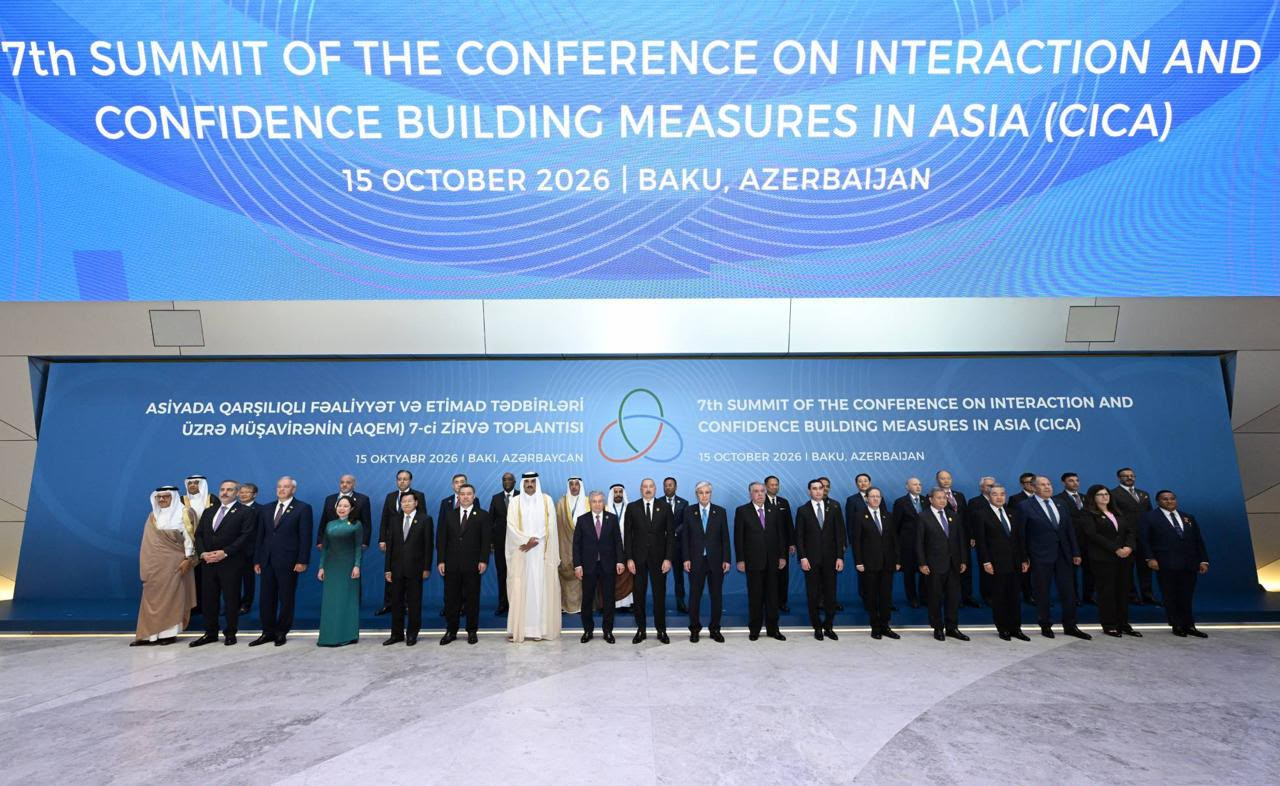




[…] as a national security strategy. The AIR Center, a leading think tank, described it as the “Aliyev Doctrine,” a foreign policy framework based on five core principles: self-reliance in security, […]