
Director Gabriel Mascaro won the Silver Bear Grand Jury Prize at the Berlin Film Festival in 2025 for this movie. It’s the subtle story of a 75-year-old Brazilian woman in a near-future world where her kind are forced into special colonies for the aged. Once she’s retired, she can’t do anything without her guardian, her daughter's permission, not even get an airline ticket!
By Emad Aysha
That’s the punchline of this gorgeously told story. The old lady, Tereza (Denise Weinberg), wants to do the one thing she hasn’t done in her life, which is take a plane ride. But the bureaucracy and the near police state they live in keep foiling her plans: that, and the intrusion of fate in the guise of good or bad luck.
Tereza eventually takes a boat ride to a town where she can get a private flight on an amphibious propeller plane, and the dejected boatman, Cadu (Rodrigo Santoro), introduces her to a secret that will change her life.
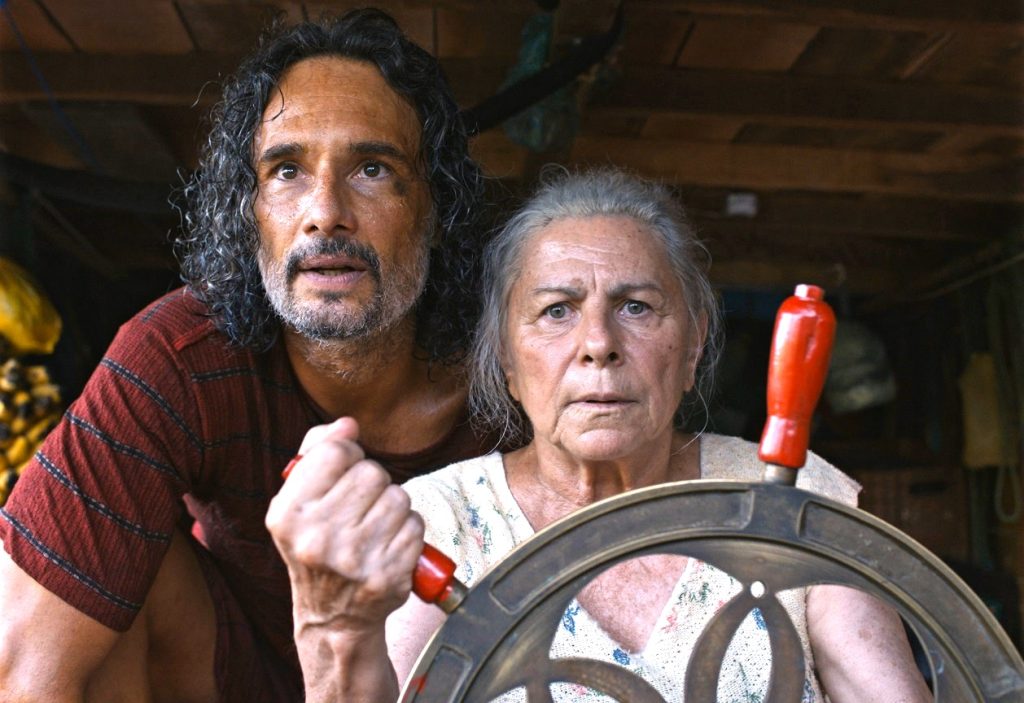
DREAM TEAM: Rodrigo Santoro and Denise Weinberg, putting the lie to the Americanism that you can't teach an old dog new tricks.
A special kind of snail leaves a blue trail. When dropped into the eyes, the blue slime helps you see the future. He takes some himself, his eyes turning a lovely shade of lilac, and he confesses to her how he lost his wife (she ran away with another man) because of his shipping antics, trying to make money.
There are a lot of absent husbands in the movie, for both Tereza and her daughter, but seeing this guy, you realise why he was away so much. It wasn’t the money; it was the freedom. Being his own boss and getting to see the world beyond the urban hellhole where he originally lived.
You see hints of this early in the movie with Tereza in a factory that processes alligators. She opens the steel doors to look outside beyond the cold fog, lying on the ground to stare up at the endless sky.
The dream of flying is the dream of freedom. How ironic that the first thing you see in the movie is a propeller plane trailing a sign behind it proclaiming proudly that we’re all entering the future together, old and young.
In reality, they’re creating job opportunities for the young by unemploying the old, even if they still have a lot of life left in them, as is the case with Tereza. And even if they have kids and grandkids to take care of them.
Now the aged are treated very politely and with respect by all the people in this movie, even if they arrest them and put them in cages, with cops looking like dog catchers. (There are informers everywhere, too, and anyone with grey hair can’t even get a room in a deserted forest.)
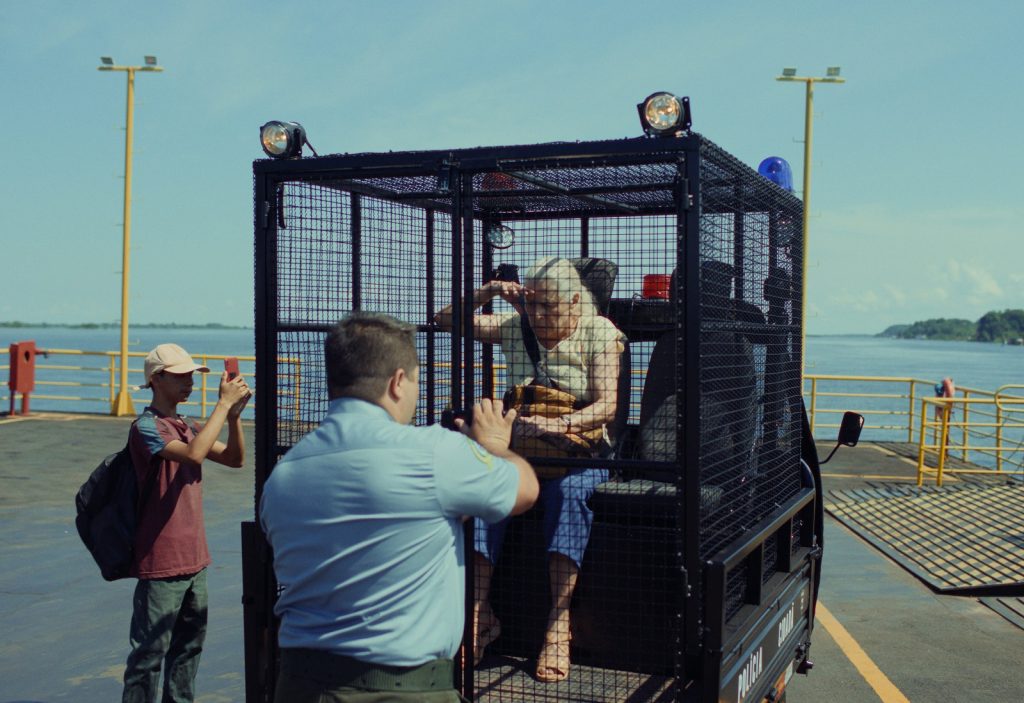
PET PATROL: Southerners understand dystopia in a much more personal and emotional way than the overly objective North. All hail Brazilian science fiction!
The scene where Tereza is forced to board the bus to the colony is equal parts surreal and hilarious, with each one of them being issued a backpack, clothes, a bottle of water, and, get this, Pampers.
She objects that she doesn’t wet herself, but it's a regulation, and they even pull out her skirt to check!
Luckily, she uses the bottle of water to ‘wet’ herself and smuggles herself away, not really knowing where she’s going. That’s when she encounters a nun on a yacht selling digital Bibles, lovely wafer-thin screens that are water-resistant, too.
The woman takes pity on her and Tereza, having previously learned how to drive a boat from Cadu. (So much for not being able to teach an old dog new tricks.) She finds herself in a gambling city, the amphibious pilot told her about earlier, and also comes across the blue trail snails on the yacht.
She’s given the power of second-sight and bets it all on a goldfish (Milky Way) against another (Red Satan) and wins a bundle. (She’s someone who’s never gambled in her life, a timid by-the-books person.)

SYMBOLS MATTER: We all follow a twisty trail in life. The key is to embrace it and stop insisting only on one definition of the good life.
The scene of triumph is worth a million bucks alone. Such a sweet and reserved lady, hooting out of happiness. The goldfish battle alone is creepy and epic.
The movie closes with her looking at that same government propeller plane from before, on the river with her newfound best bud.
You also see an alligator swimming free in the Amazon River. (The nun is actually an atheist, but sells hope to people, which is more than can be said about the government.)
Man, what a movie. The cinematography and the atmospheric music, including the heartbreaking songs, tell the story better than the dialogue or plot ever could. And that’s not discounting how well-written this all is.
The director originally started out making documentaries, and he seamlessly transfers these fact-based, by-subjectively lively skills here.
It’s also very relatable for an Arab audience, with tanned, emotive, expressive characters and witticisms we can culturally understand. The pilot says the older spare parts are better.
The gentle but grumpy Rodrigo Santoro cries and froths at the mouth – the man who originally played Xerxes in 300 (2006)!
You know what I would do if I were the dictator of Brazil? I’d set up a mothering department to make use of old-timers like Tereza. Turn the entire country into a giant maternity ward.
Tereza nurses Cadu through his visions, treating him kindly and respectfully, understanding his needs and dreams, and being there to comfort him through his failures.
You have to hand it to the Brazilians. They know how to splice the social concerns we are obsessed with as Egyptians, with the kind of futurism that the West is supposed to monopolise. Not anymore, they don’t!

SCREEN TEST: Digital camera work in the right hands can work wonders, on the cheap, whereas blockbusters constantly fumble the multimillion dollar ball.
Canada's Mr Villeneuve could take some lessons from Mascaro when it comes to blue-in-blue eyes. This movie does it better. All the colours are so fresh and lucid, compared to the grainy, grey morass of Dune Part One.