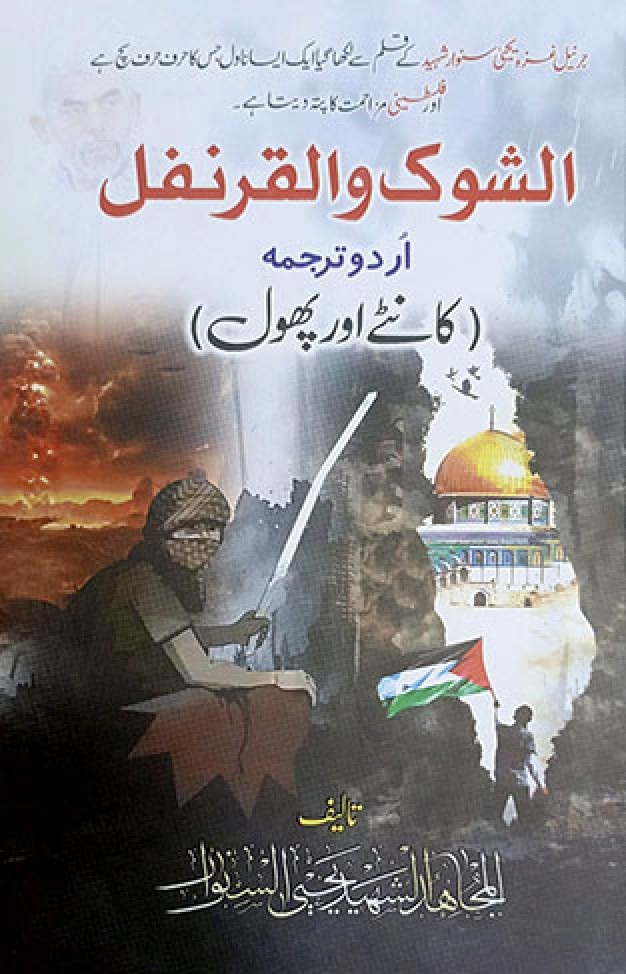
A good friend gave me Al-Shouq wal-Qaranful (Thorns and Carnations, written by Yahya Sinwar), just before I left for Egypt. I wasn't particularly eager. I had recently tried Mein Kampf – for the same reason one occasionally reads things one would prefer had never been written. It defeated me. Not morally. Stylistically. Hitler was a poor writer, which is perhaps the least of his sins but not an insignificant one. I put it down after a few chapters. I expected something similar from Sinwar: ideologically dense, propagandistic, readable only as an object of study.
I was wrong.
By Rafael Baroch
Al-Shouq wal-Qaranful is well written. Not sublime, not literature that stays with you for the beauty of its sentences, but taut, vivid, with characters that have something of real people about them. Sinwar was, besides a psychopath, a competent writer. That makes the book more dangerous than Mein Kampf, and more uncomfortable to read. Propagandists who write badly can be kept at arm's length. Propagandists who draw you into a story cannot.
He wrote it in 2004 from an Israeli prison cell. He was serving a life sentence for the murder of four Palestinians he suspected of collaboration. He learned Hebrew. He translated Israeli books into Arabic. And he wrote.
The novel was smuggled out of prison and appeared without a publisher's name. In the years that followed, it was barely read. After October 7, 2023, it became a bestseller in Amman, Baghdad, Algiers and Tehran. In Iran, seven print runs sold out in less than two weeks. Hamas distributed hundreds of copies in Beirut to politicians, cultural figures and activists. The author was dead by then – killed in a firefight in Rafah on October 16, 2024.
I read it in Egypt, and found myself returning to one question: how did Israeli intelligence fail to see this coming?
Not the book specifically. Sinwar himself. His thinking. Because what is written in this book is not subtle, not coded, not open to multiple interpretations. It is an ideological manifesto in the form of a novel, written by a man who states precisely what he wants, why he wants it, and how he believes it can be achieved.
The novel follows three men from a refugee camp in Gaza across decades of conflict. Mahmoud supports Fatah. His brother Ahmed and their cousin Ibrahim support Hamas. It is a philosophical dispute – but the dispute is settled before it begins. Mahmoud is not stupid, but naive. He believes the Oslo Accords mean something. Ibrahim knows better: if Israel ever withdraws, it will be because it has fled under pressure, not because it has honoured an agreement. The door to continued struggle remains open. There is no peace. There is only a ceasefire while waiting for better circumstances.
Ibrahim states it plainly: our enemies understand only the language of the rifle and fire.
But the novel is more than strategy. It is an aesthetic. And that aesthetic deserves attention, because it explains precisely why the book spread so rapidly after its author's death.
Look at the title. Thorns and Carnations. Not thorns or carnations – both simultaneously, inseparably. This is not accidental. Sinwar constructs his entire worldview on that tension: pain that is not resolved but transmuted, loss that is not processed but exalted, violence that is not justified but sanctified. Palestinian suffering is not, in his rendering, a problem requiring a solution. It is the source of moral authority itself. One speaks not despite the wound, but because of it. Humiliation is not a phase. It is the foundation.
That makes the book more effective than most political writing. Ideology that appeals to interest convinces those already persuaded. Ideology that transforms pain into identity binds generations.
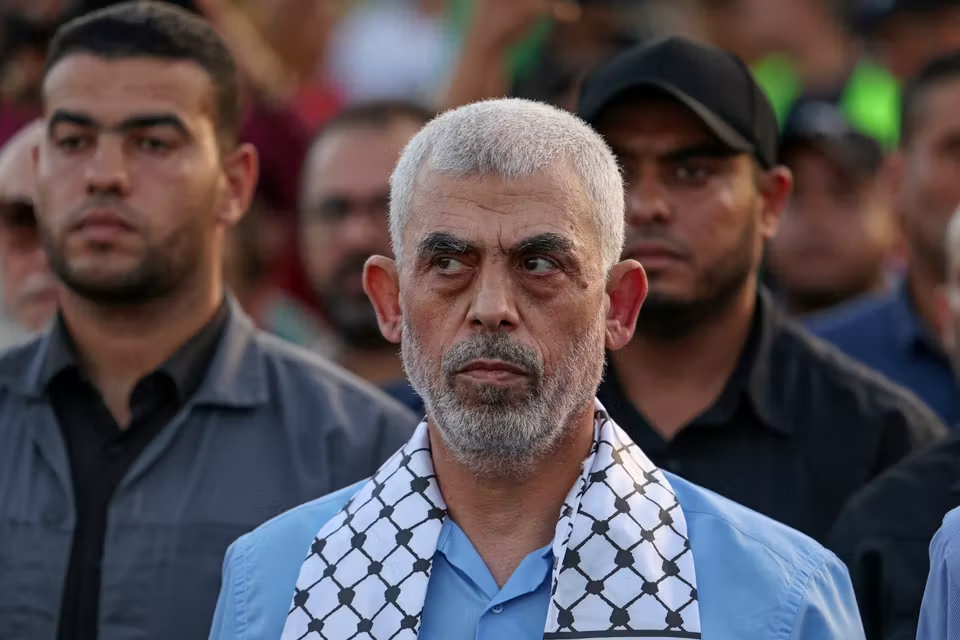
The book contains the hope, expressed while Saddam Hussein was firing missiles at Israel during the Gulf War, that they would carry chemical warheads and destroy half the Israeli population. When that proved not to be the case: "it was as though ice water had been poured over us." It glorifies attacks on buses, restaurants, and a discotheque – dozens dead, most of them young people on their way to a party, years before the mass murder at the Nova festival. It describes abductions as a strategic instrument. It ends with the hadith about the day when stones and trees will call out: " A Jew is hiding behind me, come and kill him.
Everything is in there. The plan, the ideology, the theology, the strategy. Not concealed and written down, in readable Arabic prose.
And that is precisely what matters most. Not what Sinwar wrote, but what is being done with it. Since his death, the book has not become a curiosity but a confession of faith. It is read as a testament, as prophecy, as proof that its author sealed his words with his life. In Tehran, Amman, and Baghdad, and on university campuses across the western world, it circulates as a document of moral clarity.
But anyone who reads it carefully sees something else: a worldview in which peace is structurally impossible, not for lack of political will, not for lack of a just solution, but for lack of a reason. Because in Sinwar's political theology, peace does not solve the fundamental problem – it undermines it.
The wound is not an obstacle to justice. It is justice itself. Suffering does not end when the struggle is won. It is the struggle. To heal the wound is to forfeit legitimacy. To relinquish the indictment is to dissolve the identity.
That is not a negotiating position. It is an ontology.
And ontologies cannot be negotiated away. Two-state solutions, peace agreements, international guarantees, economic incentives – all of them presuppose an adversary who wants to achieve something, a condition he is pursuing and that can be reached with sufficient pressure or sufficient compensation. But Sinwar's Ibrahim does not want a condition. He wants a meaning. And that meaning exists only as long as the enemy exists, as long as the struggle continues, as long as the wound stays open.
Victimhood as political theology is therefore not only morally problematic. It is politically fatal – for everyone, but first of all for the Palestinians themselves. A movement that derives its legitimacy from perpetual humiliation has a structural interest in ensuring that humiliation continues. Not consciously, not necessarily cynically, but structurally. The attack on the Nova festival brought no Palestinian state closer. It brought Gaza rubble. Sinwar knew this. He had written it himself: it does not matter what it costs, as long as the struggle remains sacred.
That is what makes this book so dangerous – not the incitement to violence, which can be found anywhere, but the incitement to meaning. Sinwar offered his readers something that political programmes rarely provide: a story in which suffering is not meaningless, in which the death of a son is not a tragedy but a crown, in which loss is not loss but evidence. That story outsells a two-state solution. It demands less, promises more, and requires no reality to remain true.
The book is not dangerous because it preaches hatred. There is enough hatred without literature. It is dangerous because it elevates hatred into a calling. And callings do not die with their prophets.
Sinwar is dead. The gospel he brought is not.