Modern organisations often suffer from a dangerous illusion: the belief that activity equals progress. Calendars are full. Meetings are back-to-back. Teams are constantly discussing, aligning, reviewing, escalating, and reporting. Yet at the end of the week, many leaders quietly ask themselves the same uncomfortable question:
Why is no real work getting done?
The irony is that excessive meetings are frequently used as a solution to the very problem they create. Instead of reducing confusion, they often multiply it. Instead of accelerating execution, they slow it down. Teams become trapped in an endless cycle of coordination while tangible results continue to drift further away.
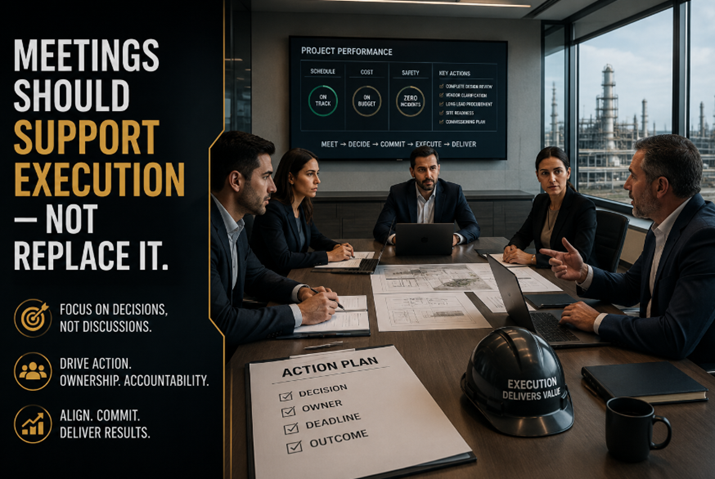
Meetings are important. Communication matters. Alignment matters. But meetings should support execution — not replace it.
I found that one of the biggest leadership mistakes is confusing visibility with productivity.
A person attending five meetings per day may appear highly engaged, while the individual quietly solving technical problems, reviewing deliverables, or closing critical actions is often less visible but significantly more valuable to project progress.
In complex engineering and project environments, this issue becomes even more dangerous.
A lack of meetings rarely causes delays. They are usually caused by unclear ownership, slow decision-making, excessive bureaucracy, or fear of accountability.
High-performing organisations understand a simple principle:
meetings should make decisions, not endless discussions.
There are three critical questions every leader should ask before scheduling another meeting:
If the answer to these questions is unclear, the meeting itself may already be part of the problem.
I have seen organisations dramatically improve performance not by increasing pressure on employees, but by reducing unnecessary operational noise. When teams are given clarity, authority, and uninterrupted focus time, execution quality improves naturally.
This does not mean eliminating meetings. Strategic reviews, safety discussions, stakeholder alignment, and technical workshops remain essential, particularly in major EPC and industrial projects. However, discipline is required. A one-hour meeting involving six senior professionals represents a significant organisational investment. If no decision is made, that investment is lost.
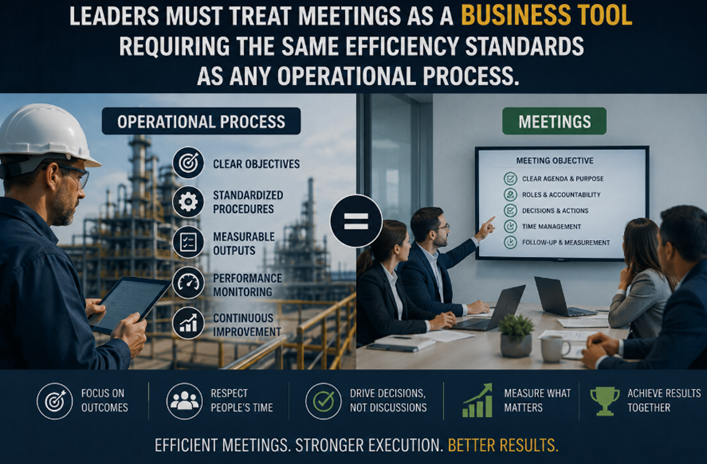
Harvard Business Review has repeatedly highlighted that ineffective meetings reduce productivity, increase employee frustration, and contribute directly to burnout and disengagement. Leaders must therefore treat meetings as a business tool requiring the same efficiency standards as any operational process.
This aligns closely with one of my previous reflections on workplace focus, where I discussed how modern professionals often mistake constant activity for meaningful output. Real performance does not come from permanent connectivity; it comes from intentional execution, clear priorities, and focused work—the silent architecture of greatness.
Ultimately, organisations do not succeed because they hold more meetings. They succeed because they make better decisions, empower capable teams, and execute consistently.
Sometimes the most productive meeting is the one that never needed to happen!