Hard decisions now, or a hard life later

There is a simple graphic that has been circulating quietly among people who take their careers seriously. On one side, a curve labelled "hard decisions now" collapses quickly into "easy life later." On the other, "easy decisions now" stretches out into a long, flat plateau that eventually bends upward into "hard life later."

Two small figures sit at the crossing point — one has already jumped through the short, sharp climb; the other is still standing in the comfortable dip, arms raised, wondering how the ground shifted beneath him.
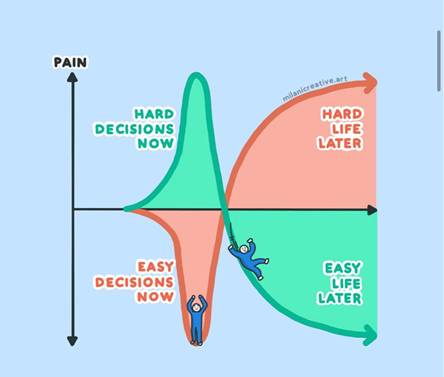
I have looked at that image more times than I care to admit, because I have lived on both sides of it.

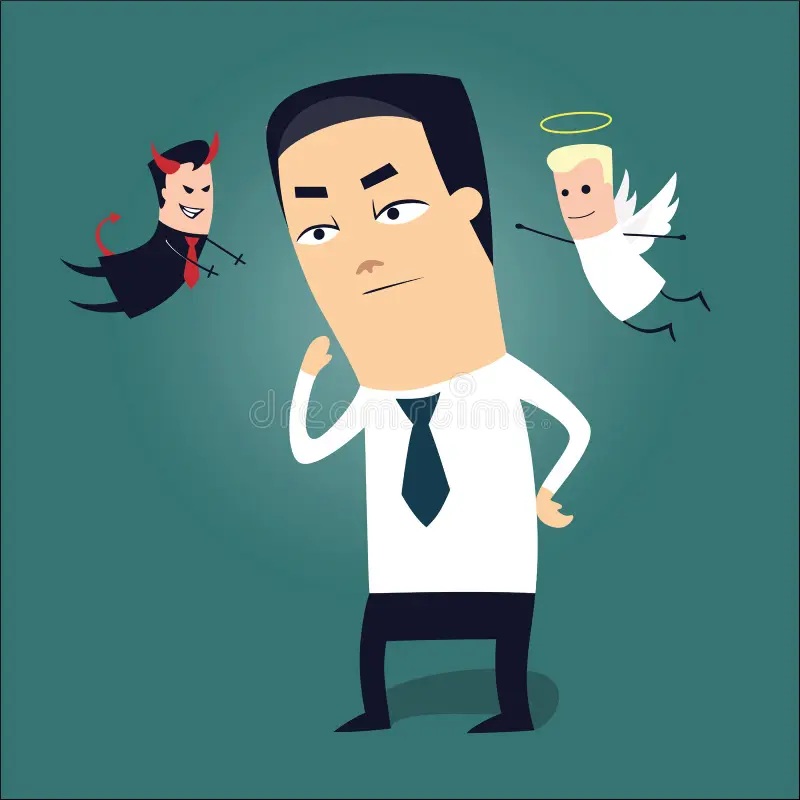
Over twenty years in corporate life, I have watched talented people choose the comfortable path more times than the hard one — not because they lacked ability, but because the hard decision rarely announces itself as urgent. It disguises itself as "not yet." Renegotiate the contract later. Have the difficult conversation with the client next quarter. Address the underperforming relationship after this deal closes. Each postponement feels rational in isolation. Compounded over years, it becomes a debt that eventually calls itself in — usually at the worst possible moment, and usually with interest.

Three things I have learned about the price of delay:

  • Discomfort now is cheaper than crisis later. A hard conversation with a client, a supplier, or a colleague costs you an uncomfortable hour today. Avoided, it costs you the relationship, the deal, or the reputation months down the line — and by then, the options for repair are far fewer and far more expensive. The pain does not disappear when you postpone it; it accrues.
  • Clarity is a decision, not a discovery. We often wait for more information before acting, as if the hard call will eventually become easy once we know enough. In my experience, clarity rarely arrives before commitment — it arrives after. You decide, then the fog clears. Waiting for certainty is often just a more sophisticated form of avoidance.
  • Short-term ease erodes long-term standing. The easiest thing I could have done at several points in my career was stay in a comfortable, familiar role rather than negotiate hard for the right terms, walk away from the wrong offer, or push back on an unreasonable timeline. Every time I chose comfort over confrontation, I paid for it later — in leverage lost, in respect not earned, in ceilings I built for myself without noticing.

This is not simply motivational language. Research from Harvard Business School on decision-making under uncertainty consistently points to the same pattern: individuals and organisations that confront difficult trade-offs early — rather than deferring them in the name of consensus or comfort — tend to preserve far more optionality and value over time than those who delay. Procrastination is rarely neutral. It is a decision, and usually the more expensive one.

I think often of the deals I have walked into where the client was chasing daily, the timeline was compressed, and someone earlier in the chain had deferred a decision that should have been made months before. By the time it reaches you, the hard decision has become a harder one, wearing the costume of an emergency.

In the end, not really about decisions at all. It is about which version of pain you are willing to accept: the short, sharp, honest kind that clears the way forward, or the long, quiet, compounding kind that waits patiently in the comfortable dip until it no longer can.

Choose the mountain, not the valley. The climb is steep, but the view — and the life — on the other side is worth every difficult step it took to get there.


 

Emile Fakhoury

Corporate Expert Writer, Business Professional in Energy/Water/Oil/Gas, Specialist in Coaching/Training, Association of Project Management UK Fellow Member. The professional who believes that adaptation to various social or corporate environments is the only way to survive and strive. Master the rules of the game in order to reach the top and change the rules.
See full bio >
The Liberum runs on your donation. Fight with us for a free society.
Donation Form (#6)

More articles you might like

One half keeps an eye on the other

George Orwell was wrong about one important thing when he wrote Nineteen Eighty-Four (published in […]

Fault lines of war: Iran, Lebanon, and the coming regional breakup

The war on Iran lacked a unified strategy. It began as a disagreement at the […]

From Nuremberg to Rotterdam: How medicine is once again at risk of being politicised

"A doctor belongs to his patient, not to the state." Since the Nuremberg Doctors' Trial, […]

The hijab question: Why Central Asia took a harder line than Russia and the West

While wearing the hijab and niqab is widespread among Muslims in the West and Russia, […]
- by The Liberum on 12/08/2026

The women Europe doesn't protect

Women’s rights: everyone talks about them. Every year for International Women’s Day, the same obligatory […]

From Mecca to the battlefield: Should David fear an Islamic Goliath?

There are moments in geopolitics when the most important thing is not what leaders say, […]