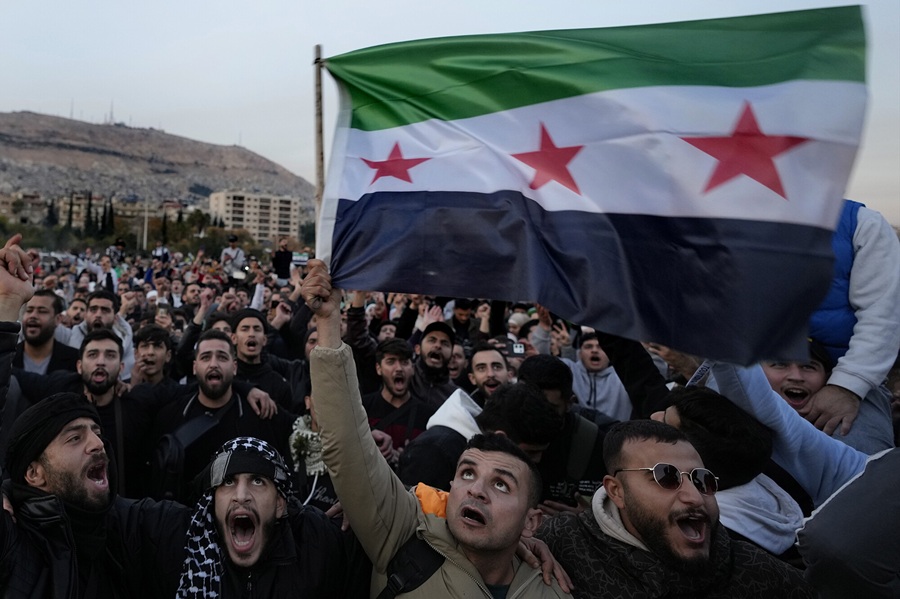
Syria in the mid-2020s is often still described as a state in reconstruction, but that framing has quietly become obsolete. What is emerging instead is something more unusual and more durable: Syria as a political layer, a geographic and administrative interface where rival external powers continuously negotiate, test limits, and distribute influence without ever resolving ownership.
By Rafic Taleb
The Ahmad al-Sharaa administration sits at the centre of this system, but not as governments usually do in a country. It is less a sovereign authority than a live protocol running atop competing foreign operating systems.
This shift is subtle but fundamental. The classic postwar question, "Who governs Syria?" has been replaced by a more complex one: "Who routes decisions through Syria?" Turkey, Israel, Iran’s remnants, and the United States are no longer primarily competing to “control” the country in a traditional sense.
Instead, they are optimising corridors of influence that pass through it. Syria has become a medium of geopolitical transmission, where power is expressed less through flags and more through permissions, red lines, logistics chains, and tolerated zones of action.
Turkey is the clearest example of this transformation. Ankara’s role has evolved from occupying space in northern Syria to embedding itself inside the administrative logic of the Syrian state.
The Al-Sharaa government does not merely coordinate with Turkey; it increasingly inherits Turkish-designed security assumptions as default parameters. Military restructuring, border management, and Kurdish integration efforts are not separate policies but extensions of an externally authored framework that Damascus administers.
In this sense, Turkey is not building a sphere of influence in Syria; it is building a runtime environment in which parts of the Syrian state now execute.
Israel operates in a different mode, but with a similar structural effect. Its actions in southern Syria are not aimed at governance or even territorial control, but at enforcing a persistent system of constraints.
The south is treated as a continuously policed boundary space where certain developments are permitted, and others are intermittently erased. Israeli strikes and interdictions function less like traditional military operations and more like system-level interrupts—correcting perceived instability before it can accumulate into strategic risk.
For the Al-Sharaa administration, this creates a paradoxical condition. Sovereignty exists on paper, but in practice southern Syria behaves like a monitored buffer zone with externally enforced boundaries.
Iran’s role, meanwhile, has shifted from architect to residual signal. After the regional war with the West and subsequent pressure on its networks, Tehran no longer projects power into Syria as a coherent system. Instead, it operates through fragments—decoupled militia remnants, logistical memories, and dormant pathways that can be reactivated but not centrally directed.
Yet even diminished, these remnants matter, because they introduce noise into any attempt by Damascus to standardise authority. The Al-Sharaa administration cannot fully “turn off” Iranian legacy influence; it can only manage its intermittency.
The United States occupies a third category altogether: the role of system stabiliser without system authorship. Washington no longer seeks to design Syria’s future, but to ensure that Syria does not become a catalyst for uncontrolled escalation among other actors.
The US’ military presence and diplomatic engagement function as load-balancing mechanisms across the region—especially between Turkey’s expansion, Israel’s security doctrine, and residual Iranian networks. In this configuration, the U.S. is less a hegemon than a regulator, adjusting pressure points without claiming ownership of the system it is stabilising.
Within this architecture, the Al-Sharaa administration is neither puppet nor sovereign in the traditional sense. It is closer to a brokered interface state: it translates between external systems that do not fully communicate with one another, but all require passage through Syrian territory.
Its power lies not in monopoly over force or territory, but in its ability to remain legible to multiple competing powers at once. Governance becomes a form of multilingual negotiation—each ministry, security institution, and border authority effectively functioning as a translation layer between incompatible external demands.
This reframing changes how Syria’s midterm trajectory should be understood. The key question is no longer whether Syria will reunify or fragment, but whether the “Syrian interface” remains stable enough to continue hosting these overlapping external systems without collapsing under their contradictions.
Stability, in this sense, is not cohesion but interoperability. Collapse would not necessarily mean renewed civil war; it could equally mean a breakdown in Syria’s ability to serve as a shared operational space for external actors, forcing them into confrontation elsewhere.
That possibility is precisely what makes Syria so central despite its internal weakness. Its value to external powers lies not in its being controllable, but in its being usable. Turkey needs it as strategic depth, Israel as a managed threat corridor, Iran as residual connectivity, and the United States as a containment buffer.
Each actor is therefore invested not in resolving Syria’s status, but in preserving its functionality as a contested but operational space.
Seen this way, the Al-Sharaa administration’s most important function may not be state-building at all, but system maintenance. They are ensuring that Syria does not stop being usable by everyone who currently disagrees on what Syria should be.
In a region where sovereignty is increasingly fragmented into overlapping permissions, Syria is becoming the rare case in which multiple sovereignties are not replacing one another but stacking on top of one another in uneasy synchronisation.
And that is the deeper shift: Syria is no longer a prize to be won. It is a platform that must be kept running, even by actors who fundamentally disagree on what should be built on it.