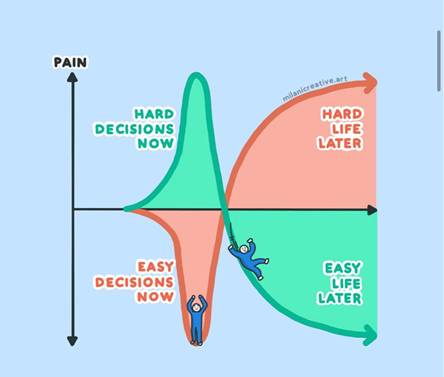
There is a simple graphic that has been circulating quietly among people who take their careers seriously. On one side, a curve labelled "hard decisions now" collapses quickly into "easy life later." On the other, "easy decisions now" stretches out into a long, flat plateau that eventually bends upward into "hard life later."
Two small figures sit at the crossing point — one has already jumped through the short, sharp climb; the other is still standing in the comfortable dip, arms raised, wondering how the ground shifted beneath him.
I have looked at that image more times than I care to admit, because I have lived on both sides of it.
Over twenty years in corporate life, I have watched talented people choose the comfortable path more times than the hard one — not because they lacked ability, but because the hard decision rarely announces itself as urgent. It disguises itself as "not yet." Renegotiate the contract later. Have the difficult conversation with the client next quarter. Address the underperforming relationship after this deal closes. Each postponement feels rational in isolation. Compounded over years, it becomes a debt that eventually calls itself in — usually at the worst possible moment, and usually with interest.
Three things I have learned about the price of delay:
This is not simply motivational language. Research from Harvard Business School on decision-making under uncertainty consistently points to the same pattern: individuals and organisations that confront difficult trade-offs early — rather than deferring them in the name of consensus or comfort — tend to preserve far more optionality and value over time than those who delay. Procrastination is rarely neutral. It is a decision, and usually the more expensive one.
I think often of the deals I have walked into where the client was chasing daily, the timeline was compressed, and someone earlier in the chain had deferred a decision that should have been made months before. By the time it reaches you, the hard decision has become a harder one, wearing the costume of an emergency.
In the end, not really about decisions at all. It is about which version of pain you are willing to accept: the short, sharp, honest kind that clears the way forward, or the long, quiet, compounding kind that waits patiently in the comfortable dip until it no longer can.
Choose the mountain, not the valley. The climb is steep, but the view — and the life — on the other side is worth every difficult step it took to get there.