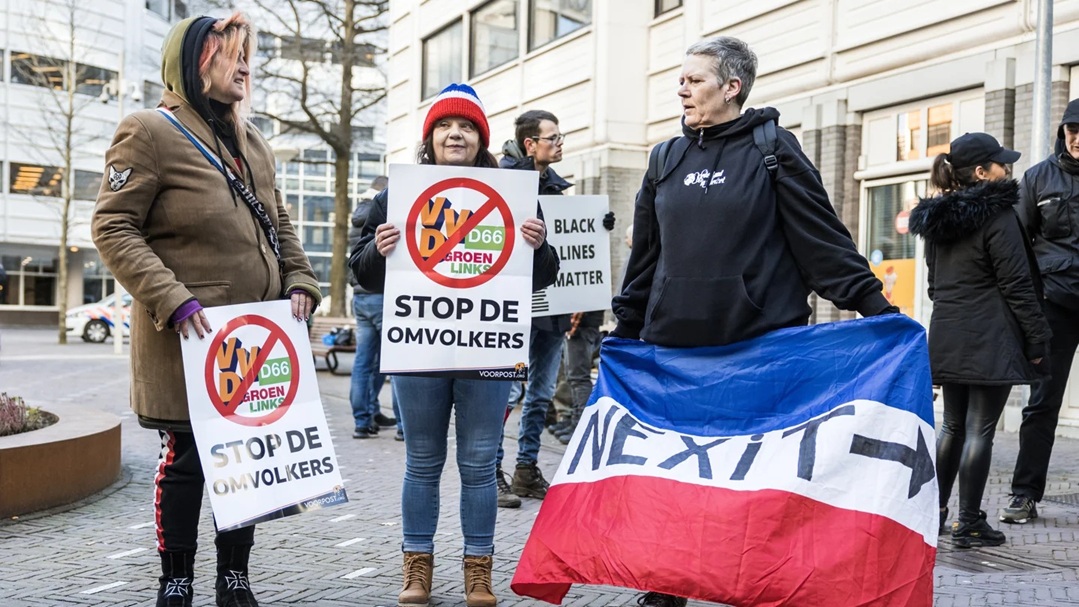
Recently, in the municipal council of a small town (Westland) in my native country, the Netherlands, an event took place that has major consequences for future European politics. The mayor fiercely opposed a municipal council member’s use of the term omvolking (population replacement). The council member explained what he meant by that word and stipulated he used it in an opposite meaning from what the Nazi’s did. But the mayor insisted it was a “Nazi-word” and could therefore not be uttered within municipal gatherings. The mayor's decision has far-reaching consequences for European politics. But is this a viable road to take?
By Paul Cliteur
The mayor, Bouke Arends (PvdA, a social-democratic party), had a confrontation with Jasper Van der Voort, a council member from a relatively new party in the Netherlands that advocates revitalising democracy and strengthening national sovereignty. A party fittingly called “Forum voor Democratie” (Forum for Democracy). The confrontation took place in the municipal council of Westland, an area in the western Netherlands.
What happened in the Westland municipal council?
Council member Van der Voort was stripped of the right to speak by the mayor. Why? Because, in his speech, the council member used a word the mayor considered inappropriate. That word was “omvolking.” In German: Umvolkung.
Mayor Bouke Arends (PvdA) first issued a warning: “You may mention it once more, but then I will take away your right to speak.” Westland council member Van der Voort nevertheless continued: “Chairman, we are against omvolking,” said the council member. He was promptly stripped of the floor: “You have been denied the floor,” said the mayor.
Some further protest from the council member followed, but he returned to his seat in the chamber. He had not been able to complete his political speech. He had been denied the floor.
The fact that a council member is stripped of the floor by the mayor because he persists in using a particular word is rather remarkable. What is also remarkable is that resistance to the term “omvolking” is not specific to the municipality of Westland. The same aversion to that word exists throughout the country — including in the Tweede Kamer, the Dutch House of Representatives, the national parliament of the Netherlands. I will go somewhat deeper into that “national resistance” to the term.
The Confrontation in the National Parliament
On July 3, 2024, then-Speaker of the House Martin Bosma asked a member of parliament, MP Thierry Baudet (FVD), not to use the word, because it “causes much offence.” He framed this as a procedural request, not as a ban.
When the MP asked, “So is the word ‘omvolking’ not allowed to be used in this chamber at all?” Bosma did not reply that it was forbidden, but that he would “greatly appreciate” it if this were taken into account. This was his answer:
“Mr Baudet, you are now using the word ‘omvolking’ in the very sense in which it was used and which was disapproved of last week in a motion adopted by a majority. I would therefore ask you to act in accordance with that motion and to refrain from using it.”
Baudet responded:
“That motion is incompatible with the constitutional freedom of expression, and that motion is therefore of no value whatsoever. The House of Representatives is not free to restrict the constitutional rights of its members by way of a motion.”
A confrontation similar to the one between Mayor Arends and council member Van der Voort had thus already taken place between Speaker Bosma and MP Baudet.
Later, in November 2025, Bosma returned to the matter. He then made explicit that there are no forbidden words in the House of Representatives. Responding to criticism that “omvolking” and “remigration” were supposedly banned, he said: “Freedom of expression applies in the House of Representatives, and there are therefore no forbidden words.”
Intelligence services against the term
Dutch counterterrorism institutions have also taken a position on the term “omvolking.” The term is frequently linked, among others, by the AIVD (General Intelligence and Security Service) and the NCTV (National Coordinator for Counterterrorism and Security), to what is called “a far-right conspiracy theory.” This occurs, for example, in a 2023 AIVD publication on “right-wing extremism.”
Are omvolking theories conspiracy theories?
That last claim, that the “omvolking theory” is a single theory that is, moreover, a “conspiracy theory”, is evidently incorrect. There is a series of identifiable theories that are by no means irrational conspiracy theories, but rather rationally grounded theories that draw on empirical data anyone can verify.
Alain Roy presents several of these theories in his booklet Les Déclinistes: ou le délire du « grand remplacement » (2023), namely those of Renaud Camus, Alain Finkielkraut, Éric Zemmour, Mathieu Bock-Côté, Michel Houellebecq, and Michel Onfray. None of these theories assumes a “conspiracy.” What they do have in common is that their authors are deeply concerned about demographic developments in European nation-states and warn of the profound changes in national culture these developments bring.
Pierre-André Taguieff’s Le grand remplacement ou la politique du mythe (2022) also discusses a number of these theories. Taguieff covers many more of them than Roy does, and based on these two books alone, it is a mystery how the AIVD and the NCTV can speak of a single theory that is supposedly also a “conspiracy theory.”
In doing so, the AIVD and NCTV contribute to what is nowadays called “misinformation” (spreading incorrect information) or even “disinformation” (spreading incorrect information while knowing it to be incorrect).
What is Omvolking?
What do those who wish to use the word “omvolking” mean by it? What does it stand for? According to the mayor, the word “omvolking” testifies to “racism.” Whether that is actually the case, however, the mayor was unwilling to explain. It simply was so. No discussion.
Van der Voort still tried with: “But we, FVD, are AGAINST omvolking.” But in doing so he had again used the word “omvolking,” and that was the basis for stripping him of the floor.
Why is that word not allowed to be used? According to the mayor, because it is supposedly “racist.” It is a “racist term,” he says. But Van der Voort denies this. According to Van der Voort, the term “omvolking” is useful for describing the demographic changes taking place in society.
Everyone can observe that far more people with a migration background are seen on the streets today than roughly 20 years ago. Entire neighbourhoods have changed in terms of population composition. In some Dutch neighbourhoods, hardly any native residents remain. Who can deny that? Why make it difficult to discuss? What is “racist” about this trend, which is in itself hard to deny?
That was also the background of a remark made by Martin Bosma in 2023, when he was still an MP for the PVV (and thus not yet Speaker of the House). During a 2023 debate, Bosma said: “Omvolking is not a theory; it has simply happened.” Apparently, as an ordinary MP, Bosma had no objections to the term “omvolking,” but as Speaker of the House he did.
Banning a term conflicts with fundamental rights
A problem with the position of the mayor of Westland, who did not want to hear the term “omvolking,” is as follows.
First of all, censoring the Forum voor Democratie faction is difficult to reconcile with democracy. After all, democracy also grants the opposition the right to speak. Silencing the opposition thus amounts to silencing democracy. Telling the opposition that it may not use certain wording touches the very core of democratic freedom.
The mayor’s conduct also conflicts with fundamental rights, such as freedom of thought (Article 9 ECHR) and freedom of expression (Article 10 ECHR).
Shouldn’t respecting democracy and fundamental rights be priority number one for a mayor? How can he disregard that so easily? The mayor would undoubtedly answer, had a debate on the matter developed (which it did not), that he is free to restrict the freedom of expression of council members when they say things that are evidently “racist.” But that was precisely the point: Van der Voort said nothing “racist.” Nor did he say anything “Nazi-like.”
After all, the racists and the Nazis were in favour of omvolking, whereas he, and his party Forum voor Democratie, are against it. Van der Voort thus wanted to make an argument against omvolking, and therefore against the Nazis, against the racists. Why should that not be allowed? Shouldn’t the mayor actually be quite pleased about that?
Not using a word like “omvolking” and declaring the entire subject taboo raises another question: is it even feasible? Or: is it practically achievable? Let us assume for a moment that Van der Voort is willing to avoid the word “omvolking” in his speeches. How would he then have to refer to the phenomenon he wants to describe?
One alternative would be to speak of the “O-word” — by analogy with the word for a Black person that is likewise taboo for some, and for which people have started using “the N-word.” The same could be done with “omvolking.” Van der Voort could then say, in his speech to the municipal council, facing the mayor and fellow council members:
“Mayor and colleagues, we of Forum voor Democratie have a strong aversion to a phenomenon that I wish to refer to as the ‘O-word.’”
Would that be allowed? Strictly speaking, the mayor could have no objection to this, since the word “omvolking” itself is not mentioned. But the entire world of thought behind the word, the concept of “omvolking”, is of course still prominently present.
So anyone who speaks of the “O-word” still draws attention to a complex set of phenomena that the mayor, in all likelihood, believes should not be mentioned at all. Which phenomena? Perhaps this is the moment to analyse them further. What are the constituent elements of “omvolking”?
First dimension of omvolking: Replacement of the European people
The core of omvolking is the replacement of one’s own population by another. Proponents of omvolking theory support this; opponents oppose it. This omvolking need not always be referred to as “omvolking” itself. Similar terms are “grand remplacement” (R. Camus), “volksvervanging” (population replacement), or “migration replacement.”
The argument in favour of omvolking usually begins with the observation that the native populations of European countries are lagging in their ability to produce offspring. To keep a population stable, parents need to have an average of 2.1 children. Does that happen?
It does not. The replacement level in developed countries is approximately 2.1 children per woman. That figure is needed to keep the population roughly constant over the long term, without immigration or emigration.
Nearly all European countries are now well below that level.
| Country | Fertility rate (children per woman) |
| Bulgaria | 1.72 |
| France | 1.61 |
| Slovenia | 1.52 |
| Netherlands | approx. 1.43 |
| Belgium | approx. 1.45 |
| Germany | approx. 1.35 |
| Sweden | approx. 1.43 |
| Denmark | approx. 1.47 |
| Italy | approx. 1.18 |
| Spain | 1.10 |
| Malta | 1.01 |
| EU average | 1.34 |
Some African countries for comparison
All African countries are well above that European average of 1.34. In countries such as Nigeria, Congo, and Niger, the rate is up to 5 times higher.
| Country | Fertility rate (children per woman) |
| Tunisia | approx. 1.8 |
| Morocco | approx. 2.2 |
| Algeria | approx. 2.8 |
| Egypt | approx. 2.5 |
| Ethiopia | approx. 3.8 |
| Nigeria | approx. 5.0 |
| Democratic Republic of Congo | approx. 6.0 |
| Niger | approx. 6.7 |
The EU’s poor average gives European bureaucrats and representatives of the European centrist parties a reason to encourage immigration instead. The shortfall of citizens in the EU is then made up with people from other parts of the world. One could also put it this way: one people (the European) is being replaced by another people (with inflow from, for example, Nigeria).
Second dimension: Change of European culture
Every country and every people has its own culture: a set of values and norms that it holds up as its ideal. Article 2 of the Treaty on European Union sets out the European values as follows:
The Union is founded on the values of respect for human dignity, freedom, democracy, equality, the rule of law and respect for human rights, including the rights of persons belonging to minorities. These values are common to the Member States in a society in which pluralism, non-discrimination, tolerance, justice, solidarity and equality between women and men prevail.
Somewhat systematised, this amounts to:
1. Human dignity,
2. Freedom and equality,
3. Democracy, the rule of law, and human rights,
4. Pluralism, non-discrimination, tolerance, justice, solidarity, and equality between women and men.
One could also say that the EU conforms to the ideals of the liberal democratic rule of law (“liberal democracy”).
Are all cultures equally committed to realising a liberal democratic rule of law?
That cannot be said. Not all cultures, and not all states, aspire to realise the ideals of the democratic rule of law. Iran, for example, has no ambition to develop a democratic rule of law along the lines of Article 2 TEU. What does it want instead? A theocracy — one not based on the idea that human law should form the basis of the political order, but rather the law of God (sharia).
The ambition to make sharia prevail everywhere is characteristic of a group of people commonly referred to as “jihadists.” As Aynaz Anni Cyrus describes in her book The Architecture of Jihad: Inside the Ideology, Law, and Global Strategy Driving Islam’s Multi-Front Expansion (2026), jihad is an enormous driving force in today’s world — not only in Iran, not only in Pakistan, not only in the Middle East, but also in Europe and the United States.
Christian missionary Peter Hammond’s book Slavery, Terrorism and Islam: The Historical Roots and Contemporary Threat (2010) is devoted to the same theme as Cyrus’s book, but Hammond goes into detail on jihad within African countries, including Nigeria, where he carried out missionary work for many years. Hammond gives an eyewitness account of the violent jihad waged by Islamists against Christians, which in effect amounts to the extermination of Christians.
Now the question of what this means for omvolking. Proponents of omvolking do not take into account the cultural differences that exist between countries and even entire cultures. They will, for instance, argue that if someone in Nigeria invokes refugee status to gain access to Europe, the cultural difference between the European country and Nigeria (which is strongly jihadist-oriented) should play no role.
Opponents of omvolking believe that this cultural difference is highly relevant and that it may, indeed, must, play a role in granting access to the European country. Admitting people from countries where jihad is part of the national culture amounts to suicide, because doing so means letting into the European country people who will undermine that country’s culture. It can also be put this way: when a democracy admits large numbers of people committed to the principles of theocracy, it will turn into a theocracy.
A development such as that which occurred in Iran in 1979, when a revolution brought a jihadist theocracy to power, also becomes a possibility in European countries.
Third dimension of omvolking: criticism of Islam
A third point on which proponents of omvolking disagree with opponents of omvolking concerns the assessment of Islam. I touched on this already when discussing Nigeria. In Nigeria, a fierce struggle is being waged between jihadists and Christians over who will govern the country.
As an observer of that struggle, one cannot remain indifferent. If the jihadists win that struggle, a new Iran will be established in Nigeria: a jihadist state. That would be disastrous, disastrous because jihadism establishes a disastrous culture, because it puts an end to democracy, the rule of law, and human rights. And that culture, the culture of democracy, the rule of law, and human rights, honours human beings more than jihadism does.
This is explained in the aforementioned book by Peter Hammond, as well as in Boualem Sansal’s Gouverner au nom d’Allah: islamisation et soif de pouvoir dans le monde arabe (2013); Sylviane Agacinski’s Face à une guerre sainte (2022); and Hamed Abdel-Samad’s Islam: Eine kritische Geschichte (2023).
Fourth dimension of omvolking: Planning
A fourth dimension of the omvolking discussion concerns whether it results from spontaneous development or planning. Some opponents of omvolking have pointed to planning. Bat Ye’or does so, for instance, in her book Eurabia: The Euro-Arab Axis (2006). According to Bat Ye’or, Europe is moving toward what she calls Eurabia. Eurabia is an appendage of the Arab/Islamic world. Eurabia is fundamentally anti-Christian, anti-Western, anti-American, and anti-Semitic. Omvolking, in her view, is the product of planning by the European bureaucracy.
There are, however, also opponents of omvolking who deny any planning. One example is Renaud Camus, author of Le Grand Remplacement (2011), or “the great replacement.”
The core of Camus’s thesis is that the original European population is gradually being replaced by immigrants, particularly from Africa and the Islamic world, as a result of: massive immigration; low birth rates among the native population; higher birth rates among some immigrant groups; and, according to Camus, a deliberate or at least accepted policy on the part of the political and cultural elites.
Camus has further developed his ideas in La Destruction des Européens d’Europe (2024) and in Enemy of the Disaster: Selected Political Writings of Renaud Camus (2025).
Camus places far less emphasis on “planning” than BatYe’or does. European security services (including, in the Netherlands, the AIVD and NCTV) are nevertheless keen to dismiss the omvolking theory as a “conspiracy theory” because the element of planning cannot, in their view, be proven — or at least, that is what they say is their motive.
Paradoxically, these security institutions thereby confirm the European bureaucracy’s suspicion of planning. After all, security services function as part of government policy. Security services do not conduct independent academic research. Nor do security services investigate the omvolking theory based on a serious study of the books by Bat Ye’or, Camus, Zemmour, Sarrazin, or any other author associated with it. Security services recycle the clichés circulating about these authors’ work.
Why?
Probably because European governments still do not want to erect a barrier against unchecked immigration and asylum. Parties that do want this, such as the PVV and FVD in the Netherlands, Alice Weidel’s Alternative für Deutschland in Germany, and Marine Le Pen’s Rassemblement National in France, are disqualified in two ways.
First, by portraying these parties as being in the grip of an irrational way of thinking: supposedly believing that European elites have hatched a conspiracy to allow immigration to continue, whereas of course there is no such thing. Second, the complaint against the PVV/FVD, AfD, and RN is that these parties spread “far-right” ideas.
The term “far-right” now stands for an ideology that does not reject violence. The term “far-right” carries connotations of “Nazi” and “fascist.” No label is as devastating as that of Nazism or fascism. So when the label “Nazi” or “fascist” is successfully attached to a particular party, that party is thereby heavily stigmatised.
It is mainly far-left agitators who have made a speciality of labelling parties and authors as “far-right.” But this far-left disqualification also leaves its mark on the centrist parties, and even on the intelligence services, which, after all, are ultimately under the control of those centrist parties. Thus, omvolking theorists too are readily associated with “far-right” ideology.
Will attempts to stigmatise parties such as the PVV and FVD in the Netherlands, Alternative für Germany in Germany, and the Rassemblement National succeed to the point that decent people no longer dare to vote for them?
Time will tell. In any case, I believe the attempts to banish the term “omvolking” from political and public discourse must be seen against the background of the discussion sketched here. I honestly do not think the centrist parties will succeed in discrediting the term “omvolking.”
Too many authors already make use of it. It is also, in itself, a useful term: it denotes a complex of interrelated factors, as my analysis of the four dimensions of omvolking shows. The fact that the Nazis, too, made use of the term is no impediment, since the Nazis were in favour of omvolking. They used it as a tactic for the Germanization of Eastern Europe.
Under the plan known as Generalplan Ost, the Nazis intended to colonise large parts of Poland, Ukraine, Belarus, and Russia with ethnic Germans. To that end, millions of Slavic inhabitants were to be expelled, forced into slave labour, or left to die as a result of hunger, violence, and deportation. The goal was to make these territories ethnically German.
After the occupation of Poland, hundreds of thousands of Poles were driven from their homes. Their houses and farms were assigned to German settlers. At the same time, ethnic Germans from other parts of Europe were relocated to these areas.
The Holocaust, too, had an omvolking aspect. The systematic persecution and destruction of the Jewish population was not only genocide, but also changed the demographic composition of large parts of Europe. In many towns and regions, centuries-old Jewish communities disappeared almost entirely.
We began with the Dutch mayor who banned the term “omvolking” and stripped a council member of the floor when he persisted in using it. It is not only unlikely that the mayor and those who share his conviction will succeed in turning “omvolking” into a taboo term, but it is also undesirable.
The omvolking that is actually taking place deserves a name. The processes at play in unchecked immigration and asylum policy likewise deserve closer analysis. The work of omvolking theorists, Camus, Bat Ye’or, Zemmour, and Sarrazin should be leading in that regard.
The term is also relevant to new European parties that might be described as radical right (not “far-right”): Forum voor Democratie, Alternative für Deutschland, and Rassemblement National. Opposition to omvolking is what these parties have in common, and thus also opposition to a practice that the Nazis employed.
For that reason too, it is absurd to qualify these radical right parties as Nazi-like.
Literature
Abdel-Samad, Hamed, Islam: Eine kritische Geschichte, DTV, Munich 2023.
Agacinski, Sylviane, Face à une guerre sainte, Seuil, Paris 2022.
BatYe’or, Eurabia: The Euro-Arab Axis, Fairleigh Dickinson University Press, Madison, Teaneck 2006.
Camus, Renaud, Enemy of the Disaster: Selected Political Writings of Renaud Camus, Vauban Books 2025.
Camus, Renaud, La Destruction des Européens d’Europe, Independently published 2024.
Cyrus, Aynaz Anni, The Architecture of Jihad: Inside the Ideology, Law, and Global Strategy Driving Islam’s
Multi-Front Expansion, Live Up to Freedom, USA 2026.
Hammond, Peter, Slavery, Terrorism and Islam: The Historical Roots and Contemporary Threat, Xulon Elite Press, United States of America, 2010.
Roy, Alain, Les Déclinistes ou le délire du « grand remplacement », Les Éditions Écosociété, Paris, 2023.
Sansal, Boualem, Gouverner au nom d’Allah: Islamisation et soif de pouvoir dans le monde arabe, Gallimard, Paris, 2013.
Sarrazin, Thilo, Deutschland schafft sich ab: Wie wir unser Land aufs Spiel setzen, 2nd ed., Deutsche Verlags-Anstalt, Munich 2012 (2010).
Sarrazin, Thilo, Feindliche Übernahme: Wie der Islam den Fortschritt behindert und die Gesellschaft bedroht, FinanzBuch Verlag, Munich 2018.
Taguieff, Pierre-André, Le Grand Remplacement ou la politique du mythe, L’Observatoire, Paris, 2022.