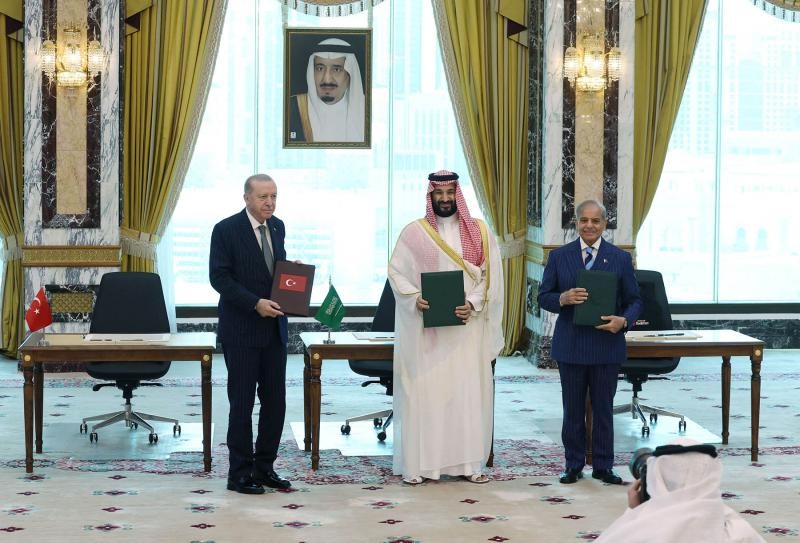
There are moments in geopolitics when the most important thing is not what leaders say, but where they choose to say it. On Friday, August 7, three of the Muslim world's most strategically important states gathered in Mecca. Saudi Arabia. Turkey to sign a defence agreement. A NATO-like fundamental principle: ‘an armed attack against one of them would be considered an attack against all three’. Immediately changed the strategic temperature of the region.
By Nadia Ahmad
While the document has a suitably restrained name, the Makkah Joint Defence Agreement- its implications are less so.
For decades, Saudi Arabia, Türkiye and Pakistan have pursued different strategic paths. Riyadh built its security architecture around the Gulf and its relationship with Washington. Ankara became the Muslim world's most consequential NATO member, simultaneously looking west toward the Atlantic alliance and east toward its own regional ambitions.
Pakistan, meanwhile, developed one of the world's most powerful Muslim militaries and the Islamic world's only publicly acknowledged nuclear arsenal.
These were not three countries waiting patiently to become one security bloc. They had different interests. Different enemies. Different alliances. Different geographies. And yet they have now decided that, at least in the field of defence, one country's vulnerability can become everyone's concern.
So, the obvious question arrives almost by itself: should David fear an Islamic Goliath? For now, the answer is not yes or no.
Because the significance of Mecca may lie less in the military forces that can immediately be placed under one command than in the political message being sent by three very different powers: perhaps the age in which individual Muslim states depended primarily on outside security guarantees is beginning to change.
That is where the story becomes much bigger than a treaty; it lies in geography. Saudi Arabia sits at the heart of the Gulf, controlling enormous energy resources and the two holiest cities in Islam. Its strategic relationship with the United States has been one of the defining pillars of Middle Eastern security for generations.
Türkiye occupies another world entirely. A NATO member, a major military power and an increasingly independent actor stretching from the Black Sea to the Middle East. Its defence industry has become one of its most important instruments of foreign policy.
Then there is Pakistan. Thousands of kilometres away, Pakistan sits between South Asia, Central Asia and the Middle East. It possesses a large standing military, nuclear weapons and decades of defence cooperation with Saudi Arabia. Pakistani military personnel have long served alongside Saudi forces, making the relationship much older than the new treaty.
What has now changed is the architecture. Saudi Arabia and Pakistan had already signed a strategic mutual defence agreement in 2025. The new Mecca agreement brings Türkiye into a trilateral framework and gives the relationship a much larger geographical and strategic reach.
The three countries are therefore not beginning from zero, but building on something that already existed; that is what makes the development more serious.
Why Mecca? The location itself deserves attention. Treaties are normally signed in capitals, in palaces, government buildings, conference halls and diplomatic rooms filled with flags. This one was signed in Mecca. That does not make it automatically religious in character. The agreement is a state-to-state defence arrangement, not the creation of an Islamic holy war.
But symbolism matters in international politics. Mecca is not simply Saudi territory; it is the spiritual centre of the Muslim world.
The decision to place this particular act of strategic cooperation there inevitably gives the event a civilizational resonance that a signing ceremony in Ankara, Islamabad or Riyadh would not have carried in quite the same way. The message is subtle. Three states are not merely saying that they will cooperate. They are saying that cooperation among major Muslim powers can itself become part of the region's security architecture.
Suddenly, the map looks different. The most important phrase in the agreement is remarkably simple: that any attack on one is to be treated as an attack on all three. A familiar phrase. NATO built its post-war security architecture around precisely this logic.
Türkiye knows the formula particularly well because it has lived under NATO's collective-defence umbrella for decades.
Now Ankara is participating in another structure built around a similar principle. Fidan has described the provision as technically the same as NATO's Article 5. However, the pact leaves the precise nature of the response to consultation rather than automatically prescribing a specific military action.
This is not a Middle Eastern NATO yet. There is no single integrated military command comparable to NATO's. There is no guarantee that every crisis would produce an identical military response. And the governments involved insist that the agreement is defensive rather than directed against a named enemy.
But alliances are not created only by military hardware, but also by expectations. And expectations can change the calculations of everyone watching. The agreement names no adversary, and Türkiye has explicitly rejected the suggestion that Iran is the target. But strategic agreements rarely need to name their audience. A shield does not need to announce whom it is protecting itself against. The very existence of a larger shield changes the calculations of anyone considering testing it.
That is why the Israeli question cannot simply be avoided. Israel has spent decades living in a region where its conventional military superiority has been balanced by geography, intelligence, diplomacy and — above all — the fragmentation of its potential adversaries. Saudi Arabia, Türkiye and Pakistan are not a unified anti-Israel military machine. Their interests are too different, their relationships with Israel are too complicated, and their strategic priorities extend far beyond Israel.
Yet from Jerusalem, the emergence of a new collective-defence structure linking a wealthy Gulf power, a major NATO military and a nuclear-armed South Asian state cannot be irrelevant. David does not need to panic, yet would be foolish not to look up.
There is another shadow behind the agreement. Pakistan is a nuclear power; Saudi Arabia is not. That fact alone guarantees that every new defence arrangement between Islamabad and Riyadh will be examined through the nuclear lens.
Yet the public agreement does not create a declared Saudi nuclear umbrella, and there is no public evidence that the trilateral pact transfers Pakistani nuclear weapons or nuclear control to Saudi Arabia. The distinction matters enormously.
The mythology surrounding a possible Pakistani nuclear guarantee for Saudi Arabia has existed for years. The reality is much more complicated. But even without a nuclear transfer, Pakistan brings something strategically unusual to the table: the existence of a nuclear deterrent inside a collective-security relationship involving Saudi Arabia.
That is enough to make strategists pay attention. There is another participant in this story who did not sign the document. Washington.
For decades, the basic American bargain in the Gulf was relatively straightforward: the United States provided security, while Gulf partners provided strategic cooperation, energy stability and access. That bargain has been changing. Not necessarily collapsing, simply changing.
Saudi Arabia has increasingly demonstrated that it does not want its foreign policy reduced to choosing between Washington and everyone else.
It has developed deeper relations with China. It has pursued dialogue with Iran. It has cultivated Türkiye. It has maintained its relationship with the United States. It has increasingly behaved like a power that wants options rather than dependence.
The Mecca agreement fits that broader pattern. It does not necessarily represent a Saudi break with America. It may represent something more subtle: Saudi Arabia preparing for a world in which no single external power can be assumed to guarantee everything.
That is a very different proposition, and there is an even more intriguing possibility.
Washington may now have less incentive to pursue the complete collapse of the Iranian regime. Not because the United States suddenly trusts Tehran, but because a powerful Iran — weakened, contained and forced to live beside three increasingly coordinated Sunni powers — may serve a different strategic purpose.
A region in which one major Shi'a power balances a Saudi-Turkish-Pakistani Sunni alignment could, from Washington's perspective, be easier to manage than a vacuum created by the sudden disappearance of Iran. In that equation, equilibrium may become more valuable than regime change.
The irony would be considerable. The very emergence of a stronger Sunni security alignment could make the continued existence of a major Shi'a Iran strategically useful to the United States — not as an ally, but as a counterweight. Türkiye may be the most fascinating member of the three. Unlike Saudi Arabia and Pakistan, it is already inside the world's most powerful military alliance.
NATO membership gives Ankara a security relationship that neither Riyadh nor Islamabad possesses. So why join another collective-defence arrangement? Because Türkiye has never been content to define its strategic identity exclusively through NATO. Ankara increasingly sees itself as a power with interests stretching across multiple regions.
The Turkish military-industrial complex has also become an important instrument of influence, from drones to naval systems and other defence technologies. Türkiye therefore brings something different to the Mecca arrangement.
Pakistan brings nuclear deterrence and military depth. Saudi Arabia brings money, geography and the weight of the Gulf. Türkiye brings a major conventional military, a sophisticated defence industry and NATO experience. Three different pieces. One shield. The most interesting question is not what they signed.
It is why they signed it now. That question cannot be answered with a single word. The region has entered a period of extraordinary strategic uncertainty. Iran remains a central regional power. The Gulf states have experienced the vulnerability of missile and drone warfare. Israel remains militarily dominant but is surrounded by an increasingly complicated regional environment.
American power remains enormous, but its reliability is debated more openly by its partners than it was a generation ago. And the Muslim powers themselves have become wealthier, more militarily capable and more willing to act independently.
The result is a Middle East that increasingly resembles a chessboard on which the pieces are no longer waiting for Washington to move first. The Mecca agreement may therefore be less about creating an Islamic super-alliance than about creating strategic insurance.
If one country is threatened, the others will at least have to ask what happens next. That alone can have a deterrent effect. Perhaps the most consequential detail is that the arrangement may not remain trilateral.
Turkish officials have indicated that the framework could eventually expand, with Egypt among the countries discussed. If that happens, the strategic significance would increase considerably. Saudi Arabia. Türkiye. Pakistan. Egypt.
Four major Muslim states spanning the Gulf, Anatolia, South Asia and North Africa. That would no longer look like an improvised response to one regional crisis. It would begin to resemble the foundations of a broader security architecture.
But foundations are not buildings. Declarations are easy. Integrated militaries are difficult. Joint command structures are difficult. Interoperability is difficult.
Agreeing on what constitutes an attack — and what each country is actually prepared to risk when the missiles begin flying — is harder still. The history of international alliances is full of impressive documents that became less impressive when tested by reality.
The real test of Mecca will therefore not be the ceremony; it will be the crisis. David should watch, not tremble. So, should David fear the Islamic Goliath? Not yet.
There is no single Islamic army marching toward Jerusalem. There is no declared anti-Israel coalition. There is no evidence that Saudi Arabia, Türkiye and Pakistan have suddenly abandoned their separate national interests.
Quite the opposite. Their differences remain enormous. But something important has nevertheless happened. Three powerful Muslim states have decided that their security interests are sufficiently connected to justify a collective-defence commitment.
They chose Mecca to announce it. They used language resembling NATO's collective-defence principle. They left the door open to expansion.
And they did all this at a moment when the old regional security order is under unprecedented strain. That does not make Goliath. Not yet.
But it may be the beginning of something that David cannot afford to ignore. Because the greatest strategic changes rarely arrive with a declaration of war.
Sometimes they arrive quietly. Three leaders meet. A document is signed. A sentence is written. And suddenly, somewhere far away, military planners begin drawing a slightly different map.