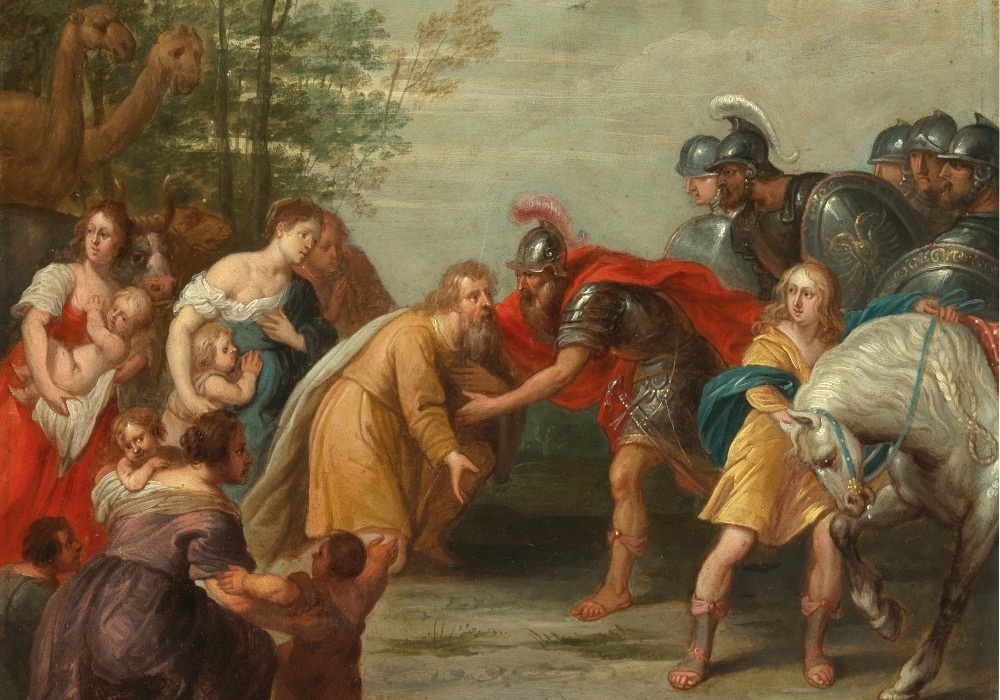
In the first part of this essay, Esau was explored not as a biological ancestor of the modern West, but as a civilisational archetype that survived through Rome, Christianity, and eventually the secular structures of Western power. If Jacob became the guardian of covenantal memory, Esau became the builder of worldly order.
By Nadia Ahmad
The West inherited both, but it inherited Rome more visibly. The enduring power of civilisations lies not merely in conquering land, but in surviving symbolically long after their political structures collapse. Rome fell, yet the West remained Roman. The biblical kingdoms disappeared into history, yet their names continue to echo through theology, politics, and collective memory.
In this sense, the story of Esau did not end with Edom. It evolved into something far larger: a civilisational inheritance woven into the foundations of the Western world, often unconsciously, through empire, Christianity, and eventually modern secular power.
The modern West rarely sees itself through biblical genealogy. It defines itself through institutions, liberalism, science, democracy, and technological progress. Yet beneath this modern self-image lies an older structure inherited from Rome and, before Rome, from the symbolic memory of Edom.
The Western world became Christian in faith, Roman in structure, and biblical in imagination. This synthesis created a civilisation that no longer recognised Esau as a literal ancestor. Still, it continued to embody many of the traits historically associated with him in biblical interpretation: pragmatism, expansion, material power, territorial order, and political universality.
The earlier essay argued that Esau became the figurative father of the West not through blood, but through civilisational inheritance. That inheritance deserves deeper exploration because it helps explain why the modern West often appears divided between two competing impulses: power and morality, empire and covenant, Rome and Jerusalem.
The West has never fully resolved this tension because it was built upon both simultaneously.
The ancient Roman Empire represented perhaps the greatest manifestation of structural and imperial pragmatism in the ancient world. Rome spread not primarily through prophecy or revelation, but through administration, law, roads, armies, engineering, and the promise of order.
Citizenship itself became imperial. Rome absorbed nations by institutionalising them. This was fundamentally different from the Jewish covenantal tradition, which preserved itself not through universal conquest but through continuity of law, ritual, and memory within a smaller people bound together by religious identity and historical consciousness.
Yet history produced an unexpected fusion. Christianity emerged from the Jewish world but universalised itself through Rome. The empire of Caesar eventually became the empire of Christ. In doing so, the Western world inherited two civilisational energies at once: the covenantal ethics of Jerusalem and the imperial structure of Rome.
This synthesis shaped Europe for centuries. The Church preserved Hebrew scripture, while Roman political logic organised Christian civilisation into a universal order that extended across continents.
This tension between covenant and empire became one of the defining contradictions of the West. Christianity preached humility, sacrifice, and spiritual equality before God, yet Christian empires conquered, colonised, and expanded across the globe.
Europe spoke in the language of salvation while operating through the mechanisms of imperial power. The cross and the sword travelled together through history, often uneasily.
In this sense, the “Esau question” never disappeared. It simply transformed. The West inherited Roman pragmatism even after it abandoned explicit Roman identity. Modern Western states still reflect Rome’s instinct toward system-building, infrastructure, legal universalism, and strategic expansion. International law, global trade routes, military alliances, bureaucratic governance, and even the modern concept of citizenship carry echoes of Roman logic adapted to modernity.
At the same time, the moral vocabulary of the West remained deeply biblical. Human rights, moral universalism, redemptive politics, and even secular concepts of historical progress emerged within a civilisation shaped for centuries by Judeo-Christian categories.
Modern secularism did not erase biblical structure; it often secularised it. Political ideologies replaced theology, but retained theological rhythms: visions of redemption, liberation, collapse, and universal truth.
This dual inheritance helps explain many of the West’s modern contradictions. It explains why Western powers often present geopolitical interventions in moral language. It explains why liberal democracies simultaneously champion universal values while pursuing strategic interests with ruthless pragmatism. Rome never fully disappeared beneath Jerusalem, nor did Jerusalem disappear beneath Rome. The Western world became a permanent negotiation between the two.
The establishment of modern Israel further complicated this inheritance. Israel emerged not only as a nation-state but as the return of biblical memory into modern geopolitics. Suddenly, the covenantal narratives that had shaped Western religious consciousness for centuries became politically embodied in a modern sovereign state. The result was psychologically and politically destabilising for many actors across the region and beyond.
For the West, Israel represented something paradoxical: both a modern ally and an ancient memory re-entering history. For many Jews, Israel was the restoration of continuity after centuries of exile and vulnerability.
For many in the Arab and Islamic world, however, Israel appeared within the context of colonial fragmentation, dispossession, and geopolitical intervention. Once again, two historical timelines collided, each carrying its own interpretation of legitimacy and historical justice.
The Islamic world developed outside the Roman-Christian synthesis that shaped Europe. Islam emerged from Arabia with its own universal structure, political theology, and imperial trajectory.
While Christianity spread through the skeleton of Rome, Islam built its civilisation through a different axis rooted in revelation, law, and expanding caliphates. This produced not merely religious difference, but competing historical imaginations.
Part of the tension between the West and parts of the Islamic world today reflects this deeper divergence in civilisational formation. The West inherited a Christianised Rome; the Islamic world inherited a universalised Arabia. Both became expansive civilisations with universal claims, yet they grounded legitimacy differently.
One fused empire with covenant through Christianity; the other fused prophecy with political order through Islam.
However, it would be simplistic and dangerous to reduce modern conflicts to ancient genealogies alone. Civilisations evolve, intermingle, and transform constantly. Modern identities are not reducible to biblical archetypes. Yet symbols matter because human beings continue to interpret politics through inherited stories. Even secular societies unconsciously preserve ancient structures of meaning beneath modern language.
This is particularly visible in the Middle East, where history is rarely dead. Ancient names, sacred geography, and prophetic memory remain politically active in ways unfamiliar to much of the contemporary secular West.
Jerusalem is not simply a capital or disputed territory. It is a symbolic intersection where covenant, empire, prophecy, and sovereignty overlap. The city condenses thousands of years of theological and political memory into a single contested space.
What makes the Esau thesis provocative is not the claim of literal descent, but the suggestion that civilisations inherit symbolic personalities across time. Rome became more than a state; it became a template.
Christianity became more than a religion; it became the moral language of Western civilisation. Israel became more than a country; it became the return of covenantal memory into modern political reality.
The modern West itself now stands at an uncertain crossroads regarding this inheritance. Europe is increasingly secular, America increasingly polarised, and Western civilisation increasingly unsure of its own metaphysical foundations. The biblical narratives that once unified Western consciousness no longer operate with the same force they once did.
Yet the symbolic structures remain embedded in institutions, ethics, political rhetoric, and collective imagination.
This creates a peculiar situation where the West often continues to act within biblical and Roman frameworks while no longer fully believing in either. It retains Rome’s machinery and fragments of Jerusalem’s moral vocabulary, but without the same civilisational confidence that once fused them.
Meanwhile, Israel remains deeply conscious of history in a region where history still shapes political identity directly. Unlike many modern states formed primarily through administrative borders, Israel carries an unusually dense historical consciousness tied to memory, exile, return, and continuity.
Whether admired or opposed, it is rarely perceived neutrally in the region because it exists simultaneously in political and symbolic dimensions.
The larger lesson may be that civilisations never fully escape their founding narratives. They modernise them, secularise them, reinterpret them, and sometimes deny them, but they rarely erase them. Babylon, Rome, Jerusalem, and Mecca are not only historical places. They are civilisational reference points that continue to shape how societies understand legitimacy, power, morality, and destiny.
In that sense, the story of Esau did not disappear with Edom. It survived through Rome, through Christendom, through Western expansion, and eventually through the modern secular order that inherited both imperial structure and biblical memory without fully recognising either.
The modern West may no longer speak openly in the language of Genesis, yet echoes of Genesis still shape its institutions, wars, moral vocabulary, and political imagination. Rome survives in its structures, Jerusalem in its conscience. Between the two stands the unresolved inheritance of Esau