Russia is moving east. The shift is no longer merely geographical. The war in Ukraine has accelerated a political, economic, and strategic reorientation already underway. Moscow increasingly looks toward China, Central Asia and the wider Global South, while its relationship with the West has become defined by confrontation rather than integration. Russia is beginning to imagine a different place for itself in the world: can Russian Orthodoxy move east with Russia without ceasing to be Russian Orthodoxy?
By Rami Audi
The question matters because the Russian state and the Russian Church do not possess the same kind of universality. A state can move its strategic horizon. A church cannot move its sacred geography quite so easily.
Russia can build partnerships with China, cultivate relations across Asia, strengthen its position in Central Asia and present itself as one of the pillars of a post-Western international order. The Russian Orthodox Church can establish parishes abroad and cultivate relationships with Orthodox communities beyond Russia.
Geopolitical expansion and religious expansion are not the same thing. Russia can become more Eurasian without becoming Chinese, Central Asian or Asian in any simple civilizational sense. Its political identity can stretch across a larger strategic space while remaining Russian. Orthodoxy faces a harder question.
An ideology can cross a border without changing its identity. A civilisation cannot cross one without asking what it is becoming.
For Russian Orthodoxy, geography is never merely geography. Its memory is inseparable from Kyiv, Byzantium and Constantinople. The baptism of Rus' was not the creation of a Russian national religion in the modern sense. It was the Rus' world's entrance into Byzantine Christianity. Its spiritual genealogy therefore runs through Constantinople before it runs through Moscow.
That history creates an uncomfortable paradox for a Russia increasingly defining itself against the West and moving toward the East. Russia's geopolitical future may be Eurasian. Its Christian inheritance is Byzantine. Those two things can coexist, but they cannot be assumed to be the same.
Indeed, Russia's present eastward turn is more complicated than a simple return to its Christian origins. The Byzantine East that gave Christianity to Rus' was not the same East toward which Moscow now turns. Constantinople was the source of Russia's Christian inheritance; China, Central Asia and the wider Asian world represent a radically different civilizational environment. Russia is therefore not simply returning east. It is entering a new East while carrying an old Christian memory.
The Soviet Union offers a revealing comparison. The Soviet project was expansionist, but its ideology was universal. Communism did not require a population to become ethnically Russian, culturally Russian or religiously Russian.
Its universal claim was ideological. The Soviet state could incorporate Muslims, Christians, Buddhists and atheists because Marxism-Leninism claimed to stand above particular religious identities. The Soviet Union could therefore expand while suppressing the very idea that sacred identity should determine political belonging.
An ideology could travel because it claimed to replace the particular. Faith cannot travel in quite the same way. It carries memory, place, ritual and inheritance with it.
Post-Soviet Russia has attempted something considerably more complicated. It has rejected Soviet atheism while retaining, in modified form, the geopolitical scale of the state that preceded it. Orthodoxy has returned to the centre of Russian national identity, while the Russian state once again thinks in terms larger than the nation-state.
This creates a fundamental tension: a national church can sanctify a nation, but can it sanctify an empire without becoming imperial itself?
That is not merely a question about Moscow. It asks what happens when theology is asked to follow geopolitics beyond the borders that shaped its modern identity.
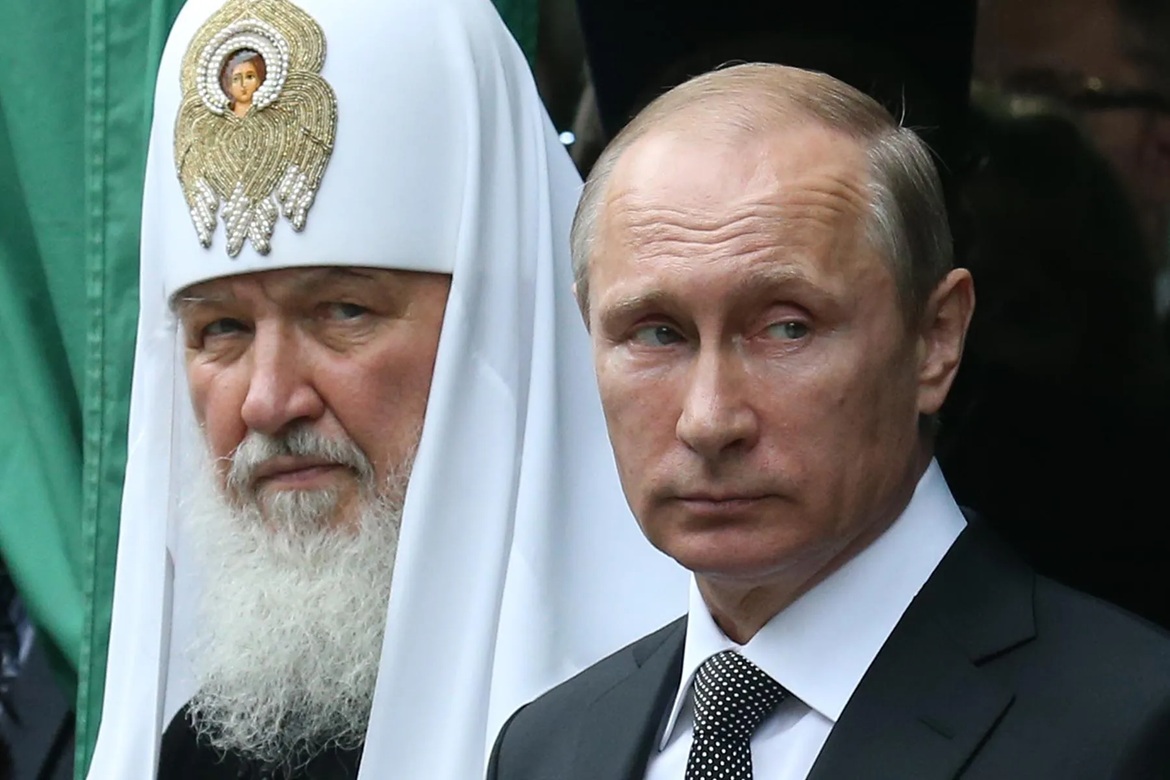
This is also where the Putinisation of Russia becomes relevant. Putinisation is not simply the concentration of political power in one leader. It describes something deeper: the gradual fusion of state authority, national identity, historical memory and political loyalty around the Kremlin.
When that process reaches the religious sphere, Orthodoxy risks being asked not merely to serve the Russian nation, but to sanctify the political narrative of the Russian state.
The distinction is crucial. A faith can belong to a civilisation without belonging to its government. Once the government becomes the civilisation's interpreter, however, the Church's independence becomes harder to preserve.
The Russian Orthodox Church has already experienced this tension most dramatically in Ukraine. Ukraine was not simply another foreign country in Moscow's religious imagination. The Moscow Patriarchate historically regarded large parts of the Ukrainian Orthodox world as belonging to its canonical space. When that space became contested, the dispute ceased to be merely ecclesiastical.
It became intertwined with competing visions of history, nationhood and sovereignty. Recent scholarship has shown how the Moscow Patriarchate's response to Ukraine became substantially more sacralized than its response to Russia's 2008 intervention in Georgia, in part because Ukraine represented a direct challenge to Moscow's conception of canonical territory.
That distinction is crucial. The Church does not simply follow the Russian state wherever it goes. It has its own territory, history, and institutional interests. And when those interests overlap with state power, theology can become geopolitical.
The danger is that the Church then begins to confuse two different things: preserving a religious civilisation and preserving a political sphere of influence. The difference is enormous.
A civilisation can survive the loss of territory. A church can survive the loss of political power. But once sacred identity depends on political expansion, the fate of the faith becomes tied to the fate of the empire. That is a dangerous bargain for any church.
The old Russian idea of Holy Russia offers an intriguing counterpoint. Properly understood, Holy Russia is not merely a political map. It is a spiritual and moral ideal. And that distinction matters. A map can expand. An ideal cannot be expanded by conquest.
The Russian Orthodox tradition associated with St. Sergius of Radonezh also emphasises Christian unity differently. The Russian tradition remembers him in terms of salvation through love and unity. Whatever its later political uses, the Christian meaning of such a formulation points away from territorial possession and toward spiritual communion.
That is precisely where the modern geopolitical question becomes uncomfortable. If unity is primarily understood as possession of territory, the Church risks becoming an extension of the state. If unity is understood as communion, the Church acquires a universal horizon that no empire can fully own.
Dostoevsky approached the same problem from another direction. In reflecting on nations, he argued that a moral idea precedes a people's political form. This insight matters because it reverses the usual nationalist assumption. A nation is not sustained by territory alone. A moral idea must give the territory meaning.
The farther Russia moves from Europe, the more urgently it may therefore have to define what “Russian” actually means.
The temptation is understandable. Russia increasingly presents itself as the defender of a civilisation distinct from Western liberalism. The Russian Orthodox Church has become an important carrier of what Moscow describes as traditional values, while Russia's political project increasingly seeks influence beyond its traditional European sphere. But the further Russia moves into a genuinely plural Eurasian environment, the harder the theological problem becomes.
China is not Orthodox. Islam overwhelmingly shapes Central Asia. India has its own religious civilisation. The wider Asian world contains Buddhist, Hindu, Muslim, Christian and secular societies with their own conceptions of sacred order.
Russia may cooperate with all of them. It may even become one of the principal political powers in a post-Western international system. But none of that makes these civilisations part of a Russian Orthodox world.
Alliances can be Eurasian. Sacred memory is never merely Eurasian.
This is where geopolitics meets theology. Political influence can be multinational. Faith cannot become universal simply because the state carrying it becomes powerful.
If Moscow wants to build a Eurasian order, it must eventually answer what kind of order it is. Is it Russian? Is it Orthodox? Is it Eurasian? Is it merely anti-Western? Or is it a strategic coalition of civilisations that have little in common beyond their desire to resist Western dominance? These are not interchangeable categories.
Russia's answer will determine Orthodoxy's future role.
There is another danger. If Russian Orthodoxy becomes too closely identified with Russian geopolitical power, every Russian strategic advance can be interpreted as an Orthodox advance, and every Russian defeat as a religious defeat. The recent use of Orthodox relics and medieval warrior-saints in support of Russian troops illustrates how closely sacred history and military nationalism have become intertwined.
The latest example is almost impossible to ignore. In September 2026, the Russian Orthodox Church sent a fragment of the right hand of Dmitry Donskoy to Russian forces in occupied Donetsk, explicitly presenting the relic to strengthen the soldiers' spirits. Orthodox clergy and military officials participated in the ceremony, while the relic was presented as a source of spiritual support for troops at the front.
The symbolism is powerful. But precisely because it is powerful, it deserves scrutiny.
Dmitry Donskoy belongs to Russia's Christian history. He does not belong exclusively to the foreign policy of any contemporary Russian government. When sacred memory becomes military symbolism, history can cease to be something a civilisation inherits and become something a state deploys.
This is perhaps where the Putinisation of Russia reaches its most revealing point. The state does not merely invoke history, but increasingly determines which parts of sacred history should accompany its armies.
That is where Orthodoxy risks losing something essential.
Christianity is not the theology of permanent geopolitical expansion. The Christian Church has survived empires. It has survived their collapse. It has lived under emperors, kings, republics and regimes hostile to belief itself. Its deepest claim is therefore radically different from an empire's.
The empire says: this territory belongs to us.
The Church says: this person belongs to God.
Those statements can coexist, but they are not the same.
Russia's future will depend partly on whether it remembers the difference.
If Russia moves east, Orthodoxy will have to decide whether it is being asked to accompany a nation or accompany a civilisation. If it chooses the first, it risks becoming increasingly nationalistic as Russia's geopolitical ambitions become increasingly multinational. If it chooses the second, it must accept that an Orthodox civilisation cannot simply be identical with Russian power.
That would require a different understanding of Russian greatness. Not the greatness of possessing more space, but the greatness of possessing a civilisation capable of surviving beyond its borders.
Perhaps this is the irony of Russia's eastward turn. Moscow may believe that it is escaping the West by becoming Eurasian. But the deeper challenge is not whether Russia can find new partners. It is whether it can build a larger geopolitical identity without reducing Orthodoxy to an instrument of national power.
Russia's eastward turn may therefore be less a discovery of a new civilisation than an attempt to give an old imperial ambition a new geopolitical vocabulary.
The Soviet Union once tried to solve the problem by eliminating religion. Russia cannot solve it that way again. Its present project depends, at least partly, on recovering the religious and historical memory that Soviet communism tried to erase.
But that recovery creates a responsibility.
If Orthodoxy is to be the soul of Russia, Russia cannot ask the soul to become merely the flag of the state. The question, then, is not whether Russia can resist the West. It is whether resisting the West has become sufficient to define a civilisation.
The future of Russian Orthodoxy may depend on something more difficult than following Russia east. It may depend on learning how to remain Orthodox without needing Russian power to define what Orthodoxy is. And that may ultimately determine whether Russia's eastward journey produces a new civilisation, or merely a larger version of an old empire.