Every project leader has seen it happen. You have a capable team, a solid plan and a committed sponsor. Then one tense steering meeting later, the room changes.
People get defensive, information stops flowing, and decisions turn reactive. We usually blame the schedule, the budget or the client.
In her APM book Neuroscience for Project Success: Why People Behave as They Do, Carole Osterweil points to something we rarely put on the risk register: the human brain.
Her message is simple and powerful. Projects are delivered by people, and people's behaviour is driven far more by the brain's survival wiring than by our Gantt charts.
The online and offline mind
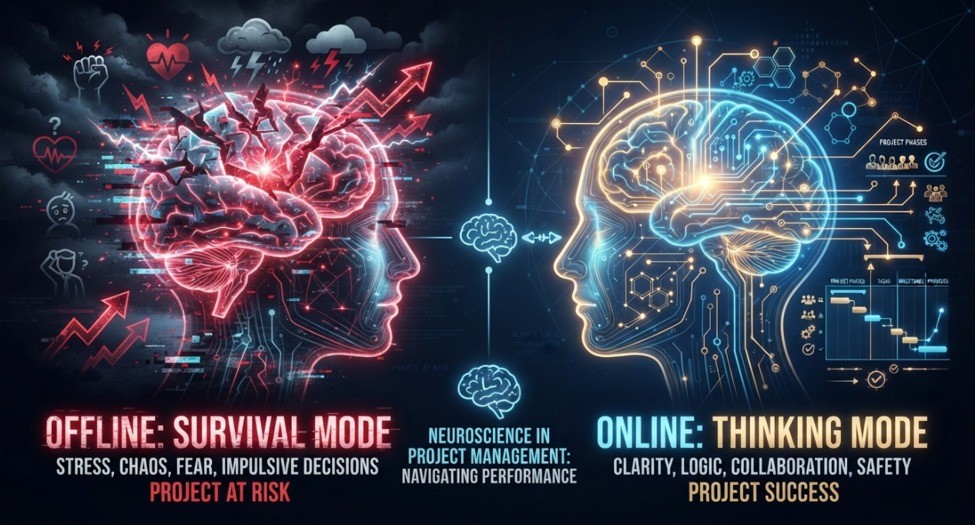
Osterweil distinguishes between a brain that is "online" and one that is "offline". When the thinking brain is online, we reason, collaborate, solve problems and see the bigger picture. When we sense a threat, the survival system takes over, and the thinking brain goes offline. We fight, freeze or flee, often in subtle, professional ways: blame, silence, micromanagement and endless escalation emails.
The brain is fundamentally a prediction machine, and it keeps asking one question: is this a reward to approach, or a threat to avoid? Uncertainty is the daily reality of every project, and it makes prediction difficult. The brain reads unpredictability as danger.
That is why the avoid response is triggered so easily, and why, as neuroscientist David Rock observes, it tends to be stronger and longer-lasting than the approach response. A leader who forgets this will keep demanding creativity from people who are, biologically, in survival mode.
SCARF: the social threats we underestimate
Osterweil's ideas fit neatly with the SCARF model. It identifies five social domains that the brain treats much like physical safety:
The Harvard connection: psychological safety
This thinking aligns closely with the work of Amy Edmondson, Novartis Professor of Leadership and Management at Harvard Business School. Her research on psychological safety shows that teams learn and perform better when members believe they can speak up, ask questions and admit mistakes without being punished or humiliated.
In neuroscience terms, psychological safety is the condition that keeps thinking brains online. Edmondson shows us what high-performing teams look like. Osterweil explains why the brain needs it.

What this means for leaders
Osterweil's most practical insight is that stress is contagious, and so is calm. A leader under pressure who reacts with tighter control spreads threat across the team. A leader who stays steady helps others regain their footing. This is co-regulation, and it is a leadership skill we can practise.
In practice, it means checking our own state before a difficult meeting. It means naming uncertainty rather than hiding it, giving people ownership of how they solve problems, recognising contributions publicly and making decisions that people see as fair. None of this softens accountability. It creates the conditions for real accountability.
Projects rarely fail because people lack skill. They fail because, at the moments that matter most, too many brains are offline. Tools, contracts and schedules remain essential, but they are run by human beings whose brains keep asking one quiet question: am I safe here?
The leaders who win are the ones who answer that question well.