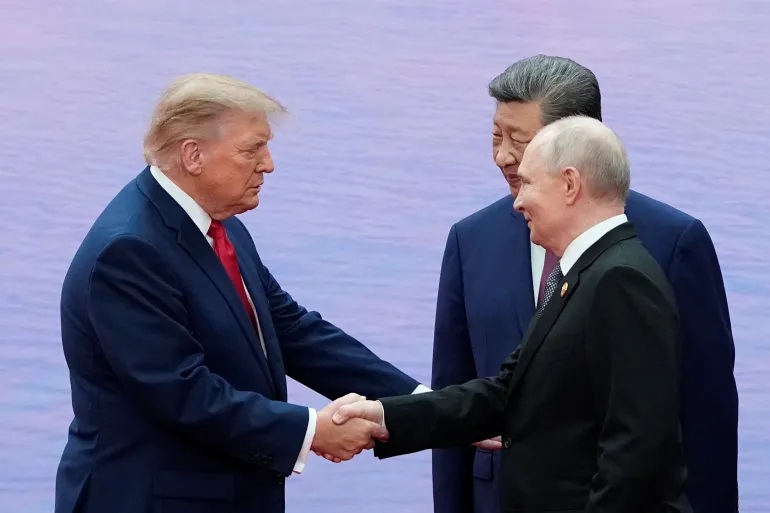
Vladimir Putin may be Russia’s own worst enemy. While the Russian president was in Shenzhen, holding fruitless talks with Chinese and American leaders, Xi Jinping and Donald Trump, Ukraine successfully put the Crimean Bridge out of operation. What else awaits Russia under such leadership?
By Nikola Mikovic
Ever since he launched the invasion of Ukraine in 2022, Putin has sought to end the war in a way that would allow him to save face. Despite several rounds of talks in Minsk, Istanbul, and Abu Dhabi, Moscow and Kyiv never managed to reach a deal that would resolve the conflict. Fully aware of Russia’s weakness, Western-backed Ukraine is unwilling to make any concessions to Putin.
Nevertheless, the Russian leader does not seem to have abandoned the hope of reaching a compromise with a country determined to achieve victory at any cost. Before the summit in Shenzhen on November 19, Russian and Ukrainian delegations met in Abu Dhabi on November 10–11, where, under US mediation, they discussed parameters for ending the war.
Unsurprisingly, no breakthrough was achieved. Kremlin officials have created a narrative in which the United States – despite arming and funding Ukraine since the first day of the war – is portrayed as a “neutral mediator” and Trump as someone who “genuinely wants peace.” Maybe he really does. But not on Putin’s terms.
Still, Putin travelled to China to meet with Trump and Xi, to once again repeat his familiar claim that the conflict in Ukraine began with what he described as a coup in Kyiv in 2014. But the American and Chinese leaders seemed largely uninterested in a story they had heard countless times before. The fact that the three presidents’ joint declaration makes no mention of Ukraine clearly suggests that Putin’s rhetoric is no longer finding an audience.
Meanwhile, Ukraine continued to inflict significant damage on Russia. The attack on the Crimean Bridge and Russia’s limited response illustrate that the Kremlin has no effective means of forcing Kyiv and its Western backers to accept Moscow’s proposals for ending the war.
In 2022, after Ukraine severely damaged the Crimean Bridge for the first time, Putin publicly promised a harsh response. Soon afterwards, Russian forces began targeting Ukraine’s energy infrastructure, causing widespread blackouts across the country but failing to affect Ukraine’s military capabilities significantly.
This time, the Russian public has remained silent over Ukraine’s strikes on the strategically important facility. Although Putin vowed a “much more painful” response, Ukrainian policymakers have little reason to fear his threats. The destruction of the Crimean Bridge is Kyiv’s retaliation for Russian missile and drone strikes on bridges in Kyiv, which began on October 1 and continue to this day. However, the bridges in Ukraine’s capital remain standing. Critics could argue that the Kremlin’s actions gave Kyiv a reason to destroy the bridge connecting Russian-controlled Crimea with southern Russia.
Putin seems to be using the same strategy towards Europe. On November 20, amid Russian attacks on western Ukraine, a Russian Kh-101 cruise missile fell in Poland’s Lublin region. Although no one was injured and no damage was reported, the incident will undoubtedly give Poland further reason to strengthen its military capabilities and prepare for a possible direct conflict with Russia.
If Russia continues launching such strikes against NATO countries, sooner or later they will be forced to respond. And their response will undoubtedly be severe. This could mark the beginning of a confrontation between Russia and NATO, or at least some of its members. Weakened by Putin’s war in Ukraine, Russia would struggle to pose a serious threat to NATO and could suffer a catastrophic defeat.
Putin’s actions are, therefore, causing damage first and foremost to Russia itself. By striking transformers in Ukraine, he is giving Kyiv a reason to destroy Russian oil refineries completely. By damaging bridges in Kyiv, he is giving Ukraine a reason to isolate Crimea strategically. By provoking NATO countries, he is giving them a reason to start a direct war with Russia eventually.
Meanwhile, he repeatedly says he is willing to keep exporting natural gas to Europe. Although relatively cheap Russian gas could help European countries further boost their military-industrial complex and provide even more aid to Ukraine, they seem determined to end their energy cooperation with Moscow. Such a policy pushes Russia deeper into China’s orbit, making Moscow Beijing’s junior partner.
From China’s perspective, the more Putin weakens the Russian Federation, the better. “Never interrupt your enemy when he is making a mistake,” Napoleon Bonaparte is believed to have said. Although Russia is not China’s enemy, Beijing has every reason to benefit from Putin’s disastrous policies.
Ultimately, the question is whether Putin is simply making mistakes or deliberately harming Russia. “Après moi, le déluge” (“After me, the deluge”), a phrase traditionally attributed to King Louis XV of France, seems to be his modus operandi.