In the Netherlands, every year around mid-November, the never-ending discussion surrounding the Sinterklaas (Saint Nicholas) celebration restarts, mainly focusing on his helper, Zwarte Piet (Black Pete). Sinterklaas is arguably the most identity-defining tradition of the Netherlands, a ritual in which nearly everyone participates. Its roots stretch back well over a thousand years, and its story concerns not only the Dutch, but Europe and Western civilisation as a whole.
By Michiel C de Jong
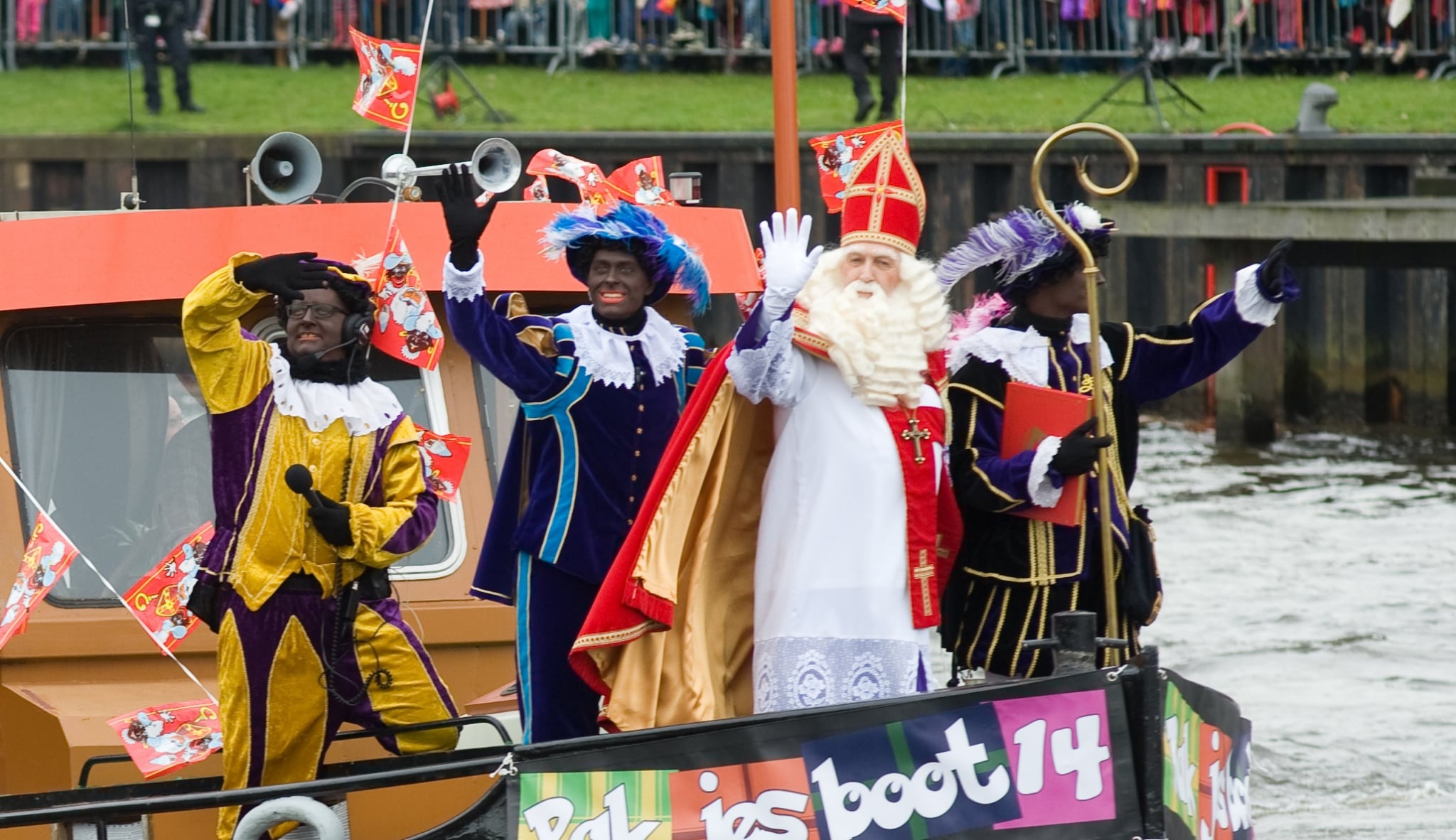
Each November the Netherlands marks the arrival of Sinterklaas, a figure modelled on the fourth-century bishop Nicholas of Myra. He enters Dutch ports by steamboat and, in the weeks that follow, hands out gifts. He is accompanied by helpers known as Black Pete, characters in Renaissance-style costumes with painted black faces. For years, this figure has sparked fierce public debate.
That debate has centred on a single question: Is Black Pete a colonial caricature? To answer it properly, we should examine where the tradition’s ingredients actually come from. Three layers stand out, and none of them is colonial.
The pagan midwinter
Gift-giving, scattering spiced biscuits, singing down the chimney, and composing comic verse about the past year all belong to the older European midwinter season. This was a liminal time: the supernatural drew close, and people thought the spirits of the ancestors entered the home, typically through the smoke-hole that preceded the chimney.
Many European cultures preserve comparable customs. The Anglo-Saxon world attached them to Christmas, Spain to Epiphany, which roughly mark the beginning and end of the midwinter period. In the Low Countries they gathered around Saint Nicholas instead.
The darker side of the season was embodied by a black bogeyman. In the eighteenth and nineteenth centuries this figure was itself sometimes called Sinterklaas. In this light, Zwarte Piet appears as the descendant of a European winter spirit: a figure of the winter night, not of the plantation.
The guild and the fair
In the Low Countries, Nicholas was the patron saint of seafarers and merchants, and therefore of the guilds. Each guild had a servant, a kind of secretary to the board, who also held an important ceremonial role. He carried a rod, an attribute Zwarte Piet still carries today.
The office resembles the beadle in the academic world and the Black Rod in the British Parliament. The servant in Sinterklaas’s entourage descends from this respected position.
Around the saint’s name day, 6 December, Nicholas markets in cities such as Amsterdam grew into large fairs. Like King’s Day, the other great Dutch folk celebration, they combined commerce with festivity. Young men and women celebrated together, which made the fair an important place for courtship.
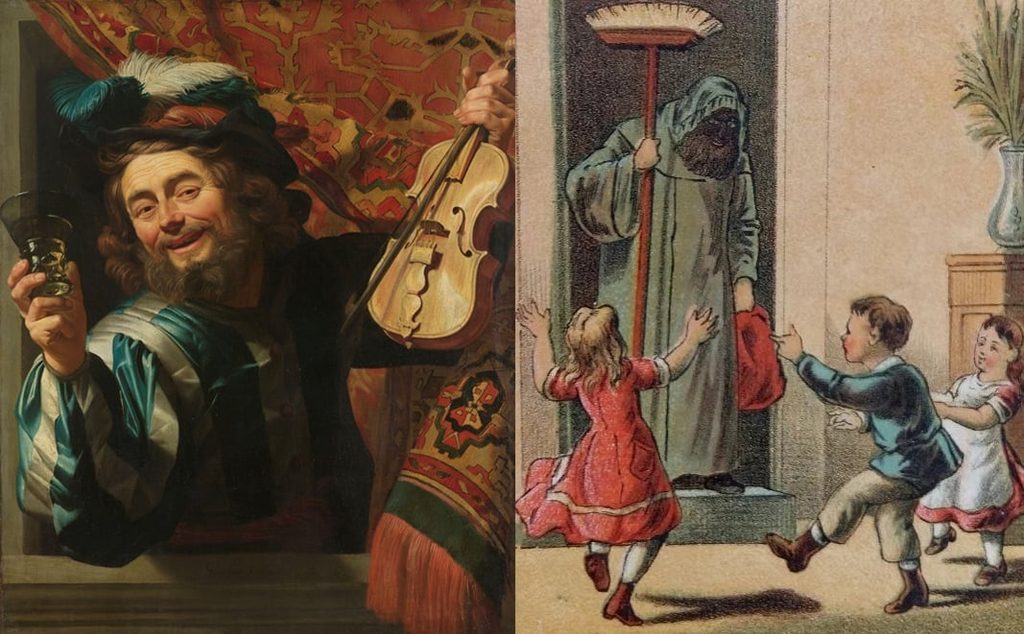
At these fairs, travelling comedians performed. Acrobatic and comic, they wore costumes much like today’s Zwarte Piet, complete with feathered caps. Seventeenth-century Dutch painters often portrayed them; therefore, we know well what they looked like.
Medieval legends of deliverance from Islamic slave raids
From the ninth century onward, a further motif entered the cult of Nicholas: his role as protector against Islamic slave raids on European Christians. In the legend of Adeodatus, a boy abducted by Muslim raiders is liberated through the saint’s intervention.
The story circulated for centuries in both text and iconography and introduced two figures into the tradition: the redeemed Christian captive and the Islamic “Moorish” raider.
The first picture-book image of the servant in the form later associated with Zwarte Piet dates from 1850. It did not invent the figure, however; it drew on motifs already long familiar in European folk culture.
The postcolonial misreading
Postcolonial scholars and activists trace Zwarte Piet’s origins to nineteenth-century colonial hierarchies, and critics often equate the figure with American blackface. Yet historical research has never uncovered a single source linking the Dutch tradition to American minstrelsy. The link is assumed, never demonstrated.
The historical record, moreover, challenges the postcolonial framework more broadly. The figure’s attested roots lie in an era when Europeans were the victims of slave raids rather than the perpetrators. Postcolonial theory is built on the opposite premise, and this context is largely disregarded and downplayed in contemporary academia.
If we want to preserve European civilisation and culture, we must examine and understand it through its own cultural lens. The folk, guild, midwinter and medieval roots of this tradition explain the figure far better than imported postcolonial categories. A custom with such depth deserves to be understood on its own terms, rather than filtered through the history of other societies.
Michiel C de Jong is an independent researcher and author who specialises in the Dutch Saint Nicholas tradition and the deception of postcolonial academics. He has published three books and runs a YouTube channel on the subject.