Much has been written in recent weeks about the events in Ceuta. Too much of it proved to be hasty, overly definitive, and sometimes simply incorrect. This applies in particular to the suggestion that the migration crisis in the Spanish enclave has now largely been resolved.
By Oscar Hammerstein
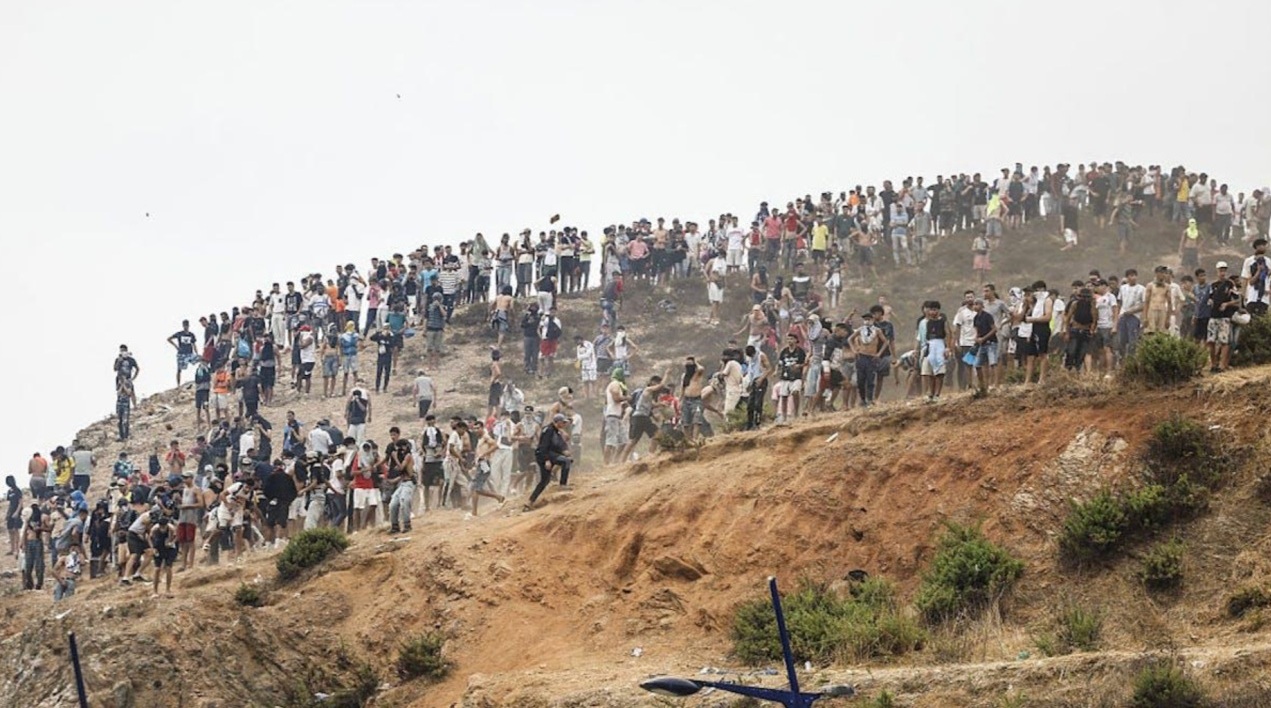
On July 30, an unprecedented event took place at the border between Morocco and Ceuta. Tens of thousands of people entered the Spanish enclave in a short span of time. Initial estimates varied widely.
At first, figures of around 49,000 people were cited; later, Spanish figures indicated more than 72,000 border crossings, and numbers exceeding 80,000 are now being reported. Dozens of people died during the chaotic storming of the border. The fact that the figures diverged so sharply should have prompted caution. The opposite occurred.
A reassuring narrative soon emerged claiming that virtually everyone had already returned to Morocco. The crisis was contained, the border was back under control, and Europe could return to business as usual.
In parts of the Dutch and European media coverage, too, attention quickly shifted from the events themselves to the political question of whether right-wing and conservative Europe was primarily using the crisis as an opportunity to advocate for stricter migration policies.
Even before it was clear how many people had actually entered Ceuta, who had organised the mass border crossing, and what role the Moroccan authorities had played in it, a culprit had already been identified elsewhere: Israel.
Within hours, a theory circulated on social media that Jerusalem, leveraging its strong ties with Morocco, had orchestrated the operation to cause trouble for Spanish Prime Minister Pedro Sánchez, a vocal critic of Israel. Even a years-old tweet by Yair Netanyahu regarding Spain’s stance on Ceuta and Melilla was cited as a clue.
In Germany, too, the suggestion arose that a US-Israeli-Moroccan connection might be behind the events; *Die Welt* covered this extensively just a few days ago, following remarks by ARD journalist Georg Restle. No evidence of Israeli orchestration was ever produced.
While Europe barely grasped what had unfolded on its southern border, a segment of the public debate apparently already knew who was behind it. Thus, the Ceuta incident fell into a familiar pattern before the facts were even established.
A centuries-old conflict between Spain and Morocco over two Spanish enclaves in North Africa was, within hours, transformed into part of an Israeli conspiracy. It is an entirely different matter that Israeli politicians and diplomats subsequently pointed, with barely concealed schadenfreude, to the awkward position of a Spanish government that lectures Israel on territorial issues while itself administering Ceuta and Melilla.
Schadenfreude after the fact is not proof of orchestration beforehand. The ease with which that distinction vanished perhaps says more about the contemporary debate surrounding Israel than about what actually took place in Ceuta. Meanwhile, a much simpler question remained unanswered: how many people were actually in Ceuta?
A crisis supposedly already over
The problem had not, in fact, been resolved. Moreover, the information regarding Ceuta proved incorrect, and remains contradictory. On August 14, *Die Welt* reported that an estimated 8,000 to 11,000 migrants were still in Ceuta, while the Spanish government cited a figure of around 5,000.
Meanwhile, on August 15, *The Times* also reported that there were approximately 10,000 migrants in Ceuta, including around 2,000 unaccompanied minors. Evidently, the reality is far harder to pin down than the reassuring political message suggested.
This is not to say that *Die Welt* and *The Times* were necessarily correct with their estimated range of 8,000 to 11,000, but rather to show that confident assertions that the crisis had been resolved were premature.
Furthermore, Spain deployed hundreds of additional police officers to Ceuta in response to new calls on social media for another mass border crossing on August 15. Morocco arrested more than a hundred people who were heading toward the enclave. Spain increased its security force presence in Ceuta to over 1,600 personnel.
Thus, anyone claiming the crisis was over evidently knew more than the authorities, who were bracing for a fresh crisis.
A new reality
Moreover, Ceuta is not merely a Spanish problem; it is an external border of Europe. Anyone reaching the enclave finds themselves on Spanish—and therefore European—soil. This makes the question of what happens next to thousands of migrants directly relevant to the rest of Europe.
This applies particularly to unaccompanied minors. They cannot simply be expelled en masse; their situations require individual assessment, yet it was precisely the reception capacity for minors in Ceuta that came under extreme strain.
Added to this is a striking paradox. A significant proportion of people from the Maghreb attempting to reach Europe have little to no chance of being granted asylum. This year, Morocco and Tunisia were added to the European Union's common list of safe countries of origin. While this does not mean that every individual asylum claim is doomed to fail, it does allow for accelerated procedures.
The events in Ceuta therefore raise an uncomfortable question: what becomes of large groups of, often young, migrants who reach Europe with little prospect of asylum, only to spend extended periods in a legal and social limbo? Here, the migration debate touches upon a subject discussed with extreme caution in the Netherlands: crime.
The German figures
On the same front page where *Die Welt* reported on Ceuta, there was a striking headline: “Moroccans more frequently come to attention for criminal behaviour.” Below it: “After Ceuta: Migrants from the Maghreb move into the spotlight.”
The newspaper linked the events in Ceuta to figures from the German federal government regarding crime among nationals of Morocco, Algeria, and Tunisia. Specifically, this concerns violent crime.
That distinction is essential. Absolute numbers reveal little. To determine whether a particular population group is overrepresented, one must compare the number of suspects against the size of that group.
For this purpose, the German Federal Criminal Police Office (BKA) uses, among other metrics, the Tatverdächtigenbelastungszahl (TVBZ): the number of registered suspects per 100,000 inhabitants of the population group in question.
According to the figures published by *Die Welt*, there are significant differences between German nationals and nationals from the Maghreb regarding serious violent crime: a TVBZ of 3,193 compared to “only” 398.
This category includes offences such as robbery, grievous bodily harm, rape, murder, and manslaughter. The conclusion can be carefully phrased: German police statistics show that, on a per capita basis, Moroccan nationals are registered as suspects of violent crime significantly more often than German nationals. A second point must immediately follow: suspects are not convicted offenders.
What about the Netherlands?
Anyone who thinks this is exclusively a German phenomenon need only look at the Dutch figures. Statistics Netherlands (CBS) reports that in 2023, 4.2 per cent of individuals of Moroccan origin born in the Netherlands were registered as suspects in a crime.
For the total Dutch population aged 12 and older, that figure was 0.8 per cent. The difference is thus more than fivefold.
Even more remarkable is the trend over time. In 2005, no less than 12.8 per cent of individuals of Moroccan origin born in the Netherlands were registered as suspects. By 2023, that figure had dropped to 4.2 per cent.
This is a spectacular improvement that should not go unmentioned in any serious discussion of the subject. Does this figure include the second generation? At the same time, however, 4.2 per cent remains well above the national average.
The figures do not reveal the cause of this decline. Nor can a link be inferred between this trend and the intensified efforts to combat organised crime in recent years. Nevertheless, this is an interesting research question, precisely because major criminal cases during that same period, such as the Marengo trial, highlighted the significant role of certain Dutch-Moroccan criminal networks in serious organised crime.
These CBS statistics do not show whether the large-scale investigation and prosecution of such networks had any measurable impact on broader crime statistics.
In any case, the Netherlands and Germany show the same trend: significant overrepresentation in registered crime statistics. However, a direct statistical comparison is impossible. The German statistics cited by *Die Welt* focus on nationality and violent crime. The Dutch figures cited above relate to background and all recorded crimes.
A Dutch national born in Rotterdam to Moroccan parents might be classified by Statistics Netherlands (CBS) as having a Moroccan background. Conversely, a man born in Germany to Moroccan parents, who has since become a naturalised citizen, might be recorded as German in German nationality statistics.
Anyone who carelessly equates these two categories is engaging in politics, not statistics. Moreover, I only believe in statistics that I have falsified myself.
Explaining the figures is harder than the figures themselves
This brings us to the most difficult part of the debate. Establishing overrepresentation is relatively straightforward; explaining it is not. Age structures differ. The gender ratio differs. Income, education, family situation, and living environment differ.
Moreover, migrants without stable residency status find themselves in a completely different social position from that of the average Dutch or German citizen. Statistics Netherlands (CBS) itself points out that gender, age, and household income are particularly important factors in explaining differences in suspect rates.
When adjustments are made for these factors, differences based on origin diminish, though they do not disappear entirely.
Furthermore, police statistics are partly the result of police activity. Those who are stopped and checked more frequently are also more likely to be registered as a suspect, defined as "a person against whom facts or circumstances give rise to a reasonable suspicion of guilt regarding a criminal offence." Consequently, the term "registered suspect" should not be carelessly equated with "perpetrator."
Yet, none of this constitutes an argument for simply ignoring the figures. That is precisely where the European migration debate so often goes off the rails. On one side, some seize upon any crime statistic as proof that immigration and crime are the same.
On the other, some immediately try to explain away any statistical overrepresentation, fearing that the "wrong" political party will exploit the data. Both approaches are unsatisfactory. A mature society must be capable of holding two ideas in mind simultaneously: that overrepresentation exists, and that this overrepresentation does not prove that Moroccan origin causes crime.
This is not a nuance intended to soften the truth; it is the truth.
The lesson of Ceuta
That is why the reporting on Ceuta is so interesting. Not because every young man from Morocco coming to Europe is a potential criminal. Rather, because Ceuta reveals just how incapable Europe remains of discussing migration without knee-jerk political reactions.
At first, no one knew whether 50,000, 70,000, or more than 80,000 people had entered. Then, it was stated with great certainty that almost everyone had already left. Yet, even before these basic facts were established, others claimed to know that Israel was behind the events.
It subsequently emerged that between 8,000 and 11,000 migrants remained in the enclave, whereas Madrid had cited a much lower figure. Meanwhile, hundreds of additional police officers and troops were deployed to prevent another mass border crossing on Saturday, August 15.
That is not the picture of a resolved incident. It is the picture of a crisis in which speculation sometimes travelled faster than the facts. That is precisely why we should be wary of both political reassurances and political panic.
First, ask how many people are actually there. Then ask who they are, how many are minors, how many are applying for asylum, how many are being sent back, and how many ultimately end up on the European mainland. And when the questions of integration and crime are subsequently raised, publish the figures: even if they are unpleasant.
German and Dutch statistics do not justify generalisations about individual Moroccans. Nor do they offer a simple explanation for crime. However, they do reveal a phenomenon that warrants serious research and serious policy.
The danger lies in the fact that making this distinction seems increasingly difficult in the current debate. Noting a statistical difference is not the same as condemning an entire population group. Suppressing the facts is not tolerance. And presenting political assumptions as facts is not journalism.
Anyone wishing to prevent migration from becoming the exclusive preserve of populists must start telling the truth about it without fear, even when that truth is more complex and unpleasant than we would like.