The war on Iran lacked a unified strategy. It began as a disagreement at the highest levels of American power, where its president, Donald Trump, initially pushed for a limited confrontation. A controlled, symbolic, and sufficient attack to satisfy Israel and repay what he viewed as a political debt for its role in his rise. The deeper security institutions of power in Washington resisted this approach, but once the conflict expanded and Iran proved resilient, their position shifted. The objective became clear: the war would continue until the Iranian regime itself collapsed.
By Rafic Teleb
Plans were drawn accordingly. They included empowering Kurdish forces, opening new fronts, and even the possibility of direct territorial operations such as seizing strategic islands. These plans faltered under regional pressure; Saudi Arabia refused to allow its bases to be used, and Turkey applied its own leverage.
Trump, facing these constraints, stepped back and chose a different path: he moved toward ending the war quickly by introducing a 60-day ceasefire.
That ceasefire was not a pause toward peace. It was a pause for restructuring. During those sixty days, the deeper power structure in Washington reorganised its approach, replaced earlier plans, and reached a new understanding with Trump.
The war resumed, but in a radically different form: faster, more intense, and designed to overwhelm. The decision was tied to timing, deliberately set for after the World Cup, marking the beginning of a new phase defined by speed and scale rather than gradual pressure.
One of the most striking aspects of this shift was the sidelining of Israel. Trump’s objective moved beyond partnership; he sought exclusive control over the outcome, including Iran’s economic resources. This triggered a silent but intense struggle between Washington and Tel Aviv.
Israel proposed a sweeping division of influence, offering the United States dominance over Iran, the Gulf, and Iraq in exchange for control over Syria, Egypt, Jordan, Lebanon, and Turkey. The United States rejected the proposal outright, signalling that this conflict was no longer about coordination, but competition.
At the same time, the global environment has tilted toward escalation. Russia has uncovered major espionage networks linked to China operating within its own state structures without Vladimir Putin’s knowledge. The world is not stabilising; it is fragmenting into overlapping conflicts and rivalries.
Within this landscape, the United States has developed a comprehensive regional project, with Syria as its entry point. The plan begins with pushing Syria into Lebanon, a move repeatedly emphasised by Trump through his insistence that Syrian leadership will carry out this role.
For Israel, this scenario is advantageous regardless of the outcome. If Syria enters Lebanon, it triggers a chain of events favourable to Israeli strategy. If it does not, Israel gains the justification to act independently, arguing that Washington has failed to deliver results.
On the ground, this strategy is already visible. Israel has expanded its presence in southern Syria, with approximately 35,000 troops positioned and control established over key high points on Mount Hermon.
Its forward trajectory is clear: advancing toward Damascus through a corridor that runs from Qalaat Jandal to Saboura, Yaafour, and Serghaya, before pushing into Lebanon’s Bekaa Valley. Infrastructure developments, including plans to build a hospital in Qalaat Jandal, are not humanitarian gestures; they are preparations for long-term settlement and control.
Parallel to this, a coordinated political and military scenario has been constructed to justify Syrian entry into Lebanon. The United States has worked closely with Syrian authorities, with financial support from the UAE, to build this framework step by step. When funding was cited as an obstacle, money arrived, hundreds of millions, delivered under the cover of investment.
When equipment was lacking, armoured shipments followed. Security incidents were manufactured or exploited, with debates over whether to attribute them to ISIS or Hezbollah. Each development contributed to a narrative: that Hezbollah poses a direct threat to Syria and must be confronted.
This narrative stands in direct contradiction to the operational reality. Channels of coordination, financial transfers, and logistical support between Syrian authorities and Hezbollah have continued. Weapons and drones have moved across borders, funds have been shared, and meetings have taken place to ensure that any future confrontation remains controlled. The objective is not immediate destruction, but managed escalation.
Iran has responded with clarity. A direct message was delivered to Damascus through Qatar: any Syrian military move into Lebanon, even on a limited scale, will trigger a severe response, including strikes on Damascus and the mobilization of forces into eastern Syria. The stakes are explicit, and the lines are drawn.
Despite this, internal restructuring within Syrian forces has continued. Military units have been reorganised, fragmented, and absorbed in ways that consolidate control under a single authority. Even groups that aligned themselves with the system have been repositioned or weakened, removed from strategic areas such as Damascus and replaced with more tightly controlled formations.
The result is a centralised structure designed for a specific role in the upcoming phase.
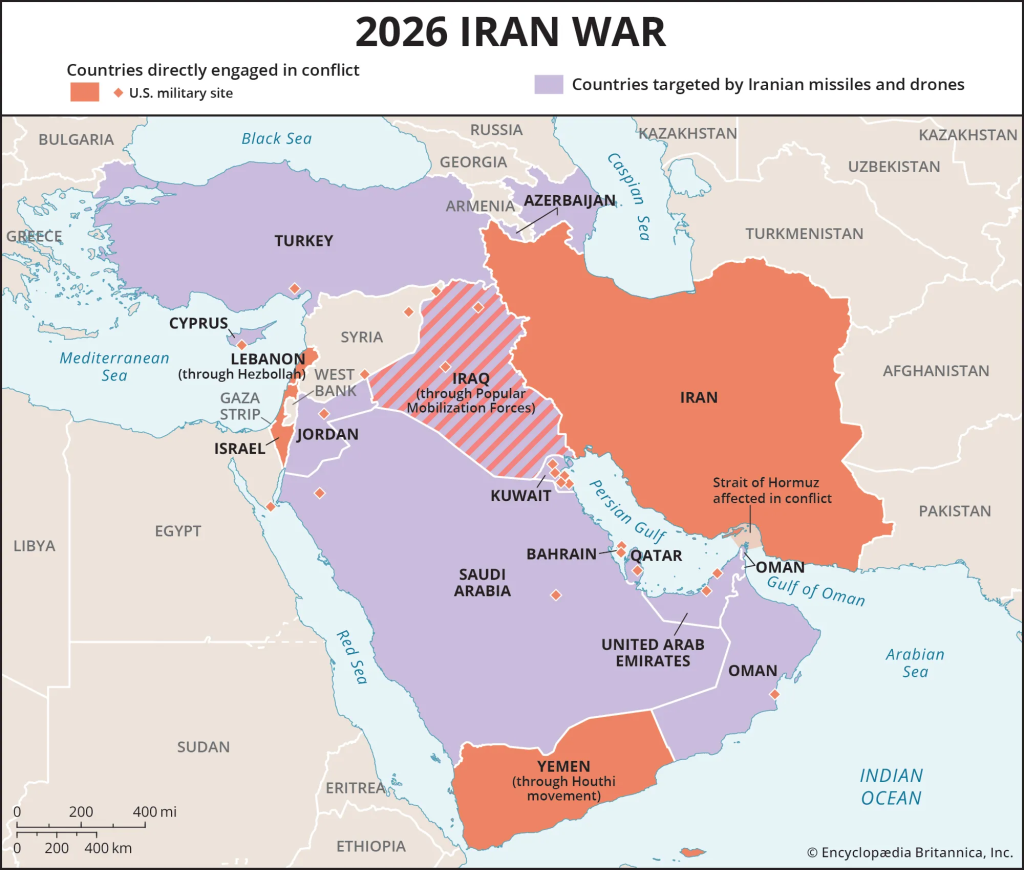
Across the region, the scale of potential escalation is unprecedented. Iranian planning points toward a broad confrontation that extends far beyond the current lines of engagement. Ground operations against Gulf states, control over strategic energy fields, large-scale strikes on infrastructure, and coordinated offensives through allied forces are all part of the expected scenario. Hezbollah, Iraqi militias, and other aligned groups form a network capable of opening multiple fronts simultaneously.
The objective is not limited to immediate gains. It is to force a regional realignment so significant that existing borders become irrelevant. This is not a contained war; it is a restructuring of the Middle East. Just as the maps drawn after World War I followed a global conflict, the maps of this region are now being shaped by a new one.
Turkey’s position is central to this outcome. It will not be able to remain outside the conflict. If it does not act against Iran, Israel will fill the vacuum in Syria. Entry into the war is not a choice for Ankara; it is an inevitability imposed by geography and strategy.
Inside Syria itself, parallel dynamics are unfolding. Internal factions are already positioning for the aftermath, communicating with international actors and offering future arrangements in exchange for power. The assumption is that the current order will not survive what is coming.
What lies ahead is not a temporary escalation followed by a return to de-escalation. It is a sustained, multi-layered conflict that will redraw influence, borders, and authority across the region. The wars of the past decade will be remembered not as defining events, but as preludes.
The region is entering a phase where speed will outpace comprehension. Events will unfold faster than they can be reported, and outcomes will be shaped before they are fully understood. The war on Iran is no longer a single conflict; it is the axis of a transformation that will define the Middle East for decades to come.