
Just saw a lovely oldish movie, A Flash of Green (1984), a humdrum tale set in 1961 Florida about a local politician trying to strong-arm conservationists into backing investment plans for a local bay. The bad guy, Commissioner Elmo Bliss (Richard Jordan), plays it safe, distancing himself until he runs for governor and can cash in on the project. In the meantime, he hires local reporter Jimmy Wing (Ed Harris) to collect dirt on the opposition.
By Emad Aysha
Jimmy has a dying wife but is in love with the widowed Kat Hobble (Blair Brown), but Bliss seduces him nonetheless, and with more than money. I wouldn’t pay this movie any heed, besides the gorgeous performances, were it not for the fact that this is exactly what Donald Trump did in his second presidency!
Trump pitched himself as the isolationist dude, distancing himself from stalwart neo-conservatives like John Bolton. Then he did a 180-degree flip when it came time to cash in on the war windfall.
Other parallels abound given that Mr Bliss – what a perfect name – gets a local right-wing group to terrorise the conservationists, on religious grounds. One of them has a daughter in an illicit relationship and the girl gets threatened. The other is a woman with an art gallery who gets lashed for lewd drawings (of herself).

DUALING OPPOSITES: Ed Harris and Blair Brown in 'A Flash of Green' (1984). They both love things green, but the first adores greenbacks and the other nature's chlorophyllic bounty.
These ultra-conservatives are also, not coincidentally, rabid anti-Communists. And most are hick yokels who are liable to get money out of the aforementioned dredge-and-fill project in Grassy Bay.
That would explain the Evangelical vote backing Mr Trump, even after his policy U-turns away from MAGA. (Check out Christopher Plummer in Dragnet [1987], a religious hypocrite in his own right leading the movement MAMA!)
The twisted psychology is even more revealing, since Mr Bliss tells Jimmy he made his money through hard work as a fisherman, and that nothing magical is left in the country. It’s an old, used place, and the best you can hope to do is make some money off it before others do, badmouthing the outsiders who think they know better.
That’s how quite a lot of Americans perceive their own country, since the closing of the frontier. There was the ‘new’ frontier with post-war internationalism, but that seems to have come to an end too.
Just read Philip K. Dick’s We Can Build You (1972), where business tycoon Sam Barrows does his own real estate gigs in the solar system. In the process, he finally creates job opportunities for people on Earth.
There’s more than a hint of utopianism and control of nature in Flash of Green, with Mr Bliss talking about making an earthly paradise. By contrast, one conservationist, a lay scientist, describes this as spitting in the face of God.
So much for science being at loggerheads with religion, and so much for conservatives being out to ‘conserve’ God’s creation; they aren’t here. I guess it pays to have a comfortable middle class that can afford to live for beauty to protect things for the rest of us.
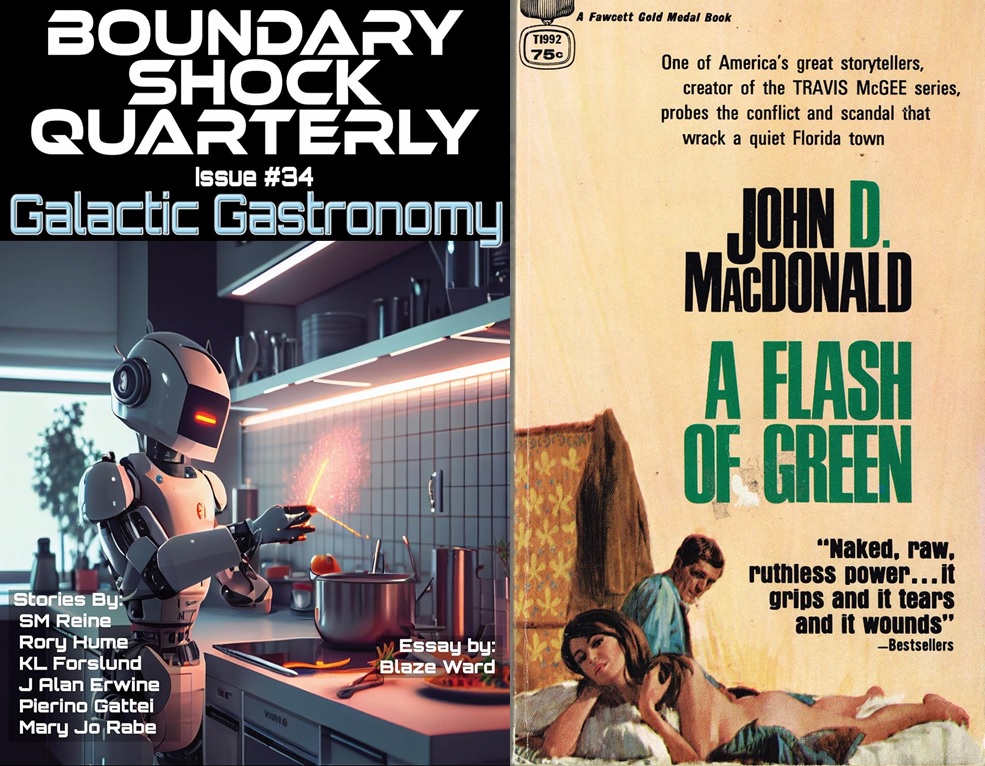
HEALTH OR WEALTH: Sometimes terrestrial fiction needs some cross-referencing, from the future, before we can understand our present-day food economy.
I’d always wondered why the penultimate sequence of Falling Down (1993) has Robert Duvall noting how they lied to everybody, even the poor fishes in the bay area, poisoned by pollution.
This movie answers it, along with the urban dislocation of LA you see in Falling Down. Taking the sci-fi angle even further, we find ecological parallels in our previous review of the Galactic Gastronomy anthology by our buddy Blaze Ward.
In one particular story, “A Thought for Food” by Joel Ewy, an entire tropical planet is seeded to provide free, healthy food, including fungus. But corporations try to corner the market and patent it all, which will inevitably create shortages.
Try having exactly what you want here in Egypt. It’s impossible. You find so many items listed as not available ‘at the moment’ at the endless fast food and café chains because there are too many outlets and not enough to go around.
Might as well have Starbucks in outer space. Sam Barrows, in We Can Build You, wants robot simulacra of great American leaders to encourage colonists to go to new worlds. Commercialising the past, in effect.
That also highlights the difference between Western and Arab SF. Americans are concerned either with the exotic delights awaiting them on other worlds or the future economics of food.
The anthology also clearly associates fancy foods with empire. M.E. Owen’s “The former King of Greenland Makes Good” features indentured servitude, while KL Forslund’s “A Dish Best Served” features a revenge plot against a galactic emperor. (He eradicates whole planets when he eats out!)

MAN-MADE CALAMITY: Philip K. Dick always drew parallels between the self-righteous in Cold War America and the Nazis in Germany himself. And he was a naturalist when it was still hip to be square.
Us, we’re busy trying to preserve our already exotic, sophisticated and quite cosmopolitan foods down here on Earth. Not to mention the etiquette that comes with them, such as waiting for your elders or hosts (or superiors) to eat first.
Arabs actually learned that trick from the Persians. Humility as an acid test for a potential minister or provincial governor, to see if he wanted to serve the people or cash in on the opportunity instead.
We also want to grow our own food by turning the deserts green; no hybridisation or food additives. You don’t get scenarios where natural goodies are harvested by expeditions in dangerous jungles for a harsh, if enlightened, overlord.
Once again, Flash of Green is a title with multiple meanings. There’s the sun flash mentioned in the movie, a kind of optical miracle portending well for the receiver.
The opening scene is also a camera snapshot of the fleeting past. And I’d suspect there’s a flash of greenbacks as well to get Jimmy on board.
In the end, Jimmy confesses to Kat and exposes Mr Bliss. He’s beaten up (repeatedly) and kicked out, and the project begins. Nonetheless, he comes back to Kat and her kids, signifying that real triumph is perseverance and hoping for the future.

SUBDUED INTENTIONS: The badguy in the movie, it will please you to know, is played by sci-fi hack Richard Jordan. This is him at his most (transparently) evil in 'Logun's Run' (1976).
I’ll eat to that in the face of the current galactic despot!!