Iraqi science fiction has always puzzled me. Apart from ‘Iraq+100’ (Comma Press, 2016) and ‘Frankenstein in Baghdad’ (2013), there are almost no major titles known abroad. The question, as always, is: how can a country that believes so much in science, a country that birthed science from the Sumerians onward, have produced so little science fiction?
By Emad Aysha
Talking to Adnan Charakh (عدنان چراخ) is the first step in filling this knowledge gap. Born in the holy city of Najaf in 1983, Adnan grew up in a household centred around a vast library, where he learned to read before even starting school. By the time he was eight years old Adnan was featured in ‘My Magazine’ – Iraq’s premier children’s publication, where he boldly declared his lifelong passion: fiction. To date, Adnan has published four books, comprising three translations from English into Arabic and an anthology that rescues and brings to life a collection of short stories buried in the pages of the last century’s periodicals.
Please introduce yourself?
I am Adnan Charakh, a computer engineer and training consultant, but above all a lifelong bibliophile. My passion for literature goes back to my childhood, to the moment I first met books, when I read Grace H. Kupfer’s Legends of Greece and Rome. Today, that devotion translates into active literary work and research, including serving as one of Iraq's top Goodreads librarians. Simply put, I love spending time reading literature, talking about it, translating it, and, honestly, even just looking at books.
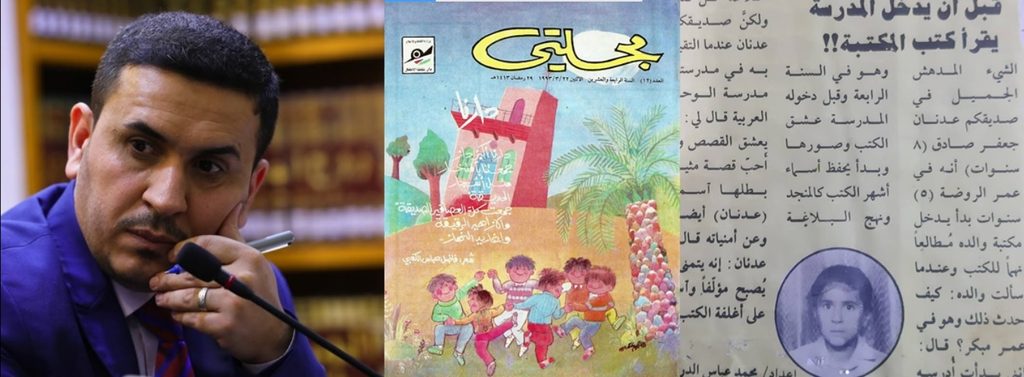
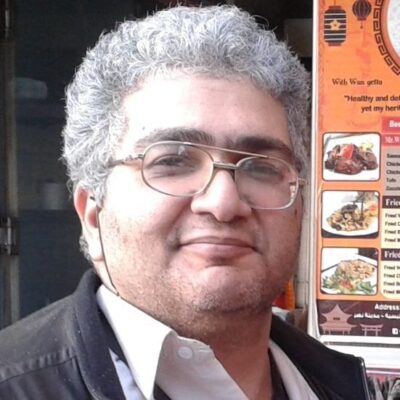
ALWAYS IN THE NEWS: Mr Adnan as a grown man [left] and his first mention as a bibliophile [right] in the above-mentioned children's magazine. [Pictures proved by interviewee]
What drew you to science fiction, and how did your academic career crisscross with it?
My journey with science fiction began early, when I was six, browsing the old magazines that filled my father’s library. That is where I first came across science fiction short stories, in the fiction column that appeared regularly in every issue. The first sci-fi work I clearly remember, though, is a novelette called The Planet of Zamaron by the renowned Iraqi writer Abdulsattar Nasir. It left a powerful impression on me. It tells of a boy abducted by aliens and taken to Zamaron, which I found quite terrifying back then! I was intrigued and hooked on that kind of story. I looked for tales of time travel, unexpected scientific outcomes, robots, and other planets whenever I chose my next read.
Even as a child, I never engaged with fiction passively. One of my favourite pastimes was retelling the stories I read and the movies I watched to my friends, though I could never resist adding a few twists of my own. Eventually, I moved from retelling to inventing original stories for them, most of which were, naturally, science fiction. We even played a game where they would give me a title on the spot, and I had to invent a story to match it.
Interesting that early forays into SF in Iraq were about alien abduction scenarios. Do you have UFO groups in Iraqi or ancient astronaut SF or lore?
I am not aware of any active communities and have never encountered such discussions within the sci-fi fandom here. As a subgenre element, perhaps The Planet of Zamaron—which I mentioned—touches on UFOs, but that remains strictly within children's fiction.
I do recall reading a story built around that theme in a series similar to the famous Choose Your Own Adventure books, published by the House of Cultural Affairs for Children (Iraqi Ministry of Culture). However, I am almost certain it was a translation and not originally written in Arabic.
Other than that, I am not aware of any local fiction centred on the ancient aliens theory. While you occasionally hear popular myths or anecdotes about ancient visitors who helped build certain civilisations, they rarely translate into serious literary discussions or sci-fi themes about Iraq’s ancient history.
Who were the most notable science fiction writers in Iraq in the 20th century? Why has nobody heard of Iraqi science fiction before Frankenstein in Baghdad?
First, I have read Frankenstein in Baghdad, and while it uses fantastical and monstrous elements, I wouldn’t categorise it as strict science fiction. And if we are looking for authors who dedicated themselves specifically to science fiction as a distinct genre, the honest answer is that there were none. What we had were scattered, isolated experiments rather than an established tradition.
Curiously, most early Iraqi sci-fi experiments were channelled into children’s literature. Works such as Abdulsattar Nasir’s The Planet of Zamaron, Salih Mahdi Habib’s The Time Gap, and Khalid Rahim’s The Mysterious Challenge stand out. I would add that Khalid Rahim devoted a good part of his work (three or four books) to science fiction, though all of it was written for children.
Beyond children’s fiction, we had a couple of adult science fiction works. The earliest was Qasim al-Khattat’s The Toiling Queen, followed by Fadhil al-Azzawi’s The Beautiful Creatures and Talib Nahi al-Khafaji’s A Beginning After an End. They also made commendable attempts at speculative fiction, such as Jafar al-Khalili’s In the Villages of the Jinn. Still, Iraqi readers at the time did not seem ready to engage with science fiction as serious adult literature, so mainstream authors steered clear of it and instead immersed themselves in Iraq’s inherently harsh and demanding reality.
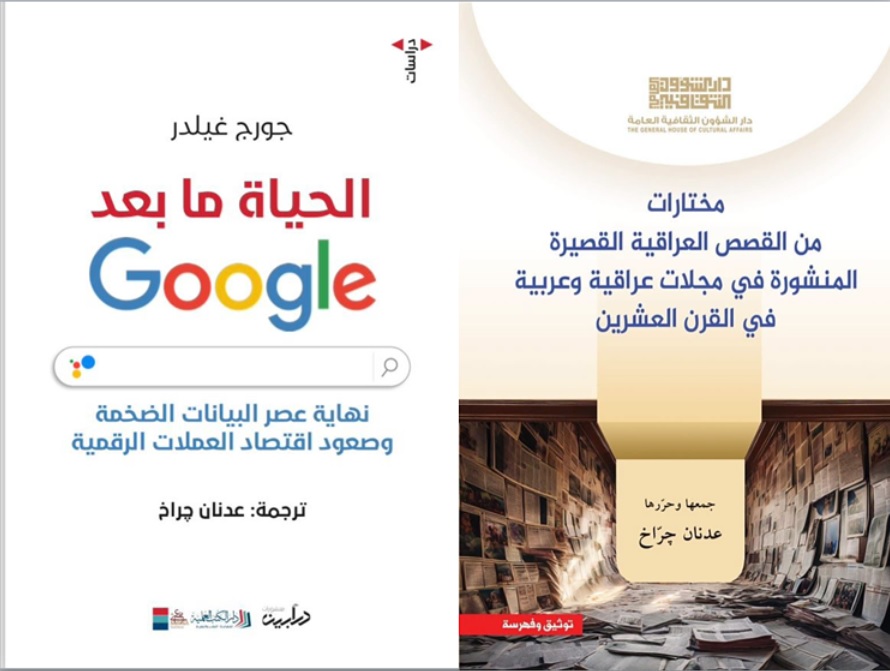
ADNAN IN SAMPLES: His translation of 'Life After Google' side-by-side with a collection he edited of Iraqi's best short fiction. (Let's hope there's some SF in there too.)
Are surrealism and magic realism popular among Iraqi authors and readers? What about fantasy?
I think this is where we can place Ahmed Saadawi’s Frankenstein in Baghdad. Magic realism found wide acceptance among Iraqi readers once they were introduced to Borges and García Márquez. However, the first notable mature attempt at magic realism in Iraqi fiction dates back to Fadhil al-Azzawi’s The Last of the Angels, published in 1992. Again, Iraq’s reality, with its wars, bloody revolutions, and multiple regime changes, kept Iraqi writers away from this kind of fiction. The Last of the Angels appeared after the end of the longest conventional war of the 20th century, between Iraq and Iran. During those eight years of war, most Iraqi fiction was directed toward what was happening on the battlefield and at its margins. Another work worth mentioning is Nizar Abdulsattar's The Night of the Angel.
After the 2003 regime change, the whole approach to literary writing in Iraq changed. A great deal was written in the genres of horror, fantasy, magic realism, and even sci-fi.
What about realism? Social or ‘socialist’ realism?
Writing about social reality has long been Iraqi authors' primary preoccupation, and arguably the domain in which they have achieved their most profound breakthroughs. From Mahmud Ahmad al-Sayyid’s Jalal Khalid (1928), often regarded as the first Iraqi novel, to the short stories and experimental narrative texts that preceded it, the Iraqi writer's overarching mission has been to diagnose the country’s social ills and offer remedies.
Iraqi narrative literature has unflinchingly tackled everything: wars, political prisons, mass migrations, and harsh living conditions. To illustrate how intensely this literature focused on material reality, consider a striking historical detail. Between 1953 and 1960 alone, more than four Iraqi novels were published with tuberculosis (al-sull) as their central theme, reflecting how brutally the disease ravaged Iraqis in the mid-20th century.
Do authors in Iraq list themselves on Goodreads?
The short answer is yes and no!
You can find most Iraqi authors on Goodreads, but readers and enthusiasts of Iraqi literature have added their pages and books almost entirely, not the authors themselves. Iraqi writers usually don't create or manage their own author profiles because the platform lacks mainstream popularity in Iraqi cultural circles. I think Goodreads is partly to blame for this shortcoming. For instance, I have been editing books on the platform since 2011, and fifteen years on, its interface remains virtually unchanged, with no real modernisation.
On a personal level, I take great pride in having added over 120 books and made more than 2,000 edits over the years, the vast majority of them devoted to Iraqi literature. I am currently working on a project to archive and add older Iraqi literary works to the site. However, I often face major challenges in finding enough biographical and bibliographic details about the books and their authors.
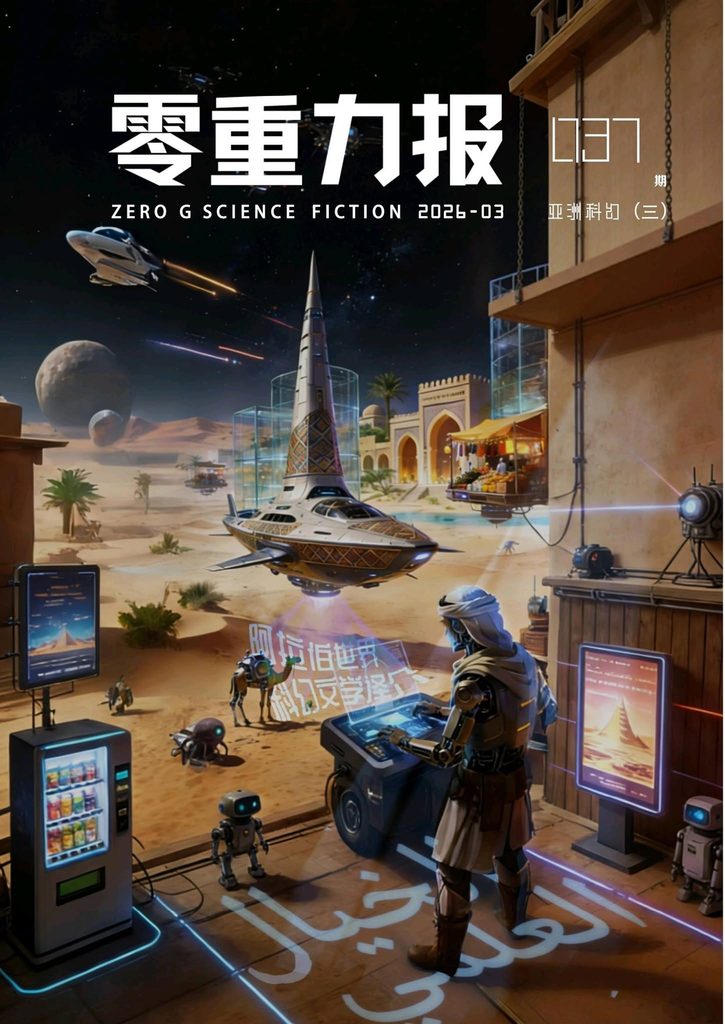
EASTEN APPRECIATION: The 37th issue of Chinese fanzine 'Zero Gravity News (March 2026) was replete with Mideastern SF, with Mr Adnan, Zoha Kazemi and my good self to boot!
What about scholarship on science fiction, and its utility in children’s education?
I am not aware of any serious academic movement at our universities that treats science fiction as an independent literary genre. Although several master’s and doctoral studies touch on speculative and fantastical literature in general, I strongly believe science fiction, especially in the era of the Fourth Industrial Revolution and its rapid technological advances, deserves far more space and serious attention in Iraqi literature and literary studies.
As for its utility in children’s education, we need it desperately today. Children are constantly bombarded with ready-made, fast-paced digital content that stifles their imagination. Personally, the science fiction stories I read in my childhood enriched me on many levels, and to this day, I still draw on sci-fi tropes (such as time travel, superpowers, and genetic experiments) in some of the professional training workshops I conduct for adults.
Finally, I have long urged education leaders to embrace literature, and science fiction in particular, as an indispensable tool for reforming and revitalising Iraq’s struggling educational system.
Acknowledgements
Special thanks to our Chinese friend River Flow for introducing us to Mr Adnan.