If you’re a fan, you’ll know my first published SF story was about the red planet, and that I’ve written about Egyptian sci-fi’s own love affair with Mars before. Well, I just finished Hanan El-Hosseini’s A Sheikh (or Elder) on Mars (2025); reviewed additionally at Baladi magazine as a minor milestone in the growing world of Arab women's sci-fi.
By Emad Aysha
The novel begins with a captive, tortured woman finding herself on the said planet. She has a translator device with her that turns her verbal thoughts into holographic images, down to the exclamation marks. She finds herself at the gates of a city guarded by impassive metal-clad individuals.
Inside, she encounters a man in a similar predicament, unsure who he is or how he got there. He knows this is the City of Riddles, and that the leader of the planet is the Elder of Mars, living in his own city.
To get there, he hitches a ride with a mysterious metal-clad individual, a robot named Jado, but he has to take him first to the City of Fire to deal with the local despot there, Ghoul. He takes him on a metal carpet – it’s literally called a flying carpet!
To add to the complexity, Jado wants to go to Earth himself, and we’re then introduced to a series of flashbacks that tell us that Egypt is in the year 2200, and has become a hub of industry and science in a world where winters freeze everything and summers are an unbearable inferno.
Egypt is the most ‘temperate’ of countries (hinting at national unity and tolerance), and a pioneering company there wants to head to Mars. The patriarch's granddaughter is Amaliah, and the man who loves her is Eyad, his employee and a brilliant engineer.
Sadly, this Romeo and Juliet pairing can’t work because she comes from the prominent Al-Sheikh family and he from the downtrodden Al-Saud family.
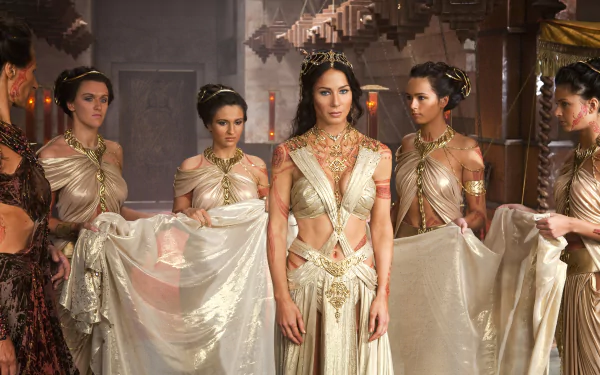
ROMANCE OF A PLANET: Lynn Collins as Dejah Thoris in the ill-fated 'John Carter' (2012). Just like Disney to foul up a feminized epic, with a worthy herione.
Back on Mars, the nameless dude gets captured by Ghoul and imprisoned with a bunch of other humans to be slowly drained of their blood to feed the mechanical Ghoul. The girl finds her way to the city, also through Jado, while the captives find a way to trick Ghoul.
At the same time, the flaming city is raided by rivals from the City of Shapeshifters, led by the envious and twisted Gennie, who is half human and half machine like his cityfolk.
Gennie hosts the girl, who turns out to be Amalia, in a palace decorated with walls made of crystal and full of flowing water. Close by, there is a transparent lake that rejuvenates you if you swim in it.
He tells her he needs her genes to fix his freakish body. He looks beautiful, but put a magic mirror in front of him, and you see his concealed, decayed monkey face. In reality, he has plans to dominate the planet and then Earth.
The man she befriended turns out to be Eyad, and he learns the shapeshifting skills from Gennie and gets her and the escaped captives to the City of the great Sheikh himself, and he’s a spitting image of the girl’s granddad!
Confusing, I know, but bear with me. The city resembles Cairo back on Earth, with a palace whose walls are decorated with white pearls and whose dome is red. Even the Sheikh’s spaceship is decorated with pearls, making it look like a woman’s accessory – I’m quoting the novel.
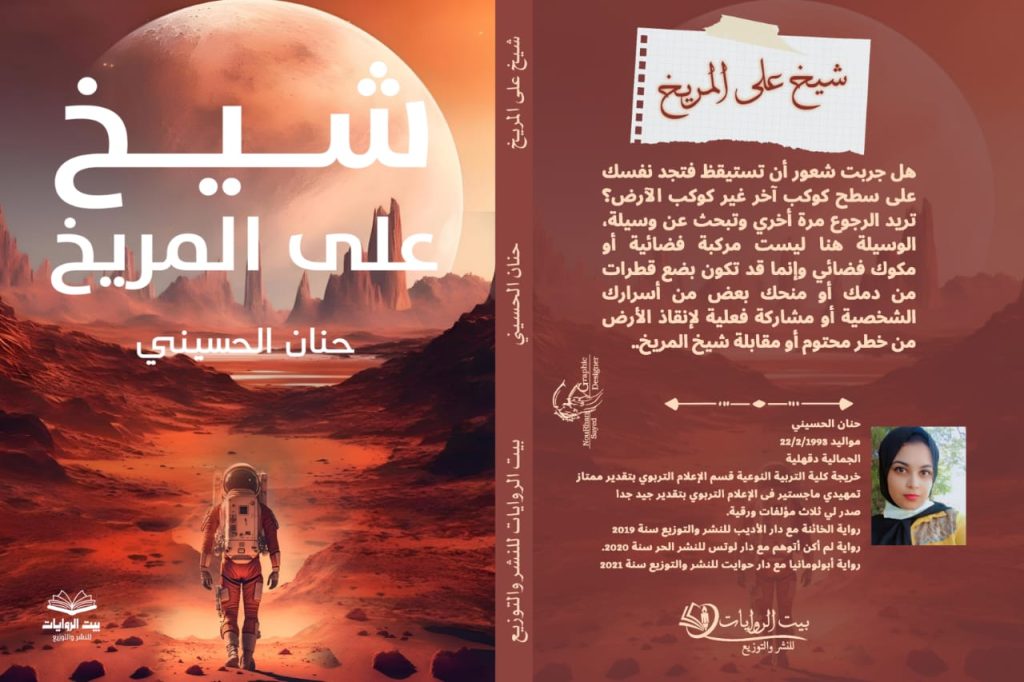
HOME SWEET HOME: The book cover of Hanan El-Hosseini’s novel; a barren landscape concealing even more barren but still warring personalities.
Amalia finds her mother among the captives and tells her that her granddad colonised Mars with robots, robot-human hybrids, and the great sheikh, a clone of himself. The family patriarch wants to use the planet for total domination of Earth.
He’s got factories for clones and parentless kids, his personal arm. But the colonists seem to have developed their own plans along the way.
The grandfather makes it to Mars, and the great Sheikh and Gennie eliminate each other, with some help from Eyad and Jado. Safely back on earth, Amalia inherits the family firm and finally marries her sweetheart Eyad, making Jado her right-hand man.
Then the novel closes with a distress call coming to them from Mars, after they supposedly destroyed all the cities there. To be continued!
What interests me in all this, beyond the woman protagonist, is the imagery and themes. There’s so much borrowed from fantasy, not least The 1001 Nights. The fountain of youth is evident, as well as magic mirrors that show you someone’s true face and hidden intentions.
It’s like watching The NeverEnding Story (1984) or The Thief of Baghdad (1961), with hints of the City of Brass, too, in the harsh metallic men. And in Arabic folklore, the Ghoul is a kind of bloodsucker.
The water underneath the crystal floor smacks of Solomon (PBUH) in the Quran, along with the jinn, of course.
Environmentalism is a clear theme, but also the fear that progress will turn us into cold-hearted machines. An emblem of the Western world that drove Earth’s temperature topsy-turvy to begin with.
Having the heroine displace an evil patriarchal figure is also a nice touch, but it only comes after a character arc of her own. In one particularly funny scene, you have Amalia on earth, doing her nails, while Eyad tries to tell her about his grandiose technological plans.
No wonder he went to Mars. To get away from it all and finally prove himself to her obnoxious family.
They actually asked an Egyptian scientist once how he ended up on Mars – working for NASA and the French Space Agency – and he explained that there’s no ‘wasta’ (nepotism) there!
That’s what I was trying to say in my own Mars story, “A Detour in Space”, with Arabs bringing our baggage with us there. A journey into space is really a journey back home.
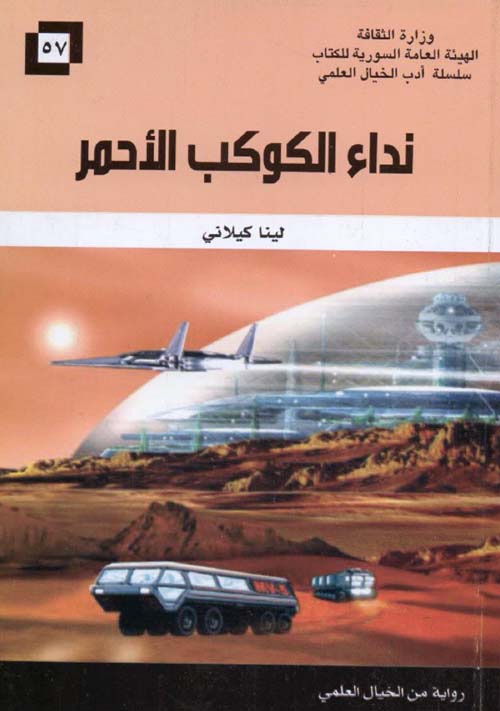
DETOX TOURS: Mars holds a special place in Arab children's literature too, as evidenced by Syrian author Lina Al-Kilani's 'Call of the Red Planet' (نداء الكوكب الأحمر).
I’d also say Jado’s character is the author’s attempt to humanise robots. Just like Ahmed Salah Al-Mahdi and Ammar Al-Masry, along with morally redeemable extraterrestrials in our brand of non-Western SF.
It pays to be vindicated!!