No conflict has ever been resolved thanks to international law; such a world has never existed. It's a fictional world that people need. But we keep talking about it because it's difficult for postmodern Europeans to accept—it clashes with their deepest convictions.
By Oscar Hammerstein
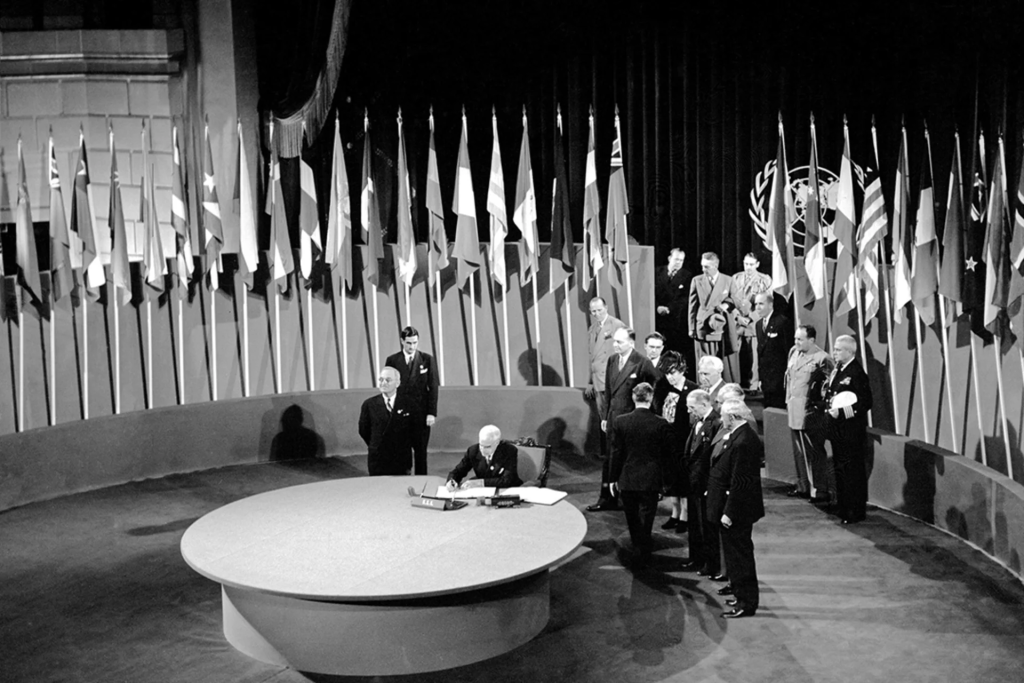
On June 26, 1945, in San Francisco, the United Nations (UN) was founded during the United Nations Conference on International Organisation. Representatives from fifty countries signed the UN Charter there. The organisation officially came into force on October 24, 1945, after a sufficient number of countries had ratified the Charter. That date is still celebrated as United Nations Day.
The idea for the organisation stemmed primarily from plans by Franklin D. Roosevelt, President of the United States during World War II. The UN was intended to replace the already failed League of Nations and create a system to prevent wars between states through international cooperation and collective security. It was the moral shield of humanity: never again war, never again genocide, never again dictators slaughtering their own people.
It was sold as a global safety belt, permanently protecting us from new Hitlers (like Khamenei and Maduro) and new massacres like those in Tehran, where at least 30,000 innocent demonstrators were murdered within two days, and in Venezuela, where thousands of people were tortured, murdered, or disappeared by security forces.
The veto power in the Security Council is one of the most remarkable constitutional constructs of the 20th century. It was conceived and pushed through by US President Franklin D. Roosevelt during the negotiations that ultimately led to its creation. Roosevelt was aware of the League of Nations' failure, the UN's predecessor.
The major powers didn't really participate (the US itself never joined). Decisions were often legally, but not politically, enforceable. Roosevelt understood that an international organisation could only function if the world's real power centres supported them. No major power would ever allow an international organisation to overrule its military.
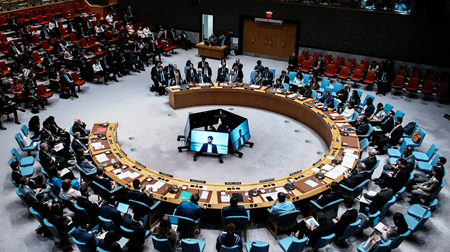
The logic was that if the major powers didn't directly clash, the UN could function. Once they did, no resolution could force a conflict—and that prevented the organisation itself from becoming a cause of war. The veto of the five (then) major powers was therefore essentially a safety valve against World War III.
The veto system simultaneously renders the UN powerless (in conflicts between major powers). This was precisely how it worked during the Cold War. The Security Council was often blocked, but the UN continued to exist. Roosevelt understood that an international legal order can only exist if it recognises political realities. Or, as it is often summarised: The UN is not a parliament of the world. It is a compromise between right and might.
The PREAMBLE to the treaty reads:
"We, the peoples of the United Nations, determined to save succeeding generations from the scourge of war, which twice in our lifetime has brought untold sorrow to humanity, and to reaffirm our faith in fundamental human rights, in the dignity and worth of the human person, in the equal rights of men and women and of nations large and small, and to create conditions under which justice and respect for the obligations arising from treaties and other sources of international law can be maintained, and to promote social progress and better conditions of life in larger freedom, and to this end to practice tolerance and live in peace with one another as good neighbors, to unite our efforts to maintain international peace and security, to ensure that armed force shall be used only in the common interest, and to establish international institutions to promote the economic and social advancement of all peoples,
We have decided to unite our efforts to achieve these objectives. Accordingly, our respective Governments, through their representatives assembled in San Francisco, having submitted their full powers and found them in good and due form, have adopted this Charter of the United Nations and hereby establish an international organisation, which shall bear the name of the United Nations.
The opening words of the UN Charter—"We the peoples of the United Nations"—were chosen with great legal and historical precision. They seem simple, but they mark a minor revolution in international law. Traditionally, international law has been governed by one principle: states are the only legal subjects. Treaties, therefore, almost always began with phrases such as: "The Governments of..." or "The States parties to this treaty..." The UN Charter broke that pattern. By writing "We the peoples," it was suggested that the legitimacy of the international order derives not only from states, but from the peoples of those states. This was strongly influenced by constitutional language, especially that of the US Constitution, which begins: "We the People…."
After two world wars, the drafters of the Charter wanted to make it clear that international peace should not be merely a diplomatic game between governments. The idea was that governments can fail or wage war, but the international order must ultimately serve humanity as a whole. Hence, the first sentence of the preamble: "to save succeeding generations from the scourge of war." Although the preamble speaks of "peoples," the organisation is actually governed by states. Especially in the Security Council, the great powers dominate with their veto power. In other words, the language is almost constitutional and universal, but the power structure is classic in its geopolitical nature.
That single formulation certainly had legal consequences. It formed the basis for the development of international human rights, the idea that individuals are also rights holders under international law, and also for international criminal justice (e.g., tribunals and the International Criminal Court). Many lawyers, therefore, view the UN Charter as a kind of "constitution of the international community."
The purpose of the United Nations was noble and formulated: to maintain international peace, curb aggression, and—perhaps even more importantly—protect human dignity.
Human rights were formalised in the Universal Declaration of 1948. Shortly thereafter, the European Convention on Human Rights entered into force (4 November 1950). This went a step further than most treaties.
It gave citizens rights against their own state. And it also gave those rights teeth: a European Court that could reprimand states—a revolutionary idea. The national law of states would no longer have the final say.
That idea already had a precedent. At Nuremberg, it was decided that the Nazis could not hide behind their own legislation. Just because something is legal in a country doesn't mean it's just. The conclusion was simple: if you truly want to protect citizens, you can't grant states unlimited sovereignty.
But here's the problem. The law must be enforceable. This was also known to the renowned professor Marcel Storme, the architect of European procedural law, who, according to his admirer Ludo Dierickx, never tired of repeating: Law must be enforceable. A law without enforcement is not law. It's like a wish on a Christmas card—a moral appeal. Every law student learns that in their first year.
Within a state, it's simple. The government enforces the law. The judge administers justice, and the police execute a sentence. But internationally? That's where things get complicated. Who compels rogue states like Iran, North Korea, and Venezuela to comply? Who prevents countries from attacking each other? Who will stop regimes like Iran's, which finance terrorist groups like Hamas and Hezbollah?
The structures built after 1945 proved completely incapable of withstanding this. In numerous countries—communist dictatorships, military regimes, some Islamic states—human rights have little meaning. Some states have even devised their own versions of human rights, adapted to religious law.
And the Security Council? It's trapped in its own construct. The veto power of the great powers makes any effective enforcement impossible as soon as one of them obstructs it. What was intended to curb aggressive states has had a strange effect: precisely the states that need international law the most are often the least amenable to challenge.
The rogue state of Iran is an ally of Russia and is being armed by China against, according to international law, clandestine oil deliveries. Only those self-proclaimed legal scholars on gossip shows think that Israel and the United States should have requested a mandate from the Security Council.
The irony is complete. The organisation that was created to tame rogue states is powerless against them.
Not so long ago, UN Secretary-General António Guterres declared that the United Nations is more relevant than ever. It sounded nice. But it's hard to escape the impression that it was more propaganda than analysis. Because where does the UN truly have authority? Not in Russia. Not in China. Not in North Korea. Not in Cuba. Not in Afghanistan. And not even in the United States, which, while not a rogue state, rarely lets others tell it what to do.
The stark conclusion, then, is this: the 1945 world order was a brilliant idea. Only one element is missing: the power to enforce justice. Justice that cannot be enforced is not justice. It is a recommendation.
Within the international legal order we built after the war, a painful truth exists. That order is noble in its principles, but poor in its resources. It proclaims what states should do, but it barely says what should happen when states defy the law and endanger others' lives.
Not so long ago, the US invasion of Venezuela was justified by the argument that the Maduro regime was threatening American lives through drug trafficking and supporting international terrorism.
The same, and even more, can be said of Iran today. Iran finances and arms Hezbollah and Hamas. Iran supports Russia in its war against Ukraine. Iran is openly developing nuclear weapons. Within its own borders, the regime has brutally suppressed and murdered tens of thousands of protesters in just a few weeks.
What has the international community done about this? Nothing. What has the United Nations done? Nothing. What have the many institutions we established after World War II done to protect humanity from tyranny and mass violence? Again: nothing.
The mechanisms built with such hope after 1945 are proving horribly weak today when confronted by regimes that despise justice. The international order speaks with lofty words, but it lacks the teeth to enforce its own rules. That failure undermines the entire post-war legal system.
Under current international law, Israel and the United States have no clear mandate to invade Iran. But it is equally true that Iran has been violating that same right for 40 years without anyone invoking international law to condemn it. Let alone proving capable of enforcing that right. Therein lies the dilemma of our time.
It is impossible to condemn Israel and America without simultaneously condemning the regime in Tehran for its flagrant crimes against its own people and the world. But condemning everyone, indiscriminately, gets us nowhere. That is the empty rhetoric of a barroom brawl.
Nor is it justifiable to accuse Israel and America of acting where the international community fails to act. After all, states are entitled to trust that the international law we created will actually be upheld. But when that law exists only on paper, only two options remain: either the crimes continue, or someone intervenes.
The idea that such regimes will be brought to reason through endless negotiations is a dangerous illusion. History teaches us that pacifism toward criminals is often nothing more than an invitation to do what they want.
By the time diplomacy celebrates its victory, there are sometimes already tens of thousands more dead than an earlier intervention would have required. Soft hands make stinking wounds.
The current attacks on Iran are therefore not merely a military event. They are primarily a symptom of the bankruptcy of an international order that has established rules but lacks the strength to enforce them.
It is politically, legally, and morally irresponsible to invoke such a powerless system against states that attempt to put an end to flagrant human rights violations. Ultimately, the world faces a stark choice: either we tolerate rogue states terrorising their own people and their neighbours, or we accept that others intervene where law itself fails.
That national interests play a role in this is self-evident. That is the nature of states. The only way to avoid this would be an international legal order that can truly enforce its prescriptions. But as long as that enforcement is lacking, the reality will always be the same: when the law remains silent, states will act. Not because they want to, but because someone has to.
And we're still a long way from that.
Oscar Hammerstein is a prominent Dutch public figure and retired lawyer. He has had a long career in the legal industry and has a strong entrepreneurial spirit. He is professionally skilled in Arbitration, European Law, Construction Law, Dispute Resolution, and Contract Law. His previous contribution can be found here.