When the debate over the burqa and other face-covering veils was beginning in Europe, I was among the first to take the initiative to address the issue from both legal and societal perspectives. As early as 2003, I submitted a bill to the Belgian Senate proposing a ban on face-concealing garments in public spaces.
By Anke Van dermeersch
In doing so, I was far ahead of my time. After all, being proven right is not the same as being right... In 2011, Belgium ultimately became the second European country, after France, to introduce a general ban on face-covering clothing in public spaces, based on the text of my bill.
The Netherlands does not have a general ban but rather a partial one that covers schools, government buildings, and public transport. More than twenty years later, the Minister of Justice’s response to my recent parliamentary question reveals that this debate is anything but outdated.
Quite the opposite.
National police figures show a clear rise in recorded violations of the ban on face-covering clothing in public spaces. The number of identified suspects in Belgium rose from 22 in 2020 to 192 in 2025.
The number of recorded incidents also increased sharply: from 19 incidents in 2020 to 183 in 2025, nearly a tenfold increase in five years. This trend demonstrates that the ban remains necessary, yet simultaneously shows that compliance is becoming increasingly problematic.
Moreover, it is striking that the authorities themselves cannot provide a complete picture of actual enforcement. The response reveals that the Justice Department cannot provide figures on recidivism, the number of administrative fines (GAS sanctions) imposed, out-of-court settlements, actual convictions, or the number of offenders who ultimately paid a fine. A law whose application the authorities can barely monitor risks losing its deterrent effect.
Local figures confirm this same trend. In the judicial district of Antwerp, the number of known suspects rose from 2 in 2020 to 109 in 2025. Of these, 68 suspects were non-Belgian nationals, and 41 were Belgian nationals. The number of registered incidents rose from 2 to 89 during the same period.
Antwerp alone thus accounts for more than half of all suspects registered in Belgium in 2025.
Belgium is not alone in this regard. Over the past fifteen years, an increasing number of European countries have reached the same conclusion. France (2011), Belgium (2011), Austria (2017), Denmark (2018), and Switzerland (at the federal level from 2025) have implemented a general ban or far-reaching restrictions on face-covering clothing in public spaces.
In addition, partial bans apply in the Netherlands, Germany, Norway, and Luxembourg, for instance, in government buildings, schools, or on public transport. Moreover, in the judgments of S.A.S. v. France (2014) and Belcacemi and Oussar v. Belgium (2017), the European Court of Human Rights confirmed that such bans can be compatible with the European Convention on Human Rights when justified by public safety concerns and the conditions for coexistence in a democratic society.
Public debate regarding the burqa ban is often reduced to a conflict between freedom of religion and government intervention. However, a look back at the original arguments reveals that a much more fundamental issue was at the heart of the matter: the position of women in our society.
While progressive movements today like to present themselves as the exclusive defenders of women's rights, in Europe it is often conservative voices that dare to ask the uncomfortable but necessary question: can a society built on the equality of women and men remain indifferent to a garment that stands worldwide as a symbol of female seclusion, subjugation, and social exclusion?
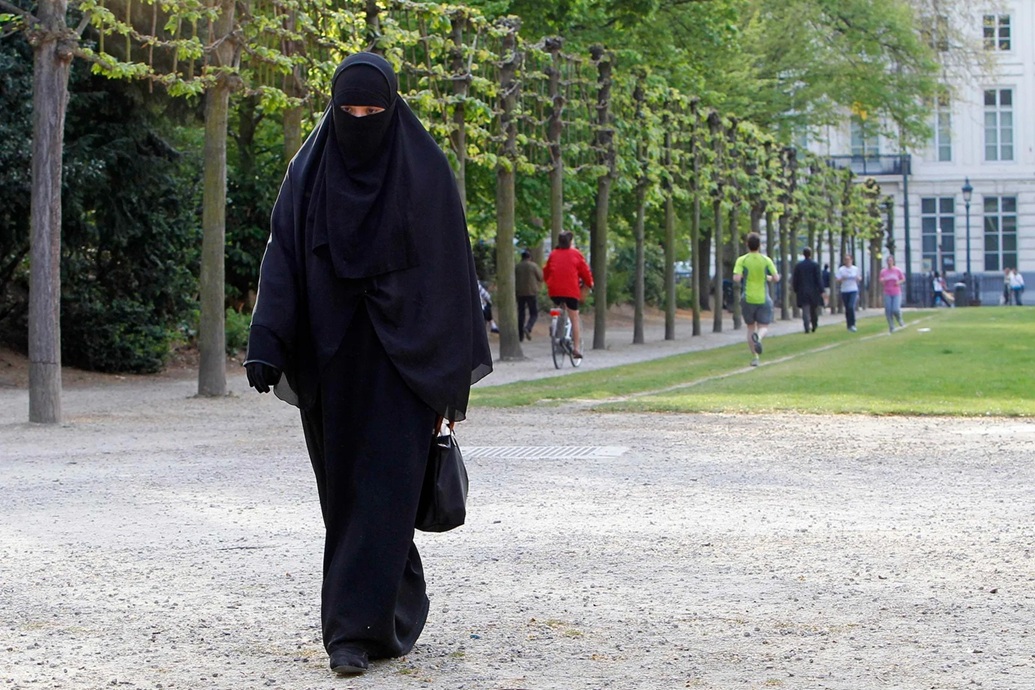
After all, the burqa is not merely a garment or a religious symbol. It goes far beyond the headscarf, which is objectionable enough in itself. A headscarf still allows a woman to participate visibly in public life; her face remains recognisable, communication remains possible, and social interaction continues.
The burqa does the exact opposite: it completely conceals the face and reduces the woman to an anonymous figure. That is no mere detail. It strikes at the very heart of our society.
In a free society, citizens meet face-to-face. Through facial expressions, we communicate, build trust, and recognise one another as equals. The face is not a mere detail, but an essential component of human dignity and social connection.
A society in which women are systematically hidden from view undermines that fundamental principle. The burqa, as well as the hijab and the chador, is a textile sarcophagus. Headscarves are fabric coffins behind which women are figuratively buried.
I pointed out this reality as early as 2003. Face-covering garments not only create problems regarding identification and public safety but also carry powerful symbolic meaning. The burqa embodies a view of humanity in which women are expected to remain passive, silent, and hidden. This stands in stark contrast to everything generations of European women have fought for.
Critics often argue that some women choose to wear a burqa voluntarily. That argument deserves attention, but it cannot be the end of the discussion. Oppressive norms can also be internalised. The fact that someone ‘voluntarily’ accepts a particular practice does not automatically mean that society is precluded from passing judgment on it.
Freedom does not mean that we must uncritically accept all symbols when they fundamentally clash with the principle of equality between women and men.
Of course, this does not mean that Muslim women should be singled out. Most Muslim women in Europe do not wear the burqa and participate fully in public life.
More than twenty years after my initial legislative proposal, the question is no longer whether the burqa ban is justified. The figures show that today’s challenge lies primarily in its consistent enforcement. A law that requires increasingly frequent application, yet one where the authorities cannot even state how many violators are ultimately sanctioned- risks losing its credibility.
Defending women's rights, human dignity, and an open society requires more than fine principles; it also demands the courage to enforce the law. That was the aim of my legislative proposal in 2003. Today, more than twenty years later, that aim is more relevant than ever.
Anke Van dermeersch is a Flemish nationalist politician and former tax lawyer who was crowned Miss Belgium in 1991. She served as a member of the Belgian Senate and the Flemish Parliament representing the right-wing party Vlaams Belang. She is also known for her controversial views and activist work against the Islamization of Europe. Her previous contribution can be read here.