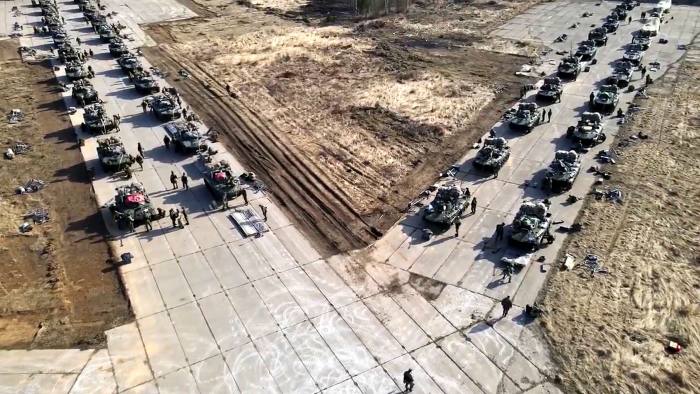
The drums of war are beating louder near the Russia – Ukraine border. Moscow has deployed a growing number of military units to Belarus, as well as to the Russian Western regions not far from the Ukrainian capital city of Kiev. Is the Kremlin preparing to invade the Eastern European country?
By Nikola Mikovic
According to reports, Russia has deployed more than 127,000 troops in the region. Six Russian landing ships capable of carrying main battle tanks, troops, and other military vehicles traveled from the Baltic Sea, through the English Channel en route to the Mediterranean last week. A deployment that could bolster an amphibious landing on Ukraine’s southern coast.
It is believed that the amphibious flotilla could potentially swing north into the Black Sea and play a significant role if the Kremlin decides to attack its neighbor. However, the very fact that NATO ships never attempted to prevent the Russian flotilla from reaching the Black Sea region questions the mainstream narrative of an “imminent Russian invasion of Ukraine”.
If the West was so concerned about Russia’s alleged plans to invade Ukraine, NATO was determined to protect the former Soviet republic. British ships could have blocked the Russian flotilla's passage to the Mediterranean.

Major incident
Such a move would create a major incident, but would not lead to World War 3. Russia’s Foreign Ministry would express its deep concerns concern over the UK actions, and the Russian ships would either have to go back to the Baltic Sea or would have to find an alternative route to reach the Mediterranean and the Black Sea.
Since the West allowed the Russian flotilla to freely go through the English Channel, the United States and its European partners may have got “security guarantees” from Moscow that the ships will not be used against Ukraine.
Alternatively, it is not improbable that Russia and the US have already agreed to redistribute their zones of influence, which means that Ukraine could soon face some kind of partition. Still, such a scenario does not seem too realistic, at least at this point.
The United States is not showing any signs of readiness to make a significant concession to the Kremlin. Even though Russia issued an “ultimatum” to Washington back in December, demanding security guarantees that Ukraine, Georgia, and other former Soviet republics that are still out of NATO will never join the Alliance.
To this day the US has not provided the official response to Moscow’s demands. Instead, the US and the United Kingdom are actively supplying weapons to Ukraine, and the Kremlin is showing no will to prevent it.
Unlike Russia which openly hesitates from attacking Ukraine, Israel is perfectly demonstrating how a powerful country protects its national interests. The Jewish State does not wait for its archenemy Iran to provide weapons to Hezbollah but launches airstrikes in Syria as soon as its intelligence services receive information that a cargo of weapons from Iran has arrived at the Syrian ports or airports.
Moscow, however, cannot implement the same model for some obvious reasons. Firstly, Israel has the United States on its side, which means that no international sanctions will ever be imposed on the Jewish State. Secondly, Israeli officials and oligarchs do not have their assets in Iranian banks, nor do their children live and study in Tehran.
As long as Russian officials have bank accounts and properties in the West, the Kremlin’s hands will be tied and Moscow will have to make concessions to its Western partners.
Does that mean that Russia will not invade Ukraine under any circumstances? Not necessarily. If an invasion is part of a wider behind-the-scenes deal between Moscow and Washington, then Russian leader Vladimir Putin will “have to do something”, as US President Joe Biden recently stressed.
In other words, a war between Russia and Ukraine may come as a result of a geopolitical deal between the Kremlin and its American partners. Like Franklin D. Roosevelt, the 32nd president of the United States, once said: “In politics, nothing happens by accident. If it happens, you can bet it was planned that way.”
The coming weeks will show if the US and Russia have agreed to fight a proxy war on the Ukrainian territory.
Nikola Mikovic is a Serbian journalist and a senior Geopolitical Analyst he publishes often for The Levant News.