In today’s professional environment, productivity is frequently mistaken for business. Long working hours, back-to-back online meetings, constant notifications, and rapid email responses create the impression of commitment. Yet real progress often tells a different story.
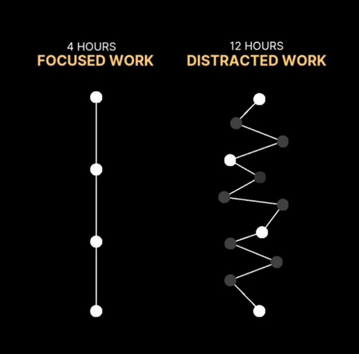
Four hours of focused, intentional work can generate more measurable value than twelve hours spent reacting to distractions. The difference lies not in effort—but in direction.
Researchers from Harvard Business School consistently emphasise that high performers create value through disciplined prioritisation, clarity of goals, and protected thinking time. Leaders are encouraged to focus on high-impact activities rather than allowing urgency to dictate their day.
Focused work is deliberate. It is built around clearly defined outcomes and protected time blocks. It advances in a straight, purposeful line. Distracted work, by contrast, moves in fragments—starting, stopping, shifting, and reacting. Energy is consumed, yet progress remains uneven.
True professional impact is built on depth, not noise.
I list my 3 fundamental distinctions between focused and distracted work:
1-Focus Creates Linear Progress, Distraction Creates Friction
Sustained attention builds cognitive momentum. When the mind remains focused on a single complex task, decision quality improves, and execution accelerates. Errors decrease because context remains intact.
Distraction introduces friction. Each interruption forces a mental reset. This switching reduces efficiency and drains energy. While the day may feel full, the actual output often falls short.
Insights from leadership research at Harvard Business School often highlight this principle: strategic effectiveness depends on allocating time to high-leverage activities. Fragmented attention undermines strategic thinking.
2-Depth Builds Mastery, Shallow Work Builds Activity
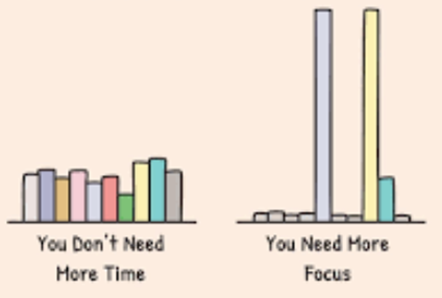
Focused work allows professionals to think deeply, solve complex problems, and anticipate risks. It strengthens judgment and develops expertise over time.
Distracted work encourages surface engagement. Tasks are initiated but not fully developed. Conversations happen, yet alignment remains partial. Activity increases, but mastery does not.
In project environments, shallow work often manifests as excessive coordination without clarity—deep work results in structured plans, thoughtful risk assessment, and decisive governance. The difference is not visible in hours—it is visible in impact.
3-Energy Allocation Determines Output Quality
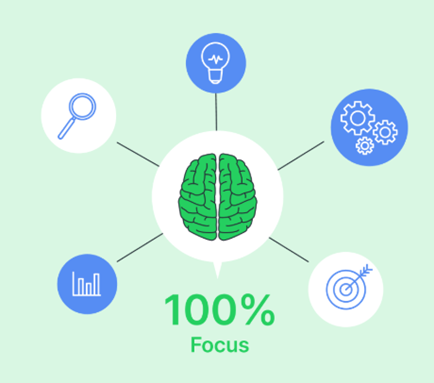
Attention is a finite strategic asset. High performers treat it accordingly. They design their day intentionally, grouping meetings, limiting interruptions, and reserving uninterrupted blocks for high-value tasks.
Distracted professionals operate reactively. Urgency dominates importance. Over time, this reactive cycle reduces clarity, creativity, and resilience.
Leadership development teachings frequently emphasise that managing energy and focus is a core executive capability. It is not simply about working harder; it is about working with intention.
Productivity is not measured by exhaustion, nor by the number of hours logged. It is measured by meaningful forward movement. Long days filled with fragmented attention create the illusion of progress. Structured, concentrated effort creates real advancement.
The essential question is not how long you work. I always produced efficiently when finishing early. It is whether your effort moves in a straight, disciplined direction or disperses into scattered motion.