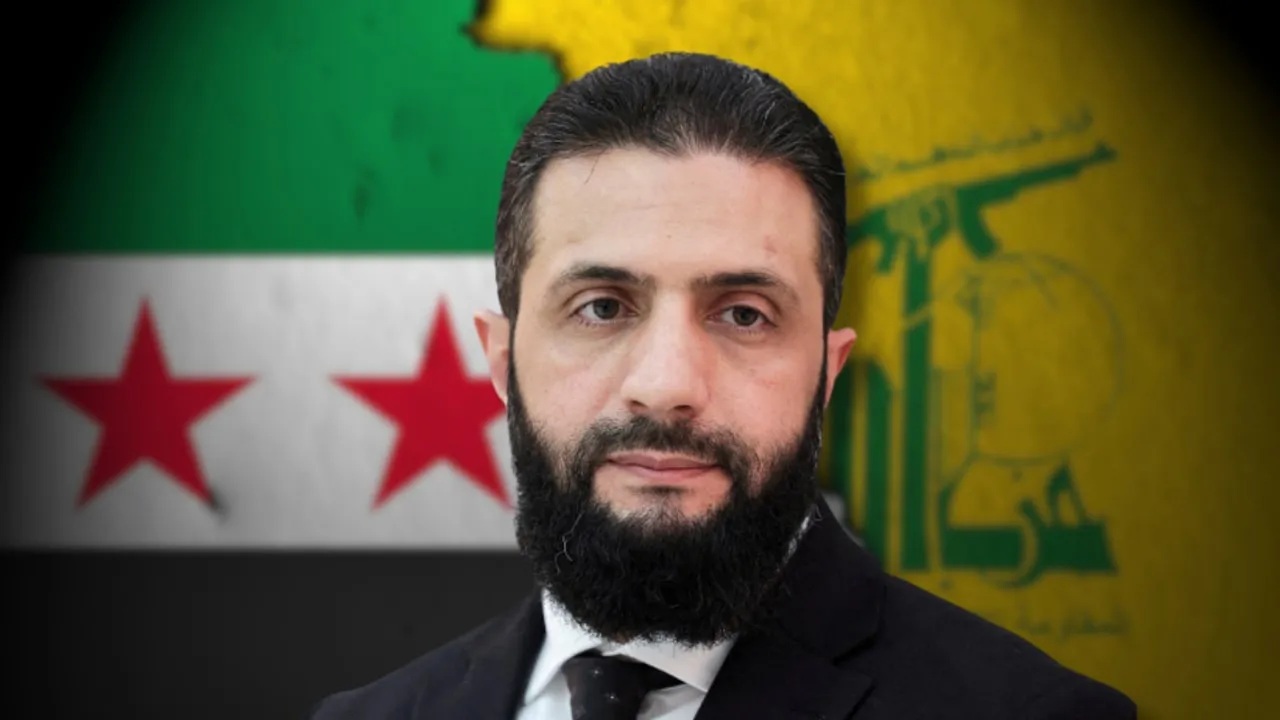
In the shifting geometry of Middle Eastern conflict, moments arise when a state is not pushed into war, but quietly sucked into it. Syria today appears to be standing at precisely such a threshold. As the confrontation between the United States, Israel, and Iran unfolds in layered, ambiguous escalation, a new and dangerous proposition has surfaced in regional discourse: that Damascus, under the leadership of Ahmad al-Sharaà, could intervene militarily in Lebanon to dismantle Hezbollah.
By Rafic Taleb
Whether this is a real strategic option or a carefully constructed illusion matters less than the fact that it is being seriously entertained—and that the consequences of acting on it could redefine Syria’s future.
The battlefield context is critical. Hezbollah has demonstrated an unprecedented operational tempo, reportedly executing dozens of military actions within a single day, including repeated drone strikes against Israeli positions and sustained pressure along multiple axes of the southern Lebanese front.
This is not symbolic resistance; it is structured escalation. Israel, for its part, has responded with calibrated force. airstrikes, targeted operations, and limited ground incursions. suggesting a doctrine of controlled escalation rather than full-scale invasion. Within this environment, Hezbollah is no longer merely a deterrent proxy of Iran; it has become the central kinetic actor in a live and expanding confrontation.
Overlaying this battlefield reality is a dense layer of strategic narrative—some verified, much of it speculative, and all of it consequential. Claims circulate that the United States has used only a fraction of its military capacity, that Iranian leadership structures are fracturing or even collapsing, and that elements within the Islamic Revolutionary Guard Corps have opened backchannels to Washington.
Other assertions suggest that Iranian actions themselves are being subtly shaped or tolerated by U.S. strategy to achieve broader geopolitical aims: economic pressure on China and India through disruptions in Hormuz, financial exhaustion of Gulf states, and the testing of advanced Chinese and Russian military technologies under real combat conditions.
Whether true or not, these narratives serve a purpose—they construct a perception of inevitability, of a war whose outcomes are already scripted, and in which secondary actors must decide whether to align early or be swept aside later.
It is within this psychological and strategic environment that al-Sharaà’s Syria is being positioned. Reports, unconfirmed yet persistent, suggest that Damascus has explored coordination with the Pentagon, sought French air cover following the deployment of the aircraft carrier Charles de Gaulle, and approached Gulf states for funding a joint operations structure. The responses, according to these accounts, have been cautious or negative.
At the same time, contradictory signals emerge: U.S. pressure on Syria to act against Hezbollah juxtaposed with official Syrian denials that any such request has been formally made. This ambiguity is not incidental; it reflects a broader pattern in modern conflict, where plausible deniability and strategic signalling operate simultaneously.
For al-Sharaà, the temptation to intervene is not difficult to understand. Domestically, Syria faces acute economic strain and a legitimacy deficit. Promises of transformation—of a “Singapore model,” of infrastructure revival, of economic renaissance—have collided with harsh realities. Military action abroad, particularly one framed as aligning with a powerful international coalition, offers a potential pathway to reset his standing.
Success in Lebanon could present him as a decisive regional actor, a partner to Western and Gulf powers, and a leader capable of reshaping the balance of power. It could delay or even neutralise internal challenges to his authority, including the spectre of alternative leadership figures waiting in the wings.
Moreover, the removal—or even significant weakening—of Hezbollah would dramatically alter the strategic landscape. From Damascus’s perspective, Hezbollah has long been both an ally and a constraint: a non-state actor whose power complicates Syrian sovereignty and whose alignment with Iran ties Syria into a broader (Axis of Resistance) that may no longer serve its leadership’s evolving priorities.
If Israel were to degrade Hezbollah alone, Syria would remain a bystander. If Syria participates in that outcome, it becomes a stakeholder in the post-Hezbollah order.
Yet the risks are profound, and arguably far outweigh the potential gains. Militarily, Hezbollah is not an opponent analogous to fragmented militias or insurgent remnants. It is a highly disciplined, battle-hardened force with deep territorial entrenchment, sophisticated command structures, and extensive combat experience.
Even Israel, with overwhelming technological superiority, has historically faced high costs in direct engagements. For Syrian forces—whose cohesion, training, and internal alignment remain uneven—intervention could quickly devolve into attritional warfare with no clear exit.
The regional repercussions would likely be immediate. Iraqi militias have already signalled that any Syrian involvement against Hezbollah would provoke direct retaliation, potentially opening a new front in eastern Syria.
Iran, for its part, may interpret any Syrian intervention as a clear alignment against it, thereby paving the way for strikes on Damascus and critical infrastructure. What begins as an external operation could quickly devolve into internal destabilisation, pulling Syria back into the very cycle of fragmentation it is striving to escape.
There is also the Lebanese dimension, often underestimated in strategic calculations. Syrian military presence in Lebanon carries a heavy historical memory—one associated not with liberation but with domination.
Any re-entry of Syrian forces, regardless of stated objectives, would likely be perceived by significant segments of the Lebanese population as a return of occupation. This could ignite internal tensions within Lebanon, complicate operations on the ground, and erode whatever political capital Syria hopes to gain internationally.
Perhaps most dangerously, the invitation itself may be a trap. The comparison, circulating in regional commentary, to Saddam Hussein’s entry into Kuwait is not merely rhetorical. Great powers have long leveraged the ambitions and insecurities of regional actors, encouraging moves that later justify their containment or removal.
In this reading, both the United States and Israel may find strategic advantage in Syria absorbing the burden of confronting Hezbollah—only to be left exposed, weakened, and isolated once that burden becomes unsustainable. Even a limited tactical success in Lebanon could be reframed through shifting alliances and narratives as a strategic defeat for Damascus.
At the core of this unfolding situation is a simple but brutal calculus: al-Sharaà’s decision is not between victory and defeat, but between different forms of risk. To intervene is to gamble Syria’s fragile stability on a complex, multi-front war whose parameters are not fully under his control.
To abstain is to risk marginalisation, to watch as regional dynamics evolve without Syrian input, and to face internal consequences for perceived inaction, potentially. In both scenarios, the margin for error is vanishingly small.
The current moment, therefore, is less about imminent war than about strategic positioning—about who moves first, who hesitates, and who miscalculates. Hezbollah continues to escalate in measured increments, Israel responds within controlled thresholds, and Iran remains engaged but cautious. Around them, narratives proliferate, alliances are tested, and actors like Syria are drawn toward decisions that could redefine their trajectories for years to come.
History suggests that the most consequential wars are not always those that begin with clear declarations, but those that emerge from a series of incremental choices, each rational in isolation, catastrophic in accumulation.
Syria now stands at such a juncture. Whether al-Sharaà steps into Lebanon or holds back, the decision will not merely shape the fate of Hezbollah—it will determine whether Syria reclaims agency in the region or becomes, once again, the terrain upon which others settle their conflicts.