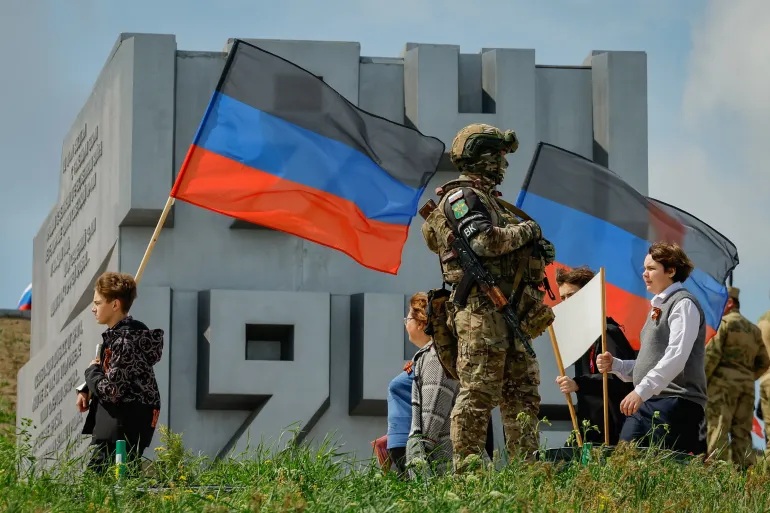
(Part I: The new Eurasian order)
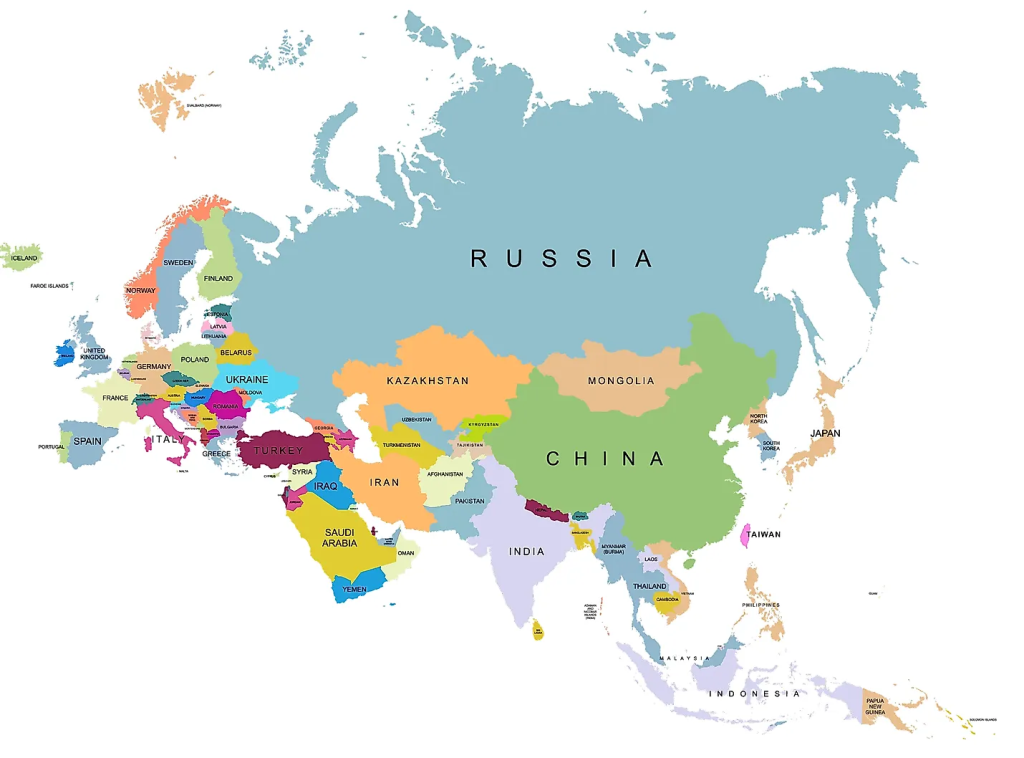
In the emerging Eurasian order, three forces are quietly reshaping global power. Russia carries the cross of the world — a historical burden stretching from Kyiv to the Middle East — balancing the weight of tradition, faith, and military confrontation. Across the same continent, China advances along quiet roads of trade and infrastructure, while Iran projects a crescent of fire through regional influence. Understanding Russia’s historical and cultural imperatives is essential to seeing how the broader Eurasian power triangle takes shape.
By Nadia Ahmad
When ancient burdens meet modern conflicts, the world itself is at stake. For centuries, Russia has seen itself as carrying the cross of the world — a civilizational burden stretching across history, not a crown of triumph but a responsibility placed upon it by destiny. Kyiv, the cradle of Eastern Slavic civilisation, lies at the centre of that cross. Losing it would not simply mean losing territory; it would mean fracturing a narrative Russia has carried for centuries. History sometimes moves with armies. Sometimes it moves with myths.
“For Russians, Ukrainians and Belarusians, Kyiv is the cradle of our civilisation.”
With these words, Vladimir Putin summarised a historical narrative deeply rooted in Russian consciousness. The reference reaches back more than a millennium to the baptism of the medieval state of Russia in Kyiv in 988 under Prince Vladimir the Great. This event brought Orthodox Christianity to the Eastern Slavs and laid the spiritual foundations of a civilisation that both Russia and Ukraine claim as part of their inheritance.
Ukraine was not merely a territory. Its churches, monasteries, and enduring cultural traditions formed the living memory of a shared Eastern Slavic past. The bells of Kyiv, the frescoes of Saint Sophia Cathedral, and the manuscripts preserved in monasteries became symbols, as tangible as any army, of a civilisation Russia still sees reflected in itself.
Nations usually measure their power in armies, economies, or alliances. Russia measures something else — history. In Russian strategic and cultural thought, the country is often portrayed as a civilisation bearing a burden imposed on it centuries ago. Not a crown of victory, but a cross.
For many Russian thinkers, their nation sees itself at the fault line of the world — between the Atlantic West and the vast Eurasian East. Suspended between these forces, Russia frames itself as the guardian of an inheritance older and deeper than any single state: the tradition of Eastern Orthodox Christianity.
The roots of this belief stretch back to one of the most dramatic moments in Christian history — the Fall of Constantinople. When the Ottoman armies captured the capital of the Byzantine Empire in 1453, the spiritual centre of Orthodox civilisation collapsed. For the Christian East, it felt like the end of a millennium-old world.
Yet history rarely leaves a vacuum. In the monasteries of Russia, a new idea slowly emerged. Clerics began to speak of a succession in Christian centres of power. Rome had fallen first. Constantinople had fallen second. But the faith itself, they believed, had not disappeared — it had simply moved north, to Moscow.
In the early sixteenth century, the monk Philotheus of Pskov wrote words that would echo through Russian political thought for centuries: “Two Romes have fallen. The third stands. And there will be no fourth.”
With that sentence, Moscow was transformed from a capital into a symbol — the Third Rome, the last guardian of Orthodox civilisation. Russian princes, tsars, and thinkers used this narrative to frame decisions, from coronation rituals to expansionist campaigns, thereby embedding a sense of destiny in political life. Ordinary citizens, too, absorbed this story: the belief that their homeland bore a historical responsibility greater than itself.
But whether this represents historical destiny or a powerful national myth remains open to debate. History repeatedly shows that nations convinced they carry a civilizational mission often become trapped by that very belief.
The “Third Rome” idea shaped how many Russians interpreted external pressures. Empires rose and fell, revolutions swept through the land, yet the narrative of resisting Western encroachment persisted. Even the Soviet Union — officially atheist — inherited part of this posture. While the church disappeared from public life, the deeper narrative of Russia as a civilisation resisting the West survived.
When the Soviet Union collapsed in 1991, that identity was shaken but not erased. The eastward expansion of NATO and the drift of former Soviet republics toward Western institutions revived historical anxieties in Moscow.
Into this context stepped Vladimir Putin. His rise represented not only political continuity but an attempt to reclaim a sense of historical purpose. Religious and civilizational imagery returned to public life. Church domes once again dominated Moscow’s skyline, and tradition became part of the political narrative.
Yet civilisations convinced of their historical mission often interpret normal geopolitical pressures as existential threats. Within this framework, the crisis that erupted in Ukraine was not simply territorial.
Ukraine occupies a central place in the historical narrative of Eastern Slavic civilisation, as the cradle of Kyivan Rus and Orthodox Christianity among the Slavs. Losing Ukraine to the Western orbit symbolised a rupture of shared historical and cultural roots.
But historical myths can be dangerous guides.
The war in Ukraine quickly produced consequences far beyond Moscow’s calculations. NATO rediscovered cohesion. European defence budgets increased. Sanctions reshaped global trade networks. Paradoxically, even a Russian victory in Ukraine could deepen Moscow’s isolation: a local triumph might provoke the alignment of much of the world against Russia.
Along the Ukrainian front, cities and towns became stages where history met human endurance. Kyiv’s monuments, Lviv’s cobbled streets, and the monasteries of Chernihiv became living reminders of a civilisation under siege — and of the stakes Moscow attached to its vision of destiny.
The crisis has also reverberated across the Middle East. Israel and the United States confront Iran and its regional allies. Hezbollah has been drawn closer into tensions along Lebanon’s southern border, while the Syrian arena has undergone a dramatic transformation.
Moscow’s focus on Europe allowed the fragile secular order in Damascus to weaken. Over time, forces once restrained by Russian strategic presence gained ground, and a more radical, jihadist-aligned governance replaced the secular regime that had held the country together. In this way, Russia’s historical burden carried consequences far beyond its intended sphere, leaving old allies vulnerable to dynamics it could no longer control.
Wars that once appeared separate are now intertwined. The geopolitical earthquake stretches from Europe to the Middle East, affecting global stability.
In this sense, the cross metaphor becomes striking. A cross is not a symbol of triumph. It is a symbol of burden. For centuries, many Russians have believed their nation carries such a burden — defending a civilizational inheritance stretching back to Byzantium. Yet Christian theology reminds us that the cross is never the end of the story. The crucifixion precedes the resurrection.
The upheavals now unfolding — in Ukraine, across Europe, and in the Middle East — resemble a global crucifixion. The post-Cold War order, once taken for granted, is fracturing. Alliances are tested. Old assumptions collapse. Russia’s campaign illustrates the risk: even a victory in Ukraine could be pyrrhic, securing territory while antagonising the broader international community — effectively winning Ukraine while losing the world.
At the same time, Europe watches with both concern and reflection. Germany’s renewed defence initiatives, Poland’s fortification along its eastern borders, and public debates in capitals from Paris to Brussels reveal that the crisis is as much about perception, identity, and historical memory as it is about tanks and missiles. Across the continent, people and policymakers alike are reminded that civilizational narratives, while powerful, carry consequences.
History teaches a final lesson: crucifixion without reflection is tragedy. Crucifixion understood may lead to resurrection. As Jesus Christ said: “Whoever wants to save himself will lose it, but whoever loses himself will gain it.”
The Ukrainian cross may therefore symbolise more than a battlefield. It may mark the moment when the old-world order yields to a new one — reminding nations that the burden they carry can either lead to renewal or to isolation.
Even as borders shift and alliances realign, the story of Russia — and of the civilisations it intertwines with — continues to unfold. The weight of history remains, and with it the question: will the cross carried become a path to wisdom, or a weight that crushes the world it seeks to bear?

[…] Part II of the series: The New Eurasian Order, Part I, can be read here […]
[…] III of the series: The New Eurasian Order, Part I, can be read here & Part II here)While wars rage from Ukraine to the Middle East, Beijing redraws the […]