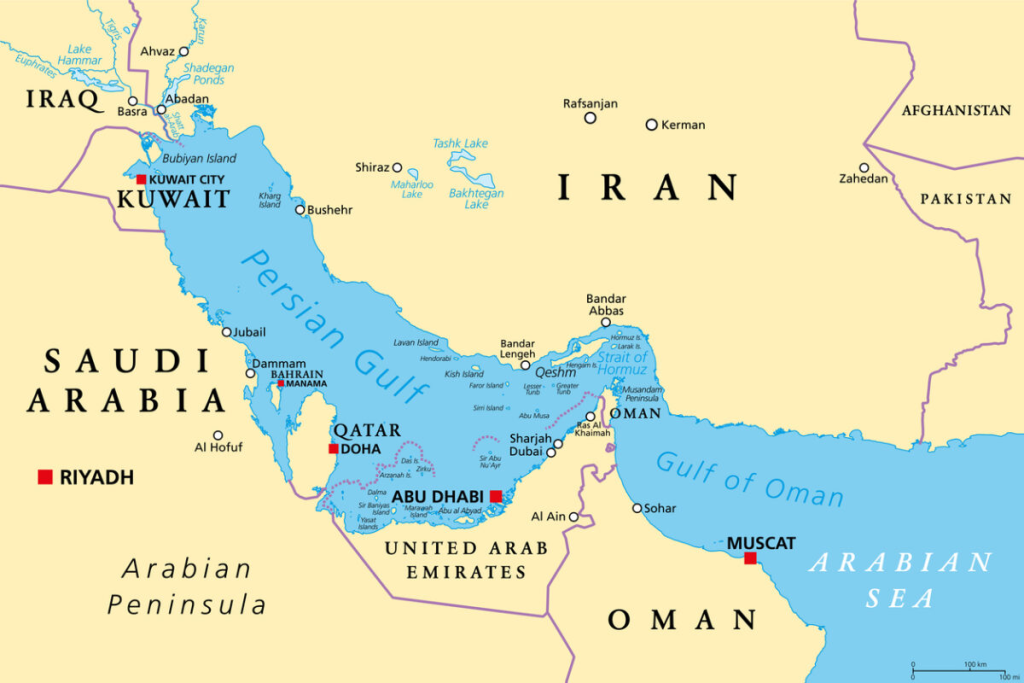
There are places on Earth that behave less like geography and more like thought. The Strait of Hormuz is one of them. On the map, it is a narrow maritime corridor between Iran and the Arabian Peninsula, but it functions like a question the world never stops answering. Not because it is large, but because it is small enough to matter. Because everything that passes through it reminds us that global systems are never truly wide, they are concentrated, fragile, and held together by points of extreme narrowness.
By Nadia Ahmad
In a region shaped by overlapping wars and pressures stretching from Gaza to the wider Middle East, Hormuz is no longer just a place on a map. It is a structure that reveals how the world actually moves.
We tend to imagine war through images: destroyed buildings, displaced families, columns of smoke rising over cities. These images dominate our screens and shape our emotional response. But modern conflict increasingly unfolds elsewhere—in the hidden architecture that sustains everyday life. Oil routes, shipping lanes, financial circuits: these are the new frontlines.
Hormuz sits at the centre of this invisible battlefield. Not because it is constantly erupting, but because it does not need to be. Its power lies in potential. The mere suggestion of disruption is enough to send ripples through global markets, recalibrate political calculations, and expose how distant societies are bound to a geography they rarely see.
This is the paradox of the modern world. The more connected systems become, the more they depend on narrow corridors. Vast networks of trade and energy ultimately converge into constrained passages. Vulnerability is not an exception to globalisation—it is its architecture. And when policymakers speak of energy security or strategic autonomy, they are responding, consciously or not, to this structural fact.
For decades, Hormuz was framed primarily through the lens of Iranian agency. It was treated as a pressure point Tehran could activate in moments of escalation, a strategic “card” embedded in regional confrontation. But this framing is increasingly incomplete.
The post-war environment does not eliminate Iran’s relevance, but it reduces the unilateral nature of its leverage. Hormuz is no longer a simple instrument of threat. It is becoming a managed strategic interface.
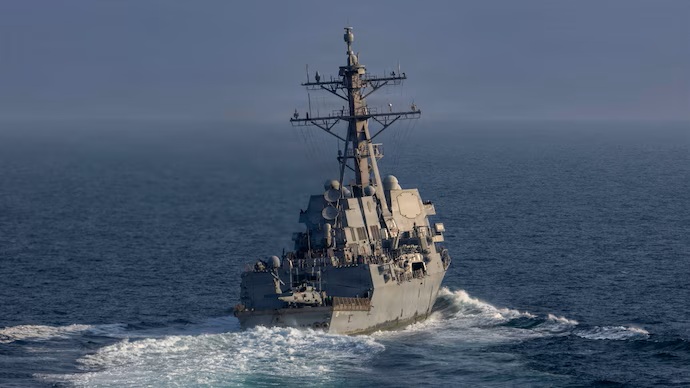
This shift matters. The Strait is now shaped not only by Iranian posture, but by layered systems of control: naval presence by external powers, insurance regimes that determine risk pricing, maritime security coordination, and the diversification of energy routing strategies across global markets. In this configuration, the Strait is not closed or open—it is continuously regulated.
And regulation has a geopolitical meaning of its own.
Hormuz is not only a regional chokepoint. It is also embedded in a wider systemic competition. A significant share of global energy flows—particularly those feeding Asian industrial economies—passes through it. This means that any recalibration of its security architecture indirectly affects the strategic exposure of China’s energy lifelines.
Here, the Strait ceases to be a Gulf–Iran interface alone. It becomes a latent pressure node within the broader US–China strategic environment. Not because it is militarised in that direction, but because its continuity of flow is now part of a larger geopolitical calculus.
This is where the deeper transformation becomes visible: control over Hormuz is no longer about the possibility of closure but about managing continuity amid competition. And this shift interacts directly with Pakistan’s rising role in the regional system.
Pakistan’s importance is inseparable from China’s westward strategic logic. At the centre of this logic is the China–Pakistan Economic Corridor, which connects China’s western regions to the Arabian Sea via the port of Gwadar. This corridor is not simply infrastructure. It is a strategic architecture designed to reduce dependence on vulnerable maritime chokepoints and create alternative routes into global energy and trade systems.
Within this framework, Pakistan becomes more than a partner. It becomes a corridor through which Chinese economic and strategic flows are stabilised and extended. Its geography transforms from constraint to asset.
Before the Iran–Israel war, Iran occupied a parallel role in China’s westward engagement: an energy supplier, a geographic bridge, and a complementary node in Eurasian connectivity. But as Iran’s strategic flexibility becomes more constrained, Pakistan’s relative importance increases—not as a replacement, but as a more predictable and institutionally integrated channel.
The result is not substitution but redundancy: a system designed to avoid overreliance on any single corridor. Pakistan becomes part of a distributed infrastructure of access.
At the heart of this transformation is Gwadar. More than a port, Gwadar represents an attempt to rewire access to the Arabian Sea. It offers China a maritime outlet that reduces exposure to traditional chokepoints such as the Strait of Malacca—and indirectly repositions the significance of Hormuz itself within global energy logistics.
Gwadar’s importance lies in three dimensions: energy security, trade connectivity, and strategic depth. It enables alternative import routes, opens access to Middle Eastern and African markets, and reduces vulnerability to maritime disruption. In doing so, it transforms Pakistan’s coastline into a critical interface between continental and maritime systems.
But Pakistan’s rise is not only infrastructural. It is also diplomatic.
In the aftermath of regional conflict, Pakistan has increasingly been positioned as a potential intermediary in indirect engagement between Iran, the Gulf states, and external actors such as the United States. This role remains informal, but it reflects a broader recognition of Pakistan as a channel state—an actor through which communication can be routed when direct engagement is politically costly.
This channel function depends on ambiguity: access to multiple blocs without full alignment to any of them. In fragmented systems, ambiguity becomes power. Pakistan does not resolve conflicts; it enables their controlled containment.
This intermediary logic extends to its evolving relationship with Saudi Arabia. As the Gulf’s primary economic power, Saudi Arabia has been diversifying its security and diplomatic partnerships. Pakistan, with its military capacity and Islamic legitimacy, occupies a distinct position within this recalibration.
For Saudi Arabia, this provides strategic diversification. For Pakistan, it provides economic and diplomatic anchoring. Combined with China’s infrastructural expansion, this produces a triangular configuration of Gulf capital, Eurasian connectivity, and Pakistani mediation.
It is not a bloc. It is a system of overlapping dependencies.
Pakistan’s position is further shaped by its nuclear status and its enduring rivalry with India. This introduces a deterrence layer that elevates its importance beyond its economic capacity. Nuclear capability does not translate into expansion, but it ensures structural relevance in regional calculations.
Yet Pakistan’s rise remains constrained. Economic fragility, political volatility, and internal security pressures limit its capacity to fully stabilise its corridor role. Like all intermediary systems, its function depends on external continuity.
Iran, meanwhile, remains present. Constrained, but not absent. Its networks and influence persist, even as its strategic reach is reduced. This is why Pakistan is not inheriting a vacuum, but operating within a contested environment where multiple actors still retain weight.
What emerges is not replacement but redistribution. A single dominant power no longer defines regional order; rather, it is defined by interconnected nodes performing differentiated functions within a fragmented system.
And within this system, geography itself is being reinterpreted, not as territory to be controlled, but as space through which flows must be managed. In that sense, Hormuz and Pakistan belong to the same structural logic: one is a chokepoint of energy continuity; the other is a corridor of strategic redundancy. One exposes vulnerability; the other absorbs it.
This brings us back to the strait itself. Because if Hormuz represents the logic of controlled vulnerability, the Levant suggests something different.
The narrow space between Lebanon and Israel—often reduced to conflict—can also be reimagined as a different kind of corridor: a Strait of Peace. Not a passage of oil, but a passage of proximity that cannot be rerouted. Unlike maritime flows, societies do not simply bypass one another. They remain, facing each other across history, absorbing tension rather than escaping it.
In this sense, the Strait of Peace is not the absence of conflict. It is the management of nearness. In a world where Hormuz may be governed through control of flows, the Levant poses a different question: what happens when proximity itself becomes irreversible?
The answer is not resolution, but structure.
Because in a post-Westphalian Middle East, peace is not defined by separation, but by the regulation of closeness. Not by eliminating tension, but by preventing geography from becoming a weapon.
In the end, the Strait of Hormuz is not just a strategic corridor or an energy passage. It is a reminder that the modern world does not move through open space, but through narrow thresholds that carry disproportionate weight. And once those thresholds are understood, the structure of global life becomes visible: fragile, concentrated, and continuously negotiated.
Yet even within this fragility lies a second possibility. If some straits function as chokepoints that expose vulnerability, others can be imagined differently—not as sites of closure, but as conditions of managed nearness. A narrow stretch of water, quietly carrying the weight of the world—and, perhaps, the outline of a different future.