Which comes first: the happy team or the high-performing one? For decades, we assumed that if we hired smart, set key performance indicators (KPIs), and defined roles, performance would follow. But, in modern, hybrid, high-turnover workplaces, that order no longer holds.
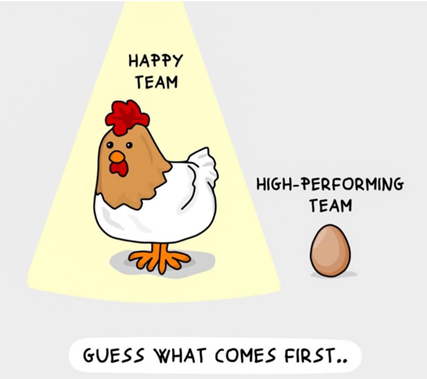
The image below nailed it. Performance is the egg. The happy team is the chicken.
From an evolutionary perspective, the egg came first—an ancestor of the modern chicken laid an egg containing the genetic mutation that produced the first true Chicken. But in our case, the chicken comes first!
For many years, organisations operated under a familiar assumption:
Hire smart, establish KPIs, define roles, and performance will naturally follow.
This model worked in relatively stable and hierarchical environments. However, in today’s modern workplace—characterised by hybrid teams, rapid change, and higher employee mobility —the traditional sequence is no longer sufficient.
The reality is that performance cannot be engineered solely through structure and targets. Increasingly, evidence shows that the foundations of sustained performance lie elsewhere: in trust, connection, and psychological safety within teams.
Happiness, trust, and a sense of belonging are no longer optional cultural benefits. They have become fundamental conditions for performance. When people feel safe expressing ideas, challenging assumptions, and contributing authentically, their collective intelligence is unlocked. When they feel respected and connected, they invest more energy, creativity, and accountability in their work.
Modern research strongly reinforces this shift in thinking. Studies across leading institutions and organisations consistently demonstrate that the emotional environment of a team directly influences its effectiveness and results.
For example, Gallup research shows that highly engaged teams are 21% more profitable and significantly better at retaining talent. MIT Sloan School of Management found that toxic workplace culture is the strongest predictor of employee attrition—more than compensation levels.
These insights point to a fundamental shift in how we design and lead teams. In the modern organisation, emotional infrastructure is just as important as operational infrastructure. Systems, processes, and targets remain essential, but without a healthy team environment, they rarely translate into sustained results.
High-performing teams today are intentionally built through leadership practices that prioritise both human connection and operational clarity.
I have found that three principles are particularly important:
• Psychological safety and trust: Teams perform better when individuals feel safe to share ideas, raise concerns, and learn from mistakes without fear of judgment.
• Shared purpose and alignment: A clear connection between individual roles, team objectives, and organisational mission strengthens motivation and collective accountability.
• Adaptive collaboration and feedback: High-performing teams maintain open communication, encourage continuous learning, and empower shared leadership rather than relying solely on hierarchy.

When these elements are present, teams become more resilient, more innovative, and better able to navigate uncertainty. Performance stops being forced and instead becomes a natural outcome of the environment created.
The leadership lesson is therefore clear. The performance cannot simply be extracted from people through pressure, incentives, or control. It must be enabled through the conditions in which people operate. Leaders who focus only on metrics often overlook the deeper drivers that make those metrics possible.
In practical terms, building strong teams today requires designing environments where trust grows quickly, where people feel valued, and where collaboration is intentional rather than accidental.
The debate about whether a happy team or a high-performing team comes first is, in reality, not a paradox at all. A healthy, connected, and psychologically safe team lays the foundation for performance.
In simple terms, the happy team is the chicken, and performance is the egg that follows. When leaders invest first in the human conditions of teamwork, sustainable performance becomes not only possible, but inevitable.