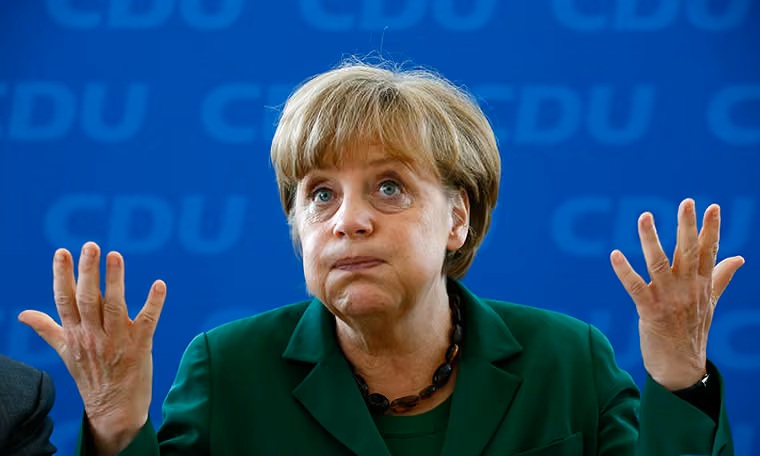
Europe’s Syria policy did not begin as a humanitarian story. It began as a political assumption dressed in moral language, in which the former German chancellor, Angela Merkel, played a historic role. The belief in European capitals that external pressure, diplomatic isolation, and regime-change frameworks could reshape a Middle Eastern state without long-term consequences at home. That assumption did not survive reality.
By Nadia Ahmad
What followed was not a controlled transition in Syria, but the fragmentation of the Syrian state itself. Institutions collapsed unevenly, territory splintered into zones of control, and authority dispersed among competing armed and political actors. In that vacuum, displacement was not an accident.
It was the predictable outcome of structural breakdown. Millions left Syria. Neighbouring countries absorbed the first wave. Europe absorbed what came after, with Germany absorbing the largest share.
At the time, European leaders still framed this as a humanitarian responsibility. Yet, that framing concealed a harder truth; Europe was not only reacting to war — it was absorbing the downstream consequences of a geopolitical approach it had helped sustain without ever seriously accounting for its domestic cost.
Nowhere did that contradiction become more politically visible than in Germany under the veteran Christian Democrat Chancellor Angela Merkel, who was in office for 16 years (2005 -2021). In the wake of the emerging crisis in Syria, she made her famous "wir schaffen das" (we can do it) declaration, thereby opening the door to mass migration.
Merkel allowed hundreds of thousands of migrants and refugees, mainly from Syria, Iraq, and Afghanistan, to enter. This controversial decision to open Germany’s borders to large-scale refugee inflows is often remembered through a moral lens: openness, responsibility, and European values in action.
But political systems are not judged by moral language. They are judged by structure, capacity, and consequence. Germany did not simply receive refugees. It became the central absorption system for a continental migration shock that had no binding European redistribution mechanism, no enforceable burden-sharing architecture, and no credible return framework tied to actual conditions inside Syria.
What was presented as an emergency measure gradually became a structural transformation of domestic reality. Municipal systems expanded under pressure. Housing markets tightened. Schools were reorganised at speed.
Welfare systems stretched beyond their original design assumptions. Labour markets absorbed part of the inflow, while other segments remained partially excluded or delayed in full integration. Over time, migration ceased to be a policy domain and became a central axis of political competition.
And once that happens, the question is no longer administrative. It becomes political at its core: how much structural change can a state absorb before it begins to redefine itself?
The deeper failure is not that Europe failed to anticipate Syria’s collapse. It operated on a political model that treated external intervention and internal consequences as separate worlds.
Europe’s Syria policy was shaped by an elite consensus combining moral universalism with strategic underestimation. The assumption was simple: pressure produces transition, transition produces stability, and stability produces return.
Every link in that chain failed. Syria did not transition. It fragmented. It did not stabilise. It hardened into competing authorities and frozen conflict zones. And it did not produce a return. It produced prolonged displacement on a scale that became structurally irreversible for large parts of the population.
But European policy continued to behave as if time would eventually reconcile expectation with reality. Instead, the contradiction moved inside Europe itself. This is where Merkel’s role becomes structurally central — not as the origin of the crisis, but as the point at which it was fully internalised within Europe’s political system.
Merkel governed through containment. Her method was not to resolve structural pressure, but to stabilise it long enough for the system to remain functional. In finance, in eurozone crises, and in migration, the logic remained consistent: avoid rupture, extend timelines, preserve equilibrium.
In 2015, that logic reached its most consequential expression. The decision to open Germany’s borders was not simply a humanitarian gesture. It was the activation of a governing philosophy: that European systems are resilient enough to absorb external shocks without fundamentally redefining their limits.
What followed tested that assumption at scale. What arrived was not a temporary wave, but a long-duration demographic and political shift produced by unresolved conflict dynamics. Germany became its primary structural destination. The consequences did not appear immediately. They accumulated.
First at the municipal level, then in education systems, then in housing markets, and finally in national politics, where migration became one of the central fault lines shaping electoral behaviour and party realignment. What began as policy gradually transformed into identity conflict.
On the one hand, defenders of the 2015 decision continue to frame it as a moral necessity and a European responsibility. On the other hand, critics increasingly see it as the moment when political limits were subordinated to moral language — with consequences that were never fully calculated or democratically debated at scale.
Between these positions sits a growing segment of the population that is no longer ideological but practical: housing pressure, wage stagnation in certain sectors, school capacity limits, public services under strain, and a constant sense that the system is adjusting faster than it is stabilising.
This is where political fatigue emerges — not from a single event, but from the accumulation of unresolved effects. The deeper contradiction now sits at the centre of Europe’s migration story: political leaders continue to speak as if they are managing a temporary situation, while in reality they are governing a permanent transformation.
Since 2015, the language has remained consistent — “integration,” “capacity,” “shared responsibility,” “European values.” But on the ground, the reality has already moved on. Public systems have been structurally reshaped under sustained pressure: housing markets under strain, education systems reorganised in response to demographic change, and municipalities operating beyond their original design capacity.
What makes this politically sensitive is not only the scale but also the denial of permanence. A system that describes structural change as a temporary adjustment eventually loses authority in the eyes of its own population.
At the European level, the underlying weakness is now exposed. The European Union does not function as a single sovereign actor on migration. It functions as a collection of states with different interests, political pressures, and tolerance for disruption.
Responsibility is therefore uneven. A small number of states absorb most of the pressure, while the system as a whole continues to speak in unified moral language. The result is not coordination. It is fragmentation under institutional branding.
This is the environment in which Merkel’s 2015 decision continues to resonate. It was not just a humanitarian gesture. It was the moment when Europe’s internal contradictions ceased to be abstract and became visible in daily political life.
And once that threshold is crossed, migration no longer behaves like a normal policy file. It becomes structural. It reshapes domestic politics, redefines electoral conflict, and forces governments to operate inside consequences they did not design and cannot easily reverse.
Europe’s misreading of Syria did not end with the war itself. It extended into the post-Assad phase. The assumption in many European capitals was that once President Bashar al-Assad’s position was weakened and the conflict entered its later stage, a manageable political transition would follow — one that would eventually produce institutional stabilisation and open the door to gradual returns.
That assumption proved strategically shallow. The exile of Assad to Russia was treated in parts of Western policy thinking as a symbolic turning point toward resolution. In reality, it marked something different: not stabilisation, but the formalisation of fragmentation.
Instead of a controlled transition, Syria entered a prolonged phase of divided authority, competing external influence, and incomplete state reconstruction. The expectation that a post-Assad order would naturally converge into stability did not materialise.
And that miscalculation matters because it directly shaped the logic of Europe’s migration policy. Return frameworks, reintegration planning, and “temporary protection” narratives were all built on the expectation that political normalisation would follow relatively quickly. It did not. Syria itself remains part of this structure, but not in the way European policy originally assumed.
The expectation of stabilisation followed by a large-scale return has not materialised. The country remains fragmented, economically weakened, and politically uneven. Authority is divided, reconstruction is incomplete, and sovereignty remains externally constrained.
Return migration, once treated as the natural second phase of the crisis, has instead become a political assumption that no longer matches reality. And in that gap, displacement stops being temporary. It becomes structural. A further shift has emerged in how displacement is framed from the Syrian side itself.
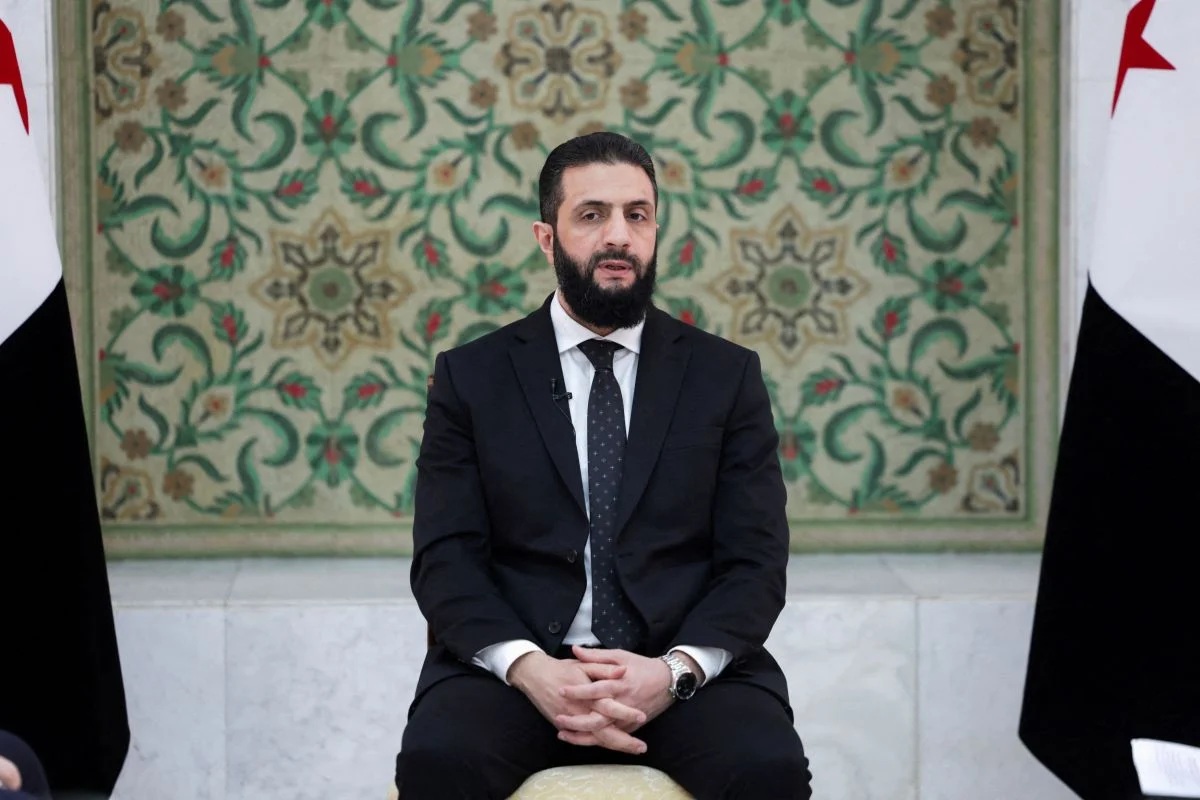
Within evolving post-conflict political narratives, figures such as Ahmad al-Sharaa (al-Julani) and other transitional actors have increasingly described the Syrian diaspora not as a temporary population awaiting return, but as a long-term strategic asset. This framing operates on multiple levels: remittances, financial flows, skills transfer, and transnational networks tied to Syrian society abroad.
But politically, the implication is direct. Displacement is no longer treated solely as a condition to be reversed. It is increasingly viewed as a durable extension of national capacity outside territorial borders.
That shift collides directly with Europe’s migration doctrine, which still assumes that return is the default end-state of displacement. If the sending side no longer treats return as the central objective, then Europe’s policy architecture loses one of its foundational assumptions.
Turkey remains the key intermediary in this system, functioning as both a buffer state and a geopolitical pressure valve between Syria and Europe. Its domestic political constraints, demographic pressures, and periodic negotiations with the European Union ensure that migration is not simply a matter of humanitarian management — it is ongoing geopolitical bargaining embedded in domestic politics. The result is not a crisis with a timeline. It is a regional condition.
Inside Europe, the consequences are now fully political.
Migration has become a structural fault line shaping electoral behaviour, institutional trust, and party-system realignment. Governments are caught between incompatible pressures: the humanitarian framework established in 2015 and the rising demand for stricter control, enforceable borders, and political limits.
This contradiction produces not only polarisation but also exhaustion — the sense that political systems are still managing the consequences of a decision that has already outgrown its original timeframe. The deeper failure is not technical. It is conceptual.
European Syria policy was built on assumptions that no longer hold: that external pressure produces a controlled transition, that displacement is temporary, and that return migration is inevitable. None survived contact with reality.
Instead, Europe encountered a different outcome: external instability does not remain external when absorbed at scale. It reorganises domestic political systems over time.
A second failure sits beneath this: the collapse of separation between foreign policy ambition and domestic political capacity. Europe treated external intervention as something detached from internal consequences. That assumption is no longer valid. Foreign policy outcomes now directly reshape the domestic political order.
Angela Merkel’s 2015 decision sits at the centre of this transformation, not as symbolism but as a structural inflexion — the moment when accumulated misjudgments became embedded in Europe’s political architecture. Today, Europe is no longer outside this reality. It is operating within it.
Germany is recalibrating under political pressure. The European Union is managing internal fractures over migration capacity and sovereignty. Syria remains unresolved. Regional actors continue to treat displacement as a long-term condition rather than a temporary disruption.
The idea that migration crises are short-term events with predictable resolution paths has already collapsed. What remains is a more difficult condition: a Europe permanently shaped by external instability it did not fully control, but fully absorbed. And in that condition, Merkel’s decision is no longer a historical debate.
It is the moment Europe entered a political reality, and it is still learning how to live with it.