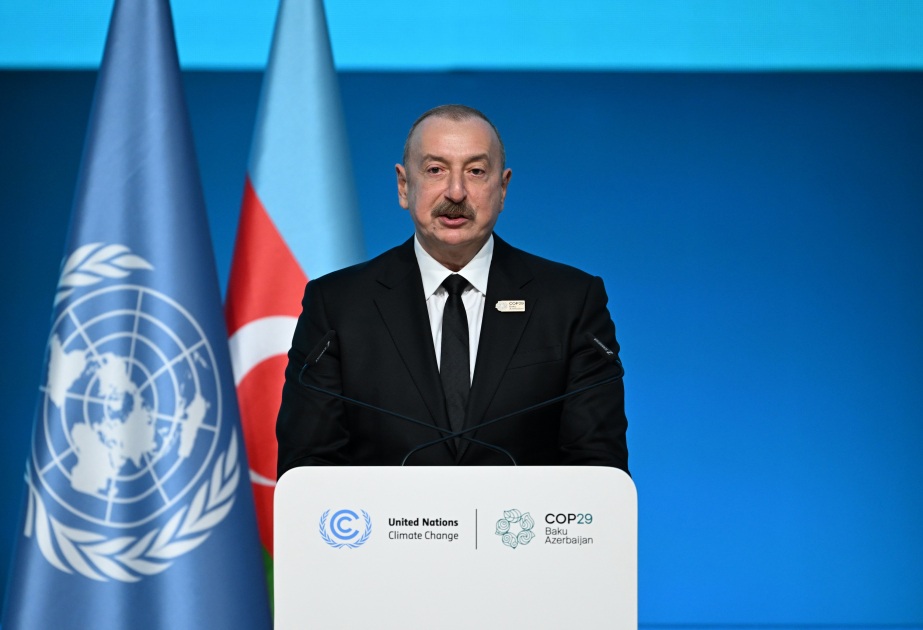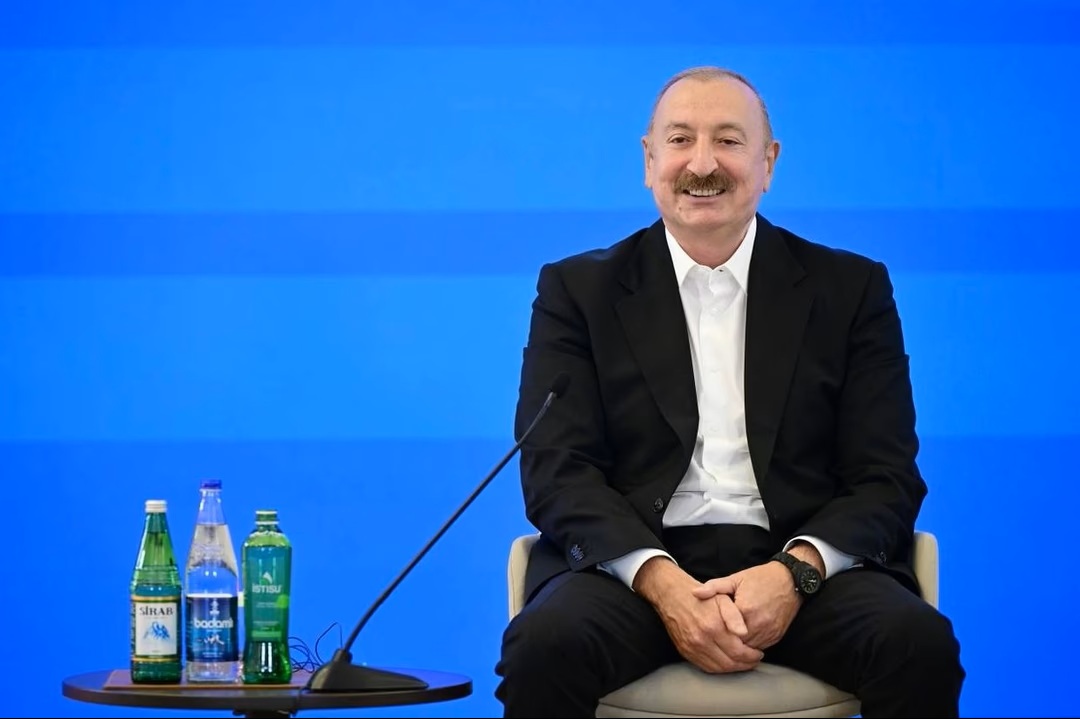
The world’s media and policy community once again met in the Azerbaijani city of Shusha this week for the opening of the 4th Shusha Global Media Forum, held under the theme The Mission of the Media in Promoting Peace: Restoring Truth and Rebuilding Trust. As in previous editions, President Ilham Aliyev gave an act de présence and sat down with media representatives and analysts in an unscripted Q&A, sending out a layered set of messages about peace, its costs, its conditions, and its fragility.
By Vasif Huseynov
The forum brought together 160 participants from 53 countries. The remarks were delivered by a leader whose country has itself moved, within less than a decade, from three decades of occupation to the front line of regional peacemaking.
The most striking thread running through the President's remarks was an insistence that peace, once achieved, must be actively protected rather than passively enjoyed. Responding to a question from veteran Ukrainian journalist Dmytro Gordon about what he would advise Ukraine and Russia today,
Aliyev repeated the counsel he had given a year earlier at the same forum: "never agree to occupation." He drew directly on Azerbaijan's own experience of resisting international pressure during and after the Second Karabagh War, when, as he recounted, even the co-chairs of the OSCE Minsk Group — the United States, France, and Russia — pushed Baku to freeze the conflict rather than resolve it.
That experience, he suggested, is precisely why Azerbaijan's position on Ukraine's territorial integrity and sovereignty has remained consistent: a state's borders should not be redrawn by force, nor without the consent of its people.
Yet alongside this firmness on principle, the President stressed a second, seemingly opposite message: that knowing when to stop is itself an act of statesmanship. Recalling Azerbaijan's decision to halt military operations in 2020 once its territorial integrity was restored, he described this as "responsibility and wisdom" rather than weakness — a deliberate choice not to let a justified war become an endless one.
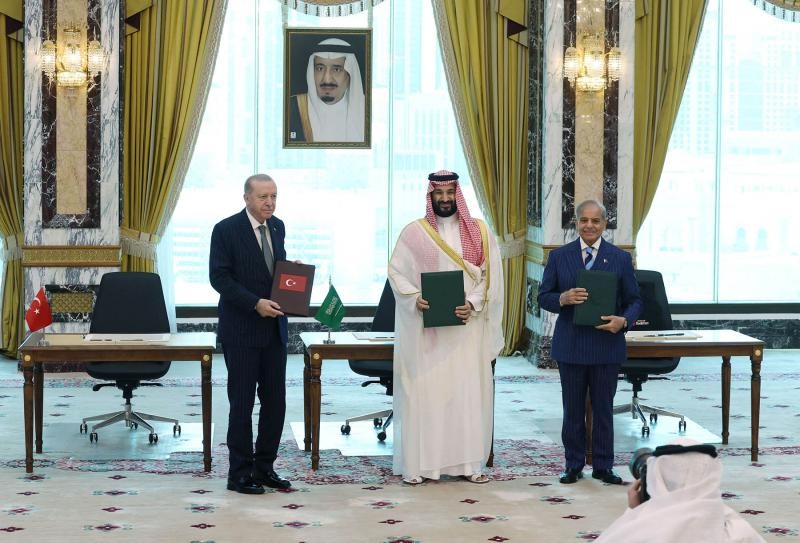
Aliyev extended this logic to the Middle East, calling on Iran and the Gulf states to end their confrontation before it metastasises into a wider conflagration, and praising Pakistan's mediation efforts, led by Prime Minister Shehbaz Sharif and Field Marshal Asim Munir, as a model of responsible third-party engagement.
The pairing of these two messages — never legitimise occupation, but know when to stop fighting — is not a contradiction so much as a distillation of Baku's own post-2020 experience: military force to restore rights, followed by a swift return to diplomacy to consolidate them.
On the Armenia-Azerbaijan track specifically, the President's tone was notably forward-looking. He credited the Trump administration's direct, results-oriented approach — culminating in the Washington Joint Declaration, the initialling of the peace treaty, and the subsequent Strategic Partnership Declaration signed with Vice President JD Vance in Baku — with breaking a stalemate that decades of multilateral mediation had failed to resolve.
He singled out the TRIPP corridor connecting Azerbaijan to Nakhchivan as a project that will "completely change the connectivity map of the region," with practical groundwork expected to begin this year. Notably, he framed this not as a bilateral Armenian-Azerbaijani matter alone but as a foundation for broader regional order.
The President emphasised that Baku wants "peace beyond the borders" precisely because a country cannot feel secure with unresolved conflict at its doorstep. This formulation speaks as much to Azerbaijan's watchfulness toward its northern and southern neighbours as to the peace process with Yerevan itself.
A third dimension of the President's remarks concerned Azerbaijan's evolving international identity. Asked to define what distinguishes a "middle power" from a small state. Aliyev pointed to defence capability tested on the battlefield rather than displayed at parades, the ability to influence events beyond one's borders.
In addition, the capacity to defend national interests on multiple fronts simultaneously is a reference to the unusual position of a state bordered by two active conflict zones. This self-assessment was reinforced by his account of Azerbaijan's mediating role between actors who otherwise struggle to talk to each other, which he attributed above all to trust: a reputation, built over years, for confidentiality and sincerity rather than hidden agendas.
The forum also surfaced the President's sharper edges. His remarks on the Parliamentary Assembly of the Council of Europe, where he insisted Baku's voting rights must be restored before any return to the table, and on France's overseas territories, delivered in response to a question from a Congolese journalist, showed a leader unafraid to reframe criticism of Azerbaijan as evidence of double standards elsewhere.
These exchanges underscored a consistent theme of the forum: that restoring "truth" and rebuilding "trust," the event's stated mission, requires contested narratives to be aired rather than avoided.
Taken together, the President’s messages from Shusha reflect a country that sees itself less as a passive beneficiary of a shifting regional order than as an active shaper of it. Whether that message finds traction beyond the South Caucasus will depend on actors far less inclined toward moderation.
As a statement of Azerbaijan's own strategic self-understanding at a genuinely pivotal moment — with peace with Armenia advancing, ties with Washington and Brussels deepening, and conflict still raging to the north and south — the Shusha remarks offered as clear a picture as any of how Baku wants to be seen: sovereign, tested, and, for the moment, at peace.