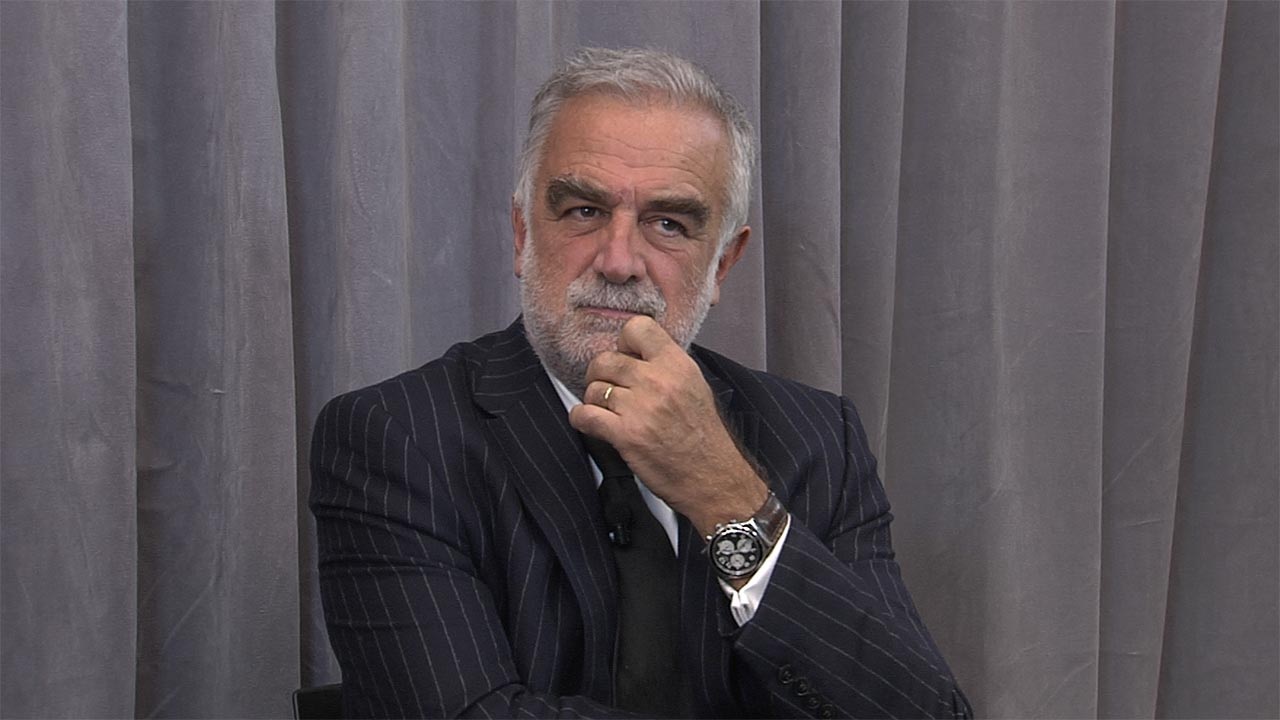
US Secretary of State Marco Rubio announced (13 July) that Washington would "dismantle the ICC [International Criminal Court], brick by brick, if necessary," accusing the court of waging lawfare against American citizens. Shortly thereafter, the court's member states voted to remove its chief prosecutor, Karim Khan, following his suspension in June after a UN-backed inquiry into sexual misconduct allegations. Judges have sued the US government over sanctions imposed on them. Against this backdrop, the case of Luis Moreno Ocampo, the court's first chief prosecutor, deserves closer scrutiny.
By Fuad Abdullayev
The International Criminal Court, an institution built on the promise of impartial accountability, is living through the most turbulent stretch of its twenty-four-year history. It is against this backdrop that the case of Luis Moreno Ocampo, the court's first chief prosecutor, deserves closer scrutiny than it has received so far. Not as an indictment of the ICC itself, but as a warning about what happens when a weakened institution's authority becomes available for private rent.
Ocampo led the Office of the Prosecutor from 2003 to 2012, a tenure remembered chiefly for the unravelling of the Kenya cases: the charges against Uhuru Kenyatta were withdrawn, those against William Ruto were vacated, and a subsequent external review found fault with his prosecutorial judgment.
Even commentators sympathetic to Washington's current campaign against the court have singled out his record as an early sign of the court's credibility problem. Writing in Newsweek this month, the American Foreign Policy Council's Ilan Berman noted that Ocampo "attracted criticism during his tenure" and "has continued to court controversy since leaving the ICC".
His controversial intervention in the Armenia-Azerbaijan conflict was cited as evidence.
That controversy has a financial backstory. Investigations by the European Investigative Collaborations network and Der Spiegel found that while serving as chief prosecutor and afterwards, Ocampo managed offshore vehicles registered in Panama and the British Virgin Islands, and that tens of thousands of dollars moved through Swiss accounts to him shortly after he left office.
He later signed a consultancy contract reportedly worth three million dollars, plus five thousand dollars per working day, with Hassan Tatanaki, a Libyan oil magnate who financed militias under General Khalifa Haftar accused of extrajudicial killings.
Asked to explain the arrangement, Ocampo said simply that his Hague salary had not been enough. It was this record – a former guardian of international justice monetising his access and credentials – that preceded his entry into the South Caucasus file.
That trouble began in August 2023, when Ocampo accepted an assignment from Armenian separatist figures in Azerbaijan’s then-occupied Karabakh region and other Armenian-aligned backers before speaking out against Azerbaijan.
He later acknowledged on social media on 30 July 2023, that his opinion had been commissioned by the self-appointed “president” of the now-dismantled separatist regime in Karabakh, an entity illegally established by Armenia in the 1990s following the ethnic cleansing of hundreds of thousands of Azerbaijanis from their homes. Ocampo then accused Azerbaijan of committing serious abuses against the region's Armenian population, at times invoking language as severe as "genocide."
This was not an isolated remark. In the months that followed, he repeated similar claims across interviews, opinion pieces, and public appearances, building a sustained campaign of accusations against Baku.
What might have remained a contested document among many was decisively reframed by video recordings published by the Azerbaijani outlet Minval Politika on 30 April 2026. In them, Ocampo describes a former aide to ex-EU foreign policy chief Josep Borrell as now “working for me” inside the European Parliament, tasked with pressuring Commission President Ursula von der Leyen and pursuing a case before the European Court of Justice to void the EU’s energy partnership with Azerbaijan.
His son, Tomás, states that the network’s objective is to remove Prime Minister Nikol Pashinyan from office, in coordination with Armenian lobbying organisations in the United States that oppose Pashinyan’s peace agenda with Azerbaijan. Whatever the provenance of the footage, its substance resolves a question that should never have needed to be resolved: a paid, coordinated influence campaign is not legal expertise, however many Hague credentials sit atop its letterhead.
None of this reflects badly on international criminal justice as an idea, and it should not be read as such. Most of the people who work at the court do so in good faith, and the underlying case for holding perpetrators of atrocities accountable remains as compelling as it was in 1998.
The institution's authority is precisely what gives someone like Ocampo his market value. That authority is fraying at the exact moment he and others are drawing on it most heavily. The court has no police force of its own; it depends entirely on member states to arrest suspects, and those states increasingly decline to do so.
Its critics point to a record of fewer than fifteen convictions in over two decades, a heavy tilt toward African defendants, and now a leadership scandal that forced out its sitting prosecutor.
A court fighting for its own institutional survival has correspondingly less capacity to police how its former officials invoke its name once they are out the door. That gap is exactly the space Ocampo's operation has occupied.
The implications extend well beyond one individual. European institutions that have cited his 2023 opinion, and the parliamentary resolutions that echoed its language, would do well to ask whether they were relying on independent legal judgment or amplifying a commissioned product.
Media outlets that gave that opinion prominent, uncritical coverage owe their audiences a reassessment now that its commercial and political context is public record.
The ICC, already consumed with defending the court against an unprecedented American pressure campaign, might usefully consider a second-order reform: clearer post-tenure conduct expectations for former prosecutors and judges, so that the credibility earned through years of institutional service cannot simply be sold to the highest bidder once the office is vacated.
Fuad Abdullayev is a leading advisor at the Centre of Analysis of International Relations and Multiculturalism (AIR Centre) in Baku, Azerbaijan. This is his first contribution to The Liberum.