The Adaptive Advantage: What career mobility really builds

For years, a resume full of moves was treated as a warning sign. Hiring managers saw a candidate who had changed employers every two or three years and quietly filed them under “flight risk”, someone likely to leave before the investment in them paid off.

I understood that instinct long before I read the research behind it, because I spent much of my career on the other side of that judgment, moving between various multinational organisations.
New research from Harvard Business School reframes that instinct.

Drawing on a study of nearly 8,700 hedge fund managers moving between more than 2,100 firms over 15 years, the researchers found that most professionals take an initial performance hit after joining a new organisation, with a typical recovery period of four months.

But employees who had changed organisations frequently absorbed a smaller dip and bounced back roughly twice as fast as their less-mobile peers. The advantage wasn’t deeper technical knowledge. It was practice: repeated exposure to new cultures, new systems, and new colleagues builds a transferable skill for quickly reading an unfamiliar environment.

That finding aligns with what I have lived on the ground through my professional experiences.

Every move into a new organisation forced me to relearn how decisions actually get made — not the org chart, but the real one- and to rebuild trust with clients almost from scratch each time.

What stayed with me across every transition was not a single company’s playbook, but the discipline of building senior-level relationships quickly, reading a new commercial culture within weeks rather than years, and getting productive on live opportunities before the ink on the offer letter had dried.

The Harvard Business School research points to three settings where that adaptability advantage matters most, and each maps directly onto the world I operate in:

  • Deeply established organisational cultures. Long-tenured teams develop unwritten rules and little patience for missteps. Professionals who have repeatedly had to decode “how things really work” read those cultures more quickly and avoid costly early mistakes that slow newcomers down.
  • Unfamiliar professional or geographic contexts. Stepping into a market or client base outside one’s usual circle demands a real recalibration of expectations and relationships. Building a network across the region, often through partners, requires exactly this kind of rapid, deliberate adaptation rather than relying on relationships built once and coasted on.
  • Collaboration-heavy, client-facing roles. Success depends on aligning engineering, proposals, finance and client stakeholders simultaneously. That is precisely where a track record of building productive working relationships quickly — rather than technical knowledge alone — determines how fast a deal actually moves.

None of this means mobility makes someone a better employee outright; the research is clear that performance converges once people settle in. What it does mean is that a varied career path deserves a second look rather than an automatic discount, particularly for turnaround situations, growth phases, and roles where getting up to speed quickly is the job itself.
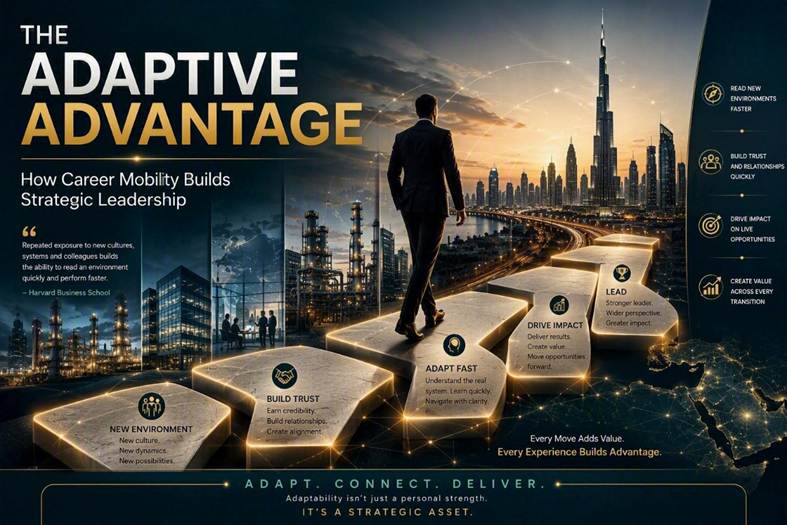
Looking back at my own path, I no longer see those transitions as a series of restarts.

Each one sharpened the same underlying capability: walking into a new room, reading it accurately, and earning trust fast enough to deliver. That is the real asset organisations should be hiring for, and the one I try to bring to every client relationship and every deal I lead today.


 

Emile Fakhoury

Corporate Expert Writer, Business Professional in Energy/Water/Oil/Gas, Specialist in Coaching/Training, Association of Project Management UK Fellow Member. The professional who believes that adaptation to various social or corporate environments is the only way to survive and strive. Master the rules of the game in order to reach the top and change the rules.
See full bio >
The Liberum runs on your donation. Fight with us for a free society.
Donation Form (#6)

Leave a Reply

Your email address will not be published. Required fields are marked *

More articles you might like

After Ceuta, the focus is on migrants from the Maghreb: Moroccans stand out for criminal behaviour

Much has been written in recent weeks about the events in Ceuta. Too much of […]

Is NATO Secretary General Mark Rutte a traitor?

Legally, no. The Penal Code contains no article for a prime minister who governs his […]
- by The Liberum on 25/08/2026

The veil of oppression: Why the Belgian Burqa Ban is a victory for women's rights

When the debate over the burqa and other face-covering veils was beginning in Europe, I […]
- by The Liberum on 24/08/2026

The Climate Policy Trap: Why failure so often leads to more of the same

Group identity, social status, and a credential-dominated policy establishment have made the climate narrative increasingly […]

Wealth, reputation, office & procedural victory are not the highest goods

Disclaimer: references to individuals, institutions, documents, and conduct are deliberately anonymised and use language such […]
- by The Liberum on 18/08/2026

Borrowed robes: How a prosecutor’s legacy became a lobbyist’s business card

US Secretary of State Marco Rubio announced (13 July) that Washington would "dismantle the ICC […]